
Datos ecológicos de Bemisia tabaci gennadius (homoptera: aleyrodidae) en tres cultivos hortícolas en el sur de la provincia de Granma, en Cuba
Article Sidebar
Main Article Content
Abstract
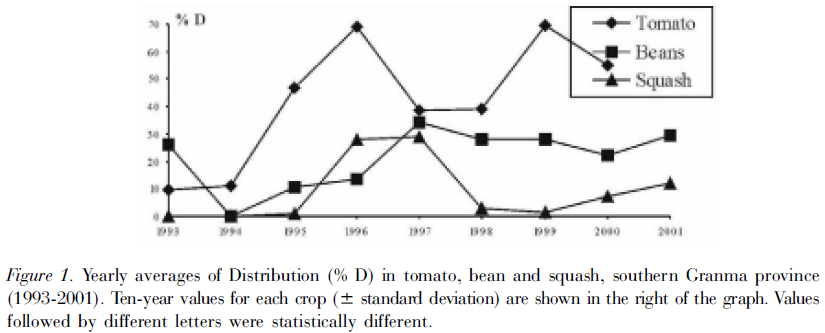
Ecological data about Bemisia tabaci Gennadius in southern Granma province, Cuba from 1993 to 2001 were analyzed. Yearly and monthly averages of distribution and affectation intensity of the pest on three horticultural crops were correlated with sown area and weather factors in simple and multiple lineal regressions. In spite tomatoes had the smallest cultivated area; the relationships between sown area and the pest were significant, showing its importance as the major host plant in these agroecosystems. Differences were statistically significant between years for each single crop. All the weather factors together explained 43 and 52% of affectation for tomatoes and beans, but only 24% for squash. The highest correlations (> 55%) resulted in the analyses when sown area and distribution were added as independent variables to the weather factors, keeping affectation as the dependent variable. It is discussed the importance of these results for pest forecasting in the region.
Article Details

This work is licensed under a Creative Commons Attribution-NonCommercial 4.0 International License.
Those authors who have publications with this journal accept the following terms of the License Attribution-NonCommercial 4.0 International (CC BY-NC 4.0):
You are free to:
- Share — copy and redistribute the material in any medium or format
- Adapt — remix, transform, and build upon the material
The licensor cannot revoke these freedoms as long as you follow the license terms.
Under the following terms:
- Attribution — You must give appropriate credit, provide a link to the license, and indicate if changes were made. You may do so in any reasonable manner, but not in any way that suggests the licensor endorses you or your use.
- NonCommercial — You may not use the material for commercial purposes.
- No additional restrictions — You may not apply legal terms or technological measures that legally restrict others from doing anything the license permits.
The journal is not responsible for the opinions and concepts expressed in the works, they are the sole responsibility of the authors. The Editor, with the assistance of the Editorial Committee, reserves the right to suggest or request advisable or necessary modifications. They are accepted to publish original scientific papers, research results of interest that have not been published or sent to another journal for the same purpose.
The mention of trademarks of equipment, instruments or specific materials is for identification purposes, and there is no promotional commitment in relation to them, neither by the authors nor by the publisher.
How to Cite
References
Acosta, T.; P. Álvarez: «Influencia climática en la ecología de plagas en el cultivo del maíz», Informe del Centro Provincial de Meteorología, CITMA, Bayamo, Granma, Cuba, 2000.
Caballero, J.; A. Verdecia; R. Alarcón: «Análisis histórico de la incidencia de Bemisia sp. y Geminivirus del tomate en el territorio de la Estación de Protección de Plantas de Manzanillo», Encuentro de Agricultura Orgánica, Granma, ACTAF, 3-4 de noviembre, 2002.
Comité Estatal de Estadística: Anuario Estadístico de Cuba, 1988.
Centro Nacional de Sanidad Vegetal: «Registro territorial histórico. Bioestadística», Señalización y Pronóstico, La Habana, 1984.
Domínguez, M.; R. Crespo; D. Cruz: «Presencia de la mosca blanca (Bemisia tabaci) en un policultivo tabaco-tomate y su relación con el virus del encrespamiento foliar amarillo del tomate (TYLCV)», IX Taller Iberoamericano y del Caribe sobre Moscas Blancas y Geminivirus, Resúmenes. Impresos Plaza América, Varadero, Cuba, julio de 2001.
Estación de Protección de Plantas: «Información bioestadística de la Estación de Protección de Plantas», Manzanillo, Granma, Cuba, 2004.
FAO: «Informe Regional sobre Tecnologías Integradas de Producción y Protección de Hortalizas», Cuernavaca, México, 1994.
González, G.: «Los geminivirus en los cultivos agrícolas de Cuba», III Seminario Científico Internacional de Sanidad Vegetal, La Habana, junio de 1997, p. 97.
González G.: «Aspectos epidemiológicos de la relación begomovirusmosca blanca en el cultivo del tomate en Cuba», Resúmenes IV Seminario Científico de Sanidad Vegetal, 10-14 de junio, La Habana, 2001, p. 218.
González, M.; J. Muñiz; A. Mateo; S. Reyes; N. Pérez et al.: «Manejo integrado del complejo mosca blanca-mosaico dorado en frijol (Phaseolus vulgaris) en Cuba», IIII Seminario Científico Internacional de Sanidad Vegetal, La Habana, junio de 1997.
González, M.: «Ecología y manejo de Bemisia spp. en la ETTP de Manzanillo», Thesis of Master Science, Universidad de Granma, Cuba, 2005.
Hilge, L.; O. Arboleda: «Las moscas blancas (Homoptera: Aleyrodidae) en América Central y el Caribe», CATIE, Serie Técnica, Informe Técnico no. 205, 1993.
Instituto de Investigación de Sanidad Vegetal: Resumen de metodologías de señalización, La Habana, 2000.
Machado, J.; M. Fonseca; D. Bruqueta; J. Pérez; C. Tornes; E. Suárez; R. Blayas: «Comportamiento de Bemisia sp. como plaga del tomate y vector del virus del encrespamiento amarillo de las hojas del tomate en dos agroecosistemas de la región del Cauto», IIII Seminario Científico Internacional de Sanidad Vegetal, La Habana, junio de 1997.
Machado, J.; D. Bruqueta; J. Pérez; C. Tornes: «Comportamiento de Bemisia spp. y el virus (TYLCV) en seis agroecosistemas de la región del valle del Cauto», VI Simposio Internacional de Sanidad Vegetal en la Agricultura Tropical, Santa Clara, Cuba, mayo de 1998.
Machado, J.; M. Fonseca; A. Puertas; D. Bruqueta; J. Pérez; C. Tornes; J. Fernández; C. Guerrero; M. Castellá; L. Sueiro; M. A. Fonseca; E. González: «Informe técnico del Comité de Expertos Territorial del Programa de Producción de Alimentos por Vías Sostenibles», CITMA, Bayamo, Granma, Cuba, 2001.
Mateo, A.; S. Reyes; M. González: «Ciclo biológico de Bemisia tabaco (Gennadius) en tres cultivos hospedantes y dinámica poblacional de la plaga en el frijol», III Seminario Científico Internacional de Sanidad Vegetal, La Habana, junio de 1997.
Martínez, M.: «Programa de sanidad vegetal contra plagas emergentes en Cuba», IV Seminario Científico Internacional de Sanidad Vegetal. Taller de Plagas Emergentes, Impresos Plaza América, Varadero, Cuba, julio de 2001.
Murguido, C.: «Manual sobre manejo integrado de plagas, enfermedades y malezas en el cultivo del frijol», PROFRIJOL, INISAV, MINAGRI, La Habana, 2000.
Murguido, C.; Ana I. Elizondo; M. Neyra; Y. Velásquez; E. Pupo; S. Reyes; J. Rodríguez; C. Toledo: «Manejo integrado de plagas de insectos en el cultivo del frijol», IV Seminario Científico Internacional de Sanidad Vegetal, La Habana, julio de 2001.
Statistics for Windows: Release 4.2, StatSof, Inc., 1993.
Toledo, C.: «Incidencia de virus y sus vectores en frijol», V Taller Territorial, Granma, Cuba, julio de 2002.
Vázquez, L.: «Contribución al conocimiento de Bemisia tabaci Genn.», Actualidades de Sanidad Vegetal 1(2): 11-13, 1991.
––––: «Sistema de diagnóstico, inventario y plantas hospedantes de moscas blancas en Cuba», Doctoral thesis, INISAV, La Habana, 1995.
––––: «Manejo integrado de plagas. Preguntas y respuestas para extensionistas y agricultores», CIDISAV, INISAV, La Habana, Cuba, 2003.
Vázquez, L.; C. Murguido: «Problemática actual de las moscas blancas y alternativas para su manejo», III Seminario Científico Internacional de Sanidad Vegetal, La Habana, junio de 1997.
Vázquez, L.; C. Murguido; G. González: «Enfoque territorial del programa de manejo integrado de la mosca blanca y el Geminivirus en el tomate», X Taller Iberoamericano y del Caribe sobre Moscas Blancas y Geminivirus», Resúmenes, Impreso Plaza América, Varadero, Cuba, julio de 2001.
Zamora, M.; D. Padilla; A. Sediles; P. Castillo: «Informe de Nicaragua», X Taller Iberoamericano y del Caribe sobre Moscas Blancas y Geminivirus, La Habana, Cuba, julio de 2001.