
Manchas de las hojas de marañón (Anacardium occidentale l.) provocadas por Phomopsis anacardii early & punith
Article Sidebar
Main Article Content
Abstract
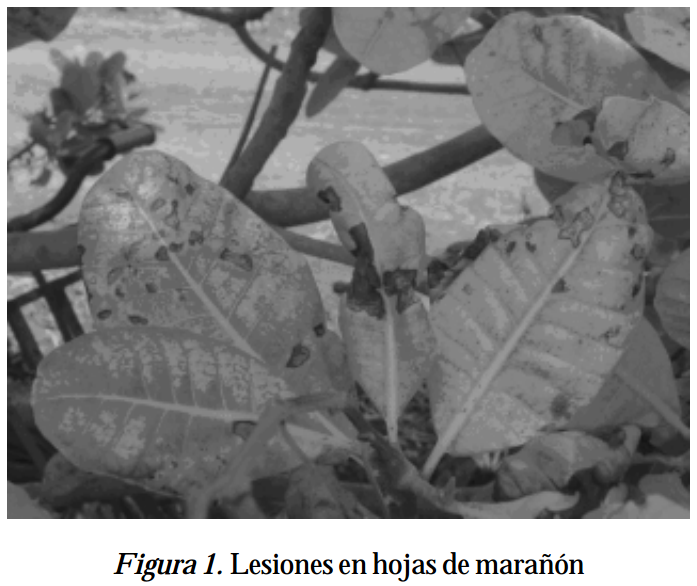
Symptoms consisting in necrotic blotches, drying shoots, leaf patches and inflorescence blights were observed on Cashew plants (Anacardium occidentale L). in Quivicán, La Havana province. Shoots and necrosed leaves were collected on paper bags, incubated in humid chambers for 48 hours in the laboratory and all the present fungal structures were identified and measured. Fungal structures observed under microscopy were transferred to sterile Petri plates with potato dextrose agar (PDA). On the natural substrates were observed brown-blackish, numerous, immersed, stromatic, solitary or aggregated, ostiolate, 100-180 µm width pycnidia. Conidiophores were hyalines, simple or ramified, septates, cylindrical of 14.0 x 3.5 µm to more than 75.0 µm of large. Conidiogenous cell hyaline, cylindrical or doliform, obclavate, enteroblastic and phialidic of less than 1 mm. Two types of conidia were observed: α-conidia (measuring 6.0 x 2.0 µm, hyalines, one-cell, fusiform, 2-3 gottules, with terminal gottules at conidia ends) and β-conidia (hyaline, filiform, one cell, curved of 24.0 x 0.5 µm). Mycelia growth was abundant, whitish to brown yellowish. Colonies on axenic media were floccose, whitish, and gray-brownish with grayish patches to red wine; colonies reverses were hyalines to pale brown with spots and black patches. Conidioma picnidial, numerous, brown to black, stromatic, solitary or aggregated, unilocular or multilocular, complex, ostiolate more than 600 mm width. The characteristics of all fungal structures agree with the description of Phomopsis anacardii Early and Punith. A Phomopsis sp. was reported affecting Anacardium occidentale (Cashew) leaves in Media Luna region of Granma Province by Urtiaga (1986), but did not provide a disease and fungal specie description. This is the first complete description of P. anacardii as causal agent of necrosis on shoots, leaves and inflorescence blights in Cashew in Cuba.
Article Details

This work is licensed under a Creative Commons Attribution-NonCommercial 4.0 International License.
Those authors who have publications with this journal accept the following terms of the License Attribution-NonCommercial 4.0 International (CC BY-NC 4.0):
You are free to:
- Share — copy and redistribute the material in any medium or format
- Adapt — remix, transform, and build upon the material
The licensor cannot revoke these freedoms as long as you follow the license terms.
Under the following terms:
- Attribution — You must give appropriate credit, provide a link to the license, and indicate if changes were made. You may do so in any reasonable manner, but not in any way that suggests the licensor endorses you or your use.
- NonCommercial — You may not use the material for commercial purposes.
- No additional restrictions — You may not apply legal terms or technological measures that legally restrict others from doing anything the license permits.
The journal is not responsible for the opinions and concepts expressed in the works, they are the sole responsibility of the authors. The Editor, with the assistance of the Editorial Committee, reserves the right to suggest or request advisable or necessary modifications. They are accepted to publish original scientific papers, research results of interest that have not been published or sent to another journal for the same purpose.
The mention of trademarks of equipment, instruments or specific materials is for identification purposes, and there is no promotional commitment in relation to them, neither by the authors nor by the publisher.
How to Cite
References
Anónimo: «Annual Report of the Indian Council of Agricultural Research for 1957-1958», 1960.
Early, M. P.; E. Punithalingam: «Phomopsis anacardii sp. nov. on Anacardium occidentale. Transactions of British», Mycological Society 59:345-347, 1972.
Intini, M.; M. E. R. Sijaona: «Little Known Diseases of Cashew (Anacardium occidentale L.) in Tanzania», Rivista di Agricultura Subtropicale e Tropicale, Italy, 77(3):423-429, 1983.
Menezes, M.; R. T. Hanlin; A. A. D. Santana: «Phomopsis anacardii, agente etiológico de leso foliares em cajueiro, Anacardium occidentale [abstract]», Fitopatologia Brasileira Suplemento 20:310, 1995.
Ohler, J. G.: «Cashew Communication 71», Department of Agricultural Research, Royal Tropical Institute, Amsterdam, Holanda, 1979.
Urtiaga, R.: Índice de enfermedades en plantas de Venezuela y Cuba, Barquisimeto, 1986.