
Determinación de la composición de proteínas Cry por SDS-PAGE en cepas nativas de Bacillus thuringiensis
Article Sidebar
Main Article Content
Abstract
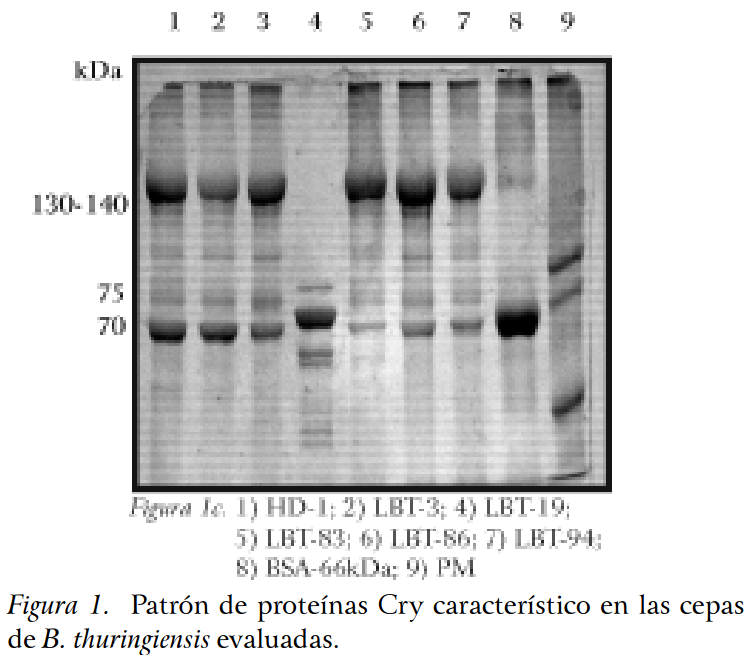
Cry protein pattern by SDS-PAGE 10% was determined in 26 native strains of Bacillus thuringiensis. Strains containing 130-140 kDa and 70 kDa proteins, like the international standard HD1, were the most abundant. Two B. thuringiensis strains with a Cry protein patron like HD137 were also found. Strains LBT-9 and LBT-56 showed a single superior band to that of 130-140 kDa. The strain LBT-19 presented the pattern reported for active strains against coleopterons, that is to say, a band of 75 kDa.
Article Details

This work is licensed under a Creative Commons Attribution-NonCommercial 4.0 International License.
Those authors who have publications with this journal accept the following terms of the License Attribution-NonCommercial 4.0 International (CC BY-NC 4.0):
You are free to:
- Share — copy and redistribute the material in any medium or format
- Adapt — remix, transform, and build upon the material
The licensor cannot revoke these freedoms as long as you follow the license terms.
Under the following terms:
- Attribution — You must give appropriate credit, provide a link to the license, and indicate if changes were made. You may do so in any reasonable manner, but not in any way that suggests the licensor endorses you or your use.
- NonCommercial — You may not use the material for commercial purposes.
- No additional restrictions — You may not apply legal terms or technological measures that legally restrict others from doing anything the license permits.
The journal is not responsible for the opinions and concepts expressed in the works, they are the sole responsibility of the authors. The Editor, with the assistance of the Editorial Committee, reserves the right to suggest or request advisable or necessary modifications. They are accepted to publish original scientific papers, research results of interest that have not been published or sent to another journal for the same purpose.
The mention of trademarks of equipment, instruments or specific materials is for identification purposes, and there is no promotional commitment in relation to them, neither by the authors nor by the publisher.
How to Cite
References
Bradley, D.: «The Insecticidal CryIB Crystal Protein of Bacillus thuringiensis ssp. thuringiensis Has Dual Specificity to Coleopteran and Lepeidopteran Larvae», J. Invertebr. Pathol. 65:162-173, 1995.
Bravo, A.; S. Sarabia; L. Lopez; H. Ontiveros; C. Abarca; A. Ortiz; M. Ortiz; L. Lina; F. J. Villalobos; G. Peña; M.E. Núñez-Valdéz; M. Soberón; R. Quintero: «Characterization of Cry Genes in a Mexican Bacillus thuringiensis Strains Collection», Applied and Environmental Microbiology. 64:4965-4972, 1998.
Brussock, S. M.; T. C. Currier: «Use of Dodecyl Sulfate-Polyacrylamide Gel Electrophoresis to Quantify Bacillus thuringiensis Delta-Endotoxins. Analytical Chemistry of Bacillus thuringiensis». Chapter 9, Analytical Chemistry of Bacillus thuringiensis, ACS Symposium series 432, 1990, pp. 78-87.
Galán, L. J.; J. A. García; M. E. Santos; I. Quintero: «Mecanismo molecular de acción de las delta-endotoxinas de Bacillus thuringiensis», Avances en la biotecnologia de B. thuringiensis, Univ. Autónoma de Nuevo León, México, 1996, pp. 129-155.
Glare, T. R.; M. O’Callaghan: Characterization, in Bacillus thuringiensis: Biology, Ecology and Safety, Inglaterra, 2001, pp. 6-10.
Laemmli, N. K.: «Cleavage of Structural Proteins During the Assembly of the Head of Bacteriophage T4», Nature 227:680, 1970, pp. 45-46.
Narva, K. E.; J. M. Payne; G. E. Schwab; L. A. Hickle; T. Galasan; A. J. Sick: «Novel Bacillus thuringiensis Microbes Active Against Nematodes and Genes Encoding Novel Nematode-Active Toxins Cloned from Bacillus thuringiensis Isolates», GeneBank 85 (GeneWorks 2.4, release 14.0, October 94), 1991.
Payne, J. M.; R. J. C. Cannon; A. L. Bagley: Novel Bacillus thuringiensis Isolates for Controlling Acarides, PCT International Patent Application no. WO 92/19106, 1992.
Rowe, G. E.; A. Margaritis: «Bioprocess Developments in the Production of Bioinsectisides by Bacillus thuringiensis», J. Ferm Bioeng (6):87-120, 1987.
Sambrook, J.; E. F. Fritsch; T. Maniatis: Molecular Cloning. A Laboratory Manual, 2nd ed., Cold Spring Harbor Laboratory Press, Cold. Spring Harbor, New York, 1989, pp. 88.
Schagger, H.; G. von Jagow: «Tricine-Sodium Dodecyl Sulfate-Polyacrylamide Gel Electrophoresis for the Separation of Proteins in the Range from 1 to 100k Da», Analytical Biochemistry 166:368-379, 1987.
Smith, G. P.; D. J. Ellar: «Mutagenesis of Two Surface-Exposed Loops of the Bacillus thuringiensis CryIC-endotoxin Affects Insecticidal Specificity», Biochem. J. 302:611-616, 1994.
Warren, G. M.; M. G. Koziel; M. A. Mullins; G. J. Nye; B. Carr; N. M. Desai; K. Kostichka; N. B. Duck; J. J. Estruch: Novel Pesticidal Proteins and Strains, Patent WO 96/10083. World Intellectual Property Organization, 1996.
Yamamoto, T.; G. K. Powell: «Bacillus thuringiensis Criystal Protein: Recent Advances in Understanding Its Insecticidal Activity», Advanced Engineered Pesticides, Mrcel Dekker, Inc. E.U., 1993, pp. 3-42.
Ziniu, Y. and H. Biwang: «Biocontrol of Plant-Parasitic Nematodes by Bacteria», Journal of Fujian Agricultural University 27(3):316-321, 1998.