
Cuantificación por densitometría de la proteína Cry de Bacillus thuringiensis
Article Sidebar
Main Article Content
Abstract
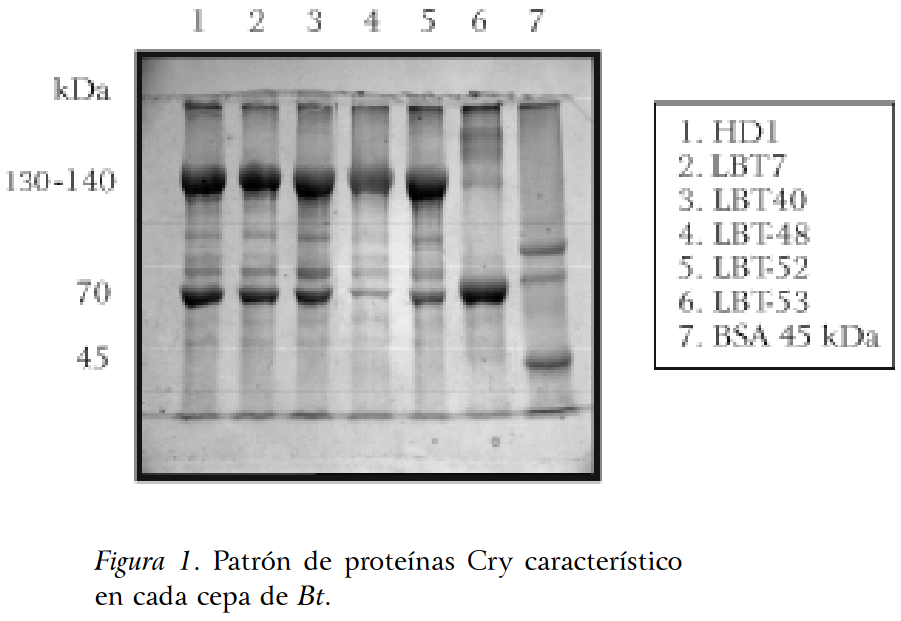
Toxin proteins Cry produced by diverse Bacillus thuringiensis strains grown in fermentation medium GTE, were separated by sodium dodecil sulphate-polyacrylamide gel electrophoresis (SDS-PAGE) and the toxin protein bands were then quantified by densitometry. The result was compared with the production of the standard HD1 in the fermentation medium LB. It is concluded that the fermentation medium, where the strains reproduces, is as important as the utilized strain for the production of this important bacteria.
Article Details

This work is licensed under a Creative Commons Attribution-NonCommercial 4.0 International License.
Those authors who have publications with this journal accept the following terms of the License Attribution-NonCommercial 4.0 International (CC BY-NC 4.0):
You are free to:
- Share — copy and redistribute the material in any medium or format
- Adapt — remix, transform, and build upon the material
The licensor cannot revoke these freedoms as long as you follow the license terms.
Under the following terms:
- Attribution — You must give appropriate credit, provide a link to the license, and indicate if changes were made. You may do so in any reasonable manner, but not in any way that suggests the licensor endorses you or your use.
- NonCommercial — You may not use the material for commercial purposes.
- No additional restrictions — You may not apply legal terms or technological measures that legally restrict others from doing anything the license permits.
The journal is not responsible for the opinions and concepts expressed in the works, they are the sole responsibility of the authors. The Editor, with the assistance of the Editorial Committee, reserves the right to suggest or request advisable or necessary modifications. They are accepted to publish original scientific papers, research results of interest that have not been published or sent to another journal for the same purpose.
The mention of trademarks of equipment, instruments or specific materials is for identification purposes, and there is no promotional commitment in relation to them, neither by the authors nor by the publisher.
How to Cite
References
Agaisse, H.; D. Lereclus: «How Does Bacillus thuringiensis Produce so much Insecticidal Crystal Protein», J. Bacteriol. 177:6027-6032, 1995.
Baum, J. M.; T. Malvar: «Regulation of Insecticidal Crystal Protein Production in Bacillus thuringiensis», Mol Microbiol 18:1-12, 1995.
Bradley, D. «The Insecticidal CryIB Crystal Protein of Bacillus thuringiensis ssp. thuringiensis Has Dual Specificity to Coleopteran and Lepeidopteran Larvae», J. Invertebr. Pathol. 65:162-173, 1995.
Brussock, S. M.: T. C. Currier: «Use of Dodecyl Sulfate-Polyacrylamide Gel Electrophoresis to Quantify Bacillus thuringiensis Delta-Endotoxins», Analytical Chemistry of Bacillus thuringiensis. Chapter 9, 1990, pp. 78-87.
Carreras, B.: «Caracterización de cepas de Bacillus thuringiensis para el control fitosanitario». Tesis en opción al título académico de Maestro en Microbiología, Mención en Microbiología General, Facultad de Biología, Universidad de La Habana, 2003.
Farrera, R. R.; F. Pérez-Guevara; M. de la Torre: «Carbon:Nitrogen Ratio Interacts with Initial Concentration of Total Solids of InsecticidalCrystal Protein and Spore Production in Bacillus thuringiensis HD-73», Appl. Microbiol Biotechnol. 49:758-765, 1998.
Galán, L. J.; J. A. GarcÍa; M. E. Santos; I. Quintero: «Mecanismo molecular de acción de la delta-endotoxinas de Bacillus thuringiensis», Avances en la biotecnologia de B. thuringiensis, Univ. Autónoma de Nuevo León, México, 1996, pp. 129-155.
Glare, T. R.; M. O’Callaghan: Characterization in Bacillus thuringiensis: Biology, Ecology and Safety, Inglaterra, 2001, pp. 6-10.
Laemmli, N. K.: «Cleavage of Structural Proteins During the Assembly of the Head of Bacteiophage T4», Nature 227:680, 1970.
Narva, K. E., J. M. Payne; G. E. Schwab; L. A. Hickle; T. Galasan; A. J. Sick: «Novel Bacillus thuringiensis Microbes Active Against Nematodes and Genes Encoding Novel Nematode-Active Toxins Cloned from Bacillus thuringiensis Isolates», GeneBank 85 (GeneWorks 2.4, release 14.0, October 94), 1991.
Payne, J. M.; R. J. C. Cannon; A. L. Bagley: Novel Bacillus thuringiensis Isolates for Controlling Acarides, PCT International Patent Application No. WO 92/19106, 1992.
Rowe, G. E.; A. Margaritis: «Bioprocess Developments in the Production of Bioinsectisides by Bacillus thuringiensis», J. Ferm. Bioeng. (6): 87-120, 1987.
Salama, H. S.; M. S. Foda; H. T. Dulmage; A. El-Sharaby: «Novel Fermentation Media for Production of Delta-Endotoxins from Bacillus thuringiensis», J. Invertebr. Pathol. 41:8-19, 1983.
Sambrook, J.; E. F. Fritsch; T. Maniatis: Molecular Cloning. A Laboratory Manual 2nd ed., Cold Spring Harbor Laboratory Press, Cold. Spring Harbor, New York, 1989.
Schagger, H.; G. von Jagow: «Tricine-Sodium Dodecyl Sulfate-Polyacrylamide Gel Electrophoresis for the Separation of Proteins in the Range from 1 to 100 kDa», Analytical Biochemistry 166:368-379, 1987.
Smith, G. P.; D. J. Ellar: «Mutagenesis of Two Surface-Exposed Loops of the Bacillus thuringiensis CryIC-Endotoxin Affects Insecticidal Specificity», Biochem. J. 302:611-616, 1994.
Warren, G. M.; M. G. Koziel; M. A. Mullins; G. J. Nye; B. Carr; N. M. Desai; K. Kostichka; N. B. Duck; J. J. Estruch: «Novel Pesticidal Proteins and Strains». Patent WO 96/10083. World Intellectual Property Organization, 1996.
Yamamoto, T.; G. K. Powell: «Bacillus thuringiensis Criytal Protein: Recent Advances in Understanding Its Insecticidal Activity», Advanced Engineered Pesticides, Mrcel Dekker, Inc., E. U., 1993, pp. 3-42.
Yudina, T. G.; O. V. Salamakha; E. V. Olekhnovich; N. P. Rogstykh; N. S. Egorov: «Effect of Carbon Source on the Biological Activity and Morphology of Paraspore Crystal from Bacillus thuringiensis», Microbiology 61:402-407, 1992.
Ziniu, Y.; H. Biwang: «Biocontrol of Plant-Parasitic Nematodes by Bacteria», Journal of Fujian Agricultural University 27(3):316-321, 1998.