
Virulencia de Beauveria bassiana y Metarhizium anisopliae, nativos del occidente de México, contra larvas de tercer estadio de Phyllophaga crinita (coleoptera: melolonthidae) bajo condiciones de laboratorio
Article Sidebar
Main Article Content
Abstract
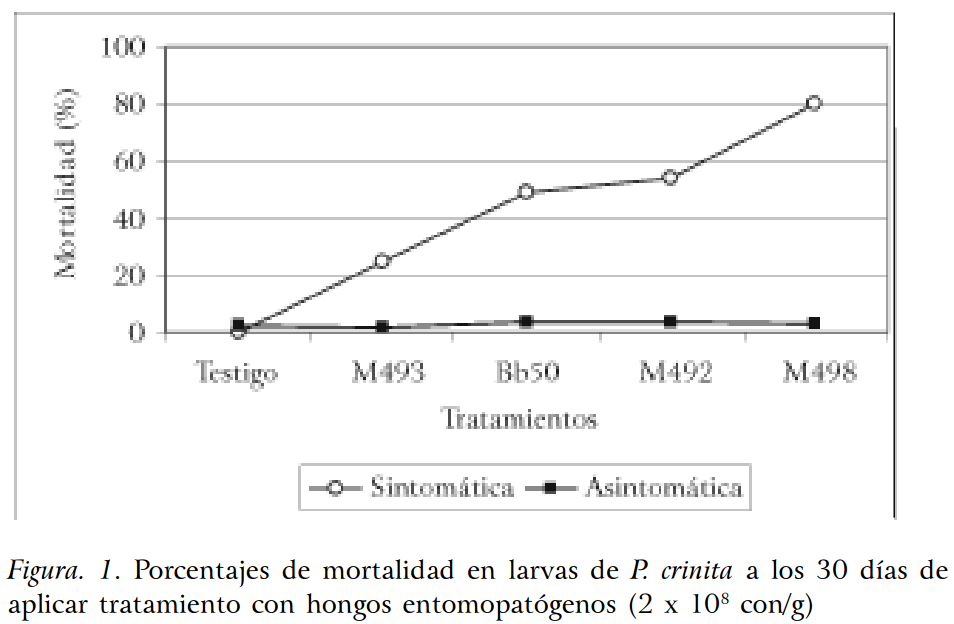
Three isolations of entomopathogen fungus Metarhizium anisopliae (Metschinikoff) Sorokin and one of Beauveria bassiana (Balsamo) Vuillemin from west Mexico were evaluated for their potential as biological control agents against white grub third instar larvae Phyllophaga crinita (Burm.) (Coleoptera: Melolonthidae), a very important root pest from the economical point of view. The evaluated fungus isolations belong to the National Biological Control Reference Center Collection (CNRCB-DGSV-SAGARPA). The isolation M. anisopliae M 498 showed the highest virulence level after 30 days of inoculation, followed by M 492, that showed similar behavior to that of B. bassiana Bb 50, and the less virulent was M 493. All isolations were evaluated at 2x10⁸ conidia per gram of medium. Treatments were statistically different in comparison to control, and they were capable to grow, produce spores, and produce mycosis, demonstrating their capacity to cause an epizooty. Most virulent isolation showing the highest potential as biological control agent against white grub P. crinita third stadium larvae was M 498 from Jalisco, Mexico, isolated from larvae of the same genus.
Article Details

This work is licensed under a Creative Commons Attribution-NonCommercial 4.0 International License.
Those authors who have publications with this journal accept the following terms of the License Attribution-NonCommercial 4.0 International (CC BY-NC 4.0):
You are free to:
- Share — copy and redistribute the material in any medium or format
- Adapt — remix, transform, and build upon the material
The licensor cannot revoke these freedoms as long as you follow the license terms.
Under the following terms:
- Attribution — You must give appropriate credit, provide a link to the license, and indicate if changes were made. You may do so in any reasonable manner, but not in any way that suggests the licensor endorses you or your use.
- NonCommercial — You may not use the material for commercial purposes.
- No additional restrictions — You may not apply legal terms or technological measures that legally restrict others from doing anything the license permits.
The journal is not responsible for the opinions and concepts expressed in the works, they are the sole responsibility of the authors. The Editor, with the assistance of the Editorial Committee, reserves the right to suggest or request advisable or necessary modifications. They are accepted to publish original scientific papers, research results of interest that have not been published or sent to another journal for the same purpose.
The mention of trademarks of equipment, instruments or specific materials is for identification purposes, and there is no promotional commitment in relation to them, neither by the authors nor by the publisher.
How to Cite
References
Bejarano, F.: «Daños crónicos a la salud provocados por los plaguicidas». Red de Acción sobre Plaguicidas y Alternativas en México (RAPAM), México, 2004.
Crocker, R. L.. «Write Grub Management in Southwestern Turfgrass». Proc. Southwest Turfgrass Conf., E.U., 1982, pp. 44-47.
Dorta, B.; J. Arcas: «Producción de hongos entomopatógenos», Microorganismos patógenos empleados en el control microbiano de insectos plaga, Buenos Aires, Argentina, 1996, pp. 195-206.
Gagnon, J. J. et al. SuperANOVA: Asscessible General Linear Modeling. Abacus Concepts, Inc., Berkeley, 1989.
Glare, T. R.: «Fungal Pathogens of Scarabs», Use of Pathogens in Scarab Pest Management, Intercept, Andover, Hampshire, Inglaterra, 1992, pp. 63-77.
Klein, M. G. et al.: «Lawn Turf and Grassland Pests», Field Manual of Techniques in Invertebrate Pathology, Kluwer Academic Publishers, Dordrecht, Holanda, 2000, pp. 681-706.
Milner, R. J.: «Selection and Characterization of Strains of Metarhizium anisopliae for Control of Soil Insects in Australia», Biological Control of Locus and Grasshoppers, CAB International, 1992, pp. 200-207.
Nájera-Rincón, M. B.: «Control biológico del complejo “gallina ciega” (Coleoptera: Melolonthidae) por hongos entomopatógenos en agroecosistemas de maíz en el occidente de México». Informe final proyecto CONACYT-SIMORELOS. Clave 970301, Morelia, Michoacán, México, 2000.
Poprawski, T. J.; W. N. Yule: «Incidence of Fungi in Natural Population of Phyllophaga spp. and Susceptibility of Phyllophaga anxia (LeConte) (Col., Scarabaeidae) to Beauveria bassiana and Metarhizium anisopliae (Deuteromycotina)», J. Appl. Ent. 112:359-365, E.U., 1991.
Rodríguez del Bosque, L. A.: «Phyllophaga crinita (Coleoptera: Melolonthidae): historia de una plaga del suelo (1955-1988)», Memorias III Mesa Redonda sobre Plagas del Suelo, Soc. Mex. Entomol., Morelia, Michoacán, México, 1988, pp. 53-79.
Rodríguez del Bosque, L. A. et al.: «Virulence of Metarhizium anisopliae and Beauveria bassiana Against Phyllophaga crinita and Anomala flavipennis (Coleoptera: Scarabaeidae) Larvae», Estudios sobre coleópteros del suelo en América, Publ. Esp. Benemérita Universidad Autónoma de Puebla, México, 2003, pp. 337-345.
Shannon, P. J.; S. M. Smith; E. Hidalgo: «Evaluación en el laboratorio de aislamientos costarricenses y exóticos de Metarhizium spp. y Beauveria spp. contra larvas de Phyllophaga spp. (Coleoptera: Scarabaeidae)», Diversidad y manejo de plagas subterráneas, Publicación Especial Soc. Mex. Entomología e Instituto de Ecología, Xalapa, Veracruz, México, 1993, pp. 203-215.