
Determinación de especies hospedantes de Alternaria solani sor. en la empresa de cultivos varios de Horquita, Cienfuegos
Article Sidebar
Main Article Content
Abstract
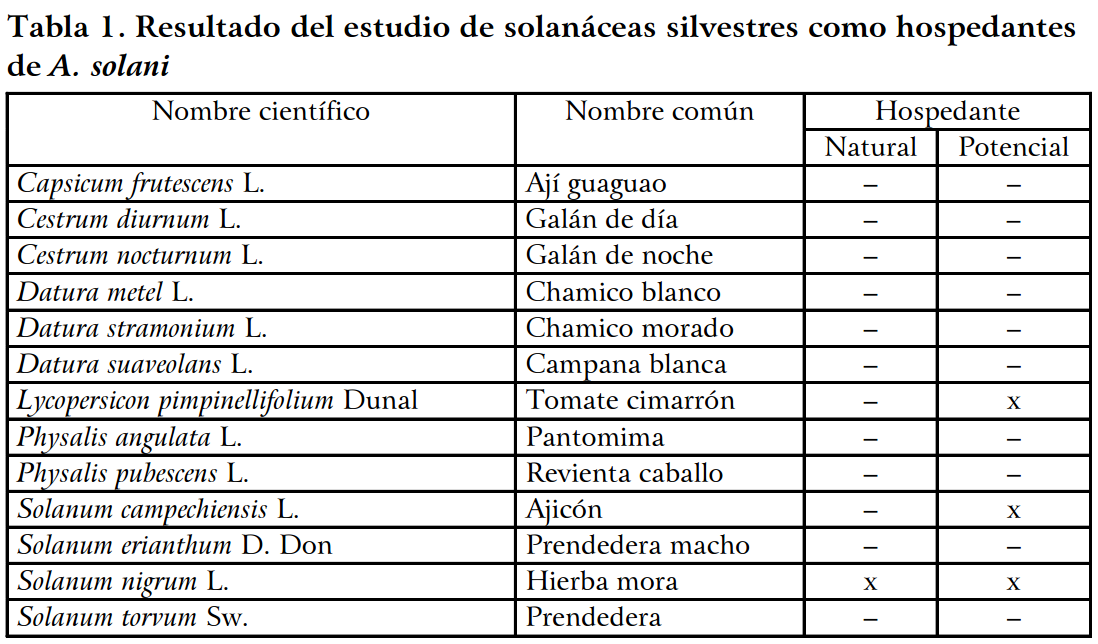
A study to know the host plants of A. solani Sor. fungus that cause the early blight in potato was made in Cienfuegos province. From the 13 plants of solanaceos family studied, Solanum nigrum L result natural host, while Solanum nigrum L., Solanum campechiensis L. and Lycopersicon pimpnellifolium Dunal were host too but under artificial inoculation condition. From 18 crop plants evaluated Lycopersicon esculentum M. and Solanum melongena L resulted host in both naturally and artificial inoculation condition.
Article Details

This work is licensed under a Creative Commons Attribution-NonCommercial 4.0 International License.
Those authors who have publications with this journal accept the following terms of the License Attribution-NonCommercial 4.0 International (CC BY-NC 4.0):
You are free to:
- Share — copy and redistribute the material in any medium or format
- Adapt — remix, transform, and build upon the material
The licensor cannot revoke these freedoms as long as you follow the license terms.
Under the following terms:
- Attribution — You must give appropriate credit, provide a link to the license, and indicate if changes were made. You may do so in any reasonable manner, but not in any way that suggests the licensor endorses you or your use.
- NonCommercial — You may not use the material for commercial purposes.
- No additional restrictions — You may not apply legal terms or technological measures that legally restrict others from doing anything the license permits.
The journal is not responsible for the opinions and concepts expressed in the works, they are the sole responsibility of the authors. The Editor, with the assistance of the Editorial Committee, reserves the right to suggest or request advisable or necessary modifications. They are accepted to publish original scientific papers, research results of interest that have not been published or sent to another journal for the same purpose.
The mention of trademarks of equipment, instruments or specific materials is for identification purposes, and there is no promotional commitment in relation to them, neither by the authors nor by the publisher.
How to Cite
References
Arnol, G. R. W.: Lista de hongos fitopatógenos de Cuba, Ed. Ciencia y Técnica, La Habana, 1981.
Castellanos, L.: «Modelación matemática y software para el pronóstico a corto plazo de la dispersión de Alternaria solani Sor. en el cultivo de la papa». Tesis para la opción de Máster en Ciencias Agrícolas, Universidad Agraria de La Habana, Cuba, 2001.
CMI: CMI Description of Patogenic Fungi and Bateria Set 48. Description no. 475, Commonwealth Mycological Institute, Kew, Surrey, Inglaterra, 1975.
Laboratorio Provincial de Sanidad Vegetal Cienfuegos: «Catálogo de plagas, enfermedades y malezas», Cuba, 1996.
Fernández, M.: «Catálogo de enfermedades de las plantas cubanas», Revista Academia de Ciencias de Cuba, no. 69, 1980.
Frobisher, M.: Microbiología, Ediciones Salvat, España, 1969, p. 55.
Mayea, S.; L. Herrera; C. M. Andreu: Enfermedades de las plantas cultivadas en Cuba, Ed. Pueblo y Educación, La Habana, 1983, pp. 238-273.
Mc Govem, R. J.; J. E. Polston; I. J. Mullahey: «Tropical Soda Apple; Newly Identified Host of Tomato, Pepper and Tobacco Viruses in Florida», Citrus and Vegetable Magazine 56 (12):10-12, 1993.
Méndez, R.: «Estudio bioecológico de Solanum nigrum L.». Resúmenes, Manacaton, Instituto de Investigaciones de Viandas Tropicales (INIVIT), Cuba, 1993.
Naranjo, M.: «Estudio sobre la epidemiología del tizón temprano». Tesis de Grado, Universidad Central Martha Abreu, Villa Clara, Cuba, 1984.
Seidel, D.: Lista preliminar de hongos fitopatógenos de Cuba, Ed. Pueblo y Educación, La Habana, 1976.