
Comportamiento del manchado del grano en variedades de arroz (oryza sativa lin.) De ciclo medio
Article Sidebar
Main Article Content
Abstract
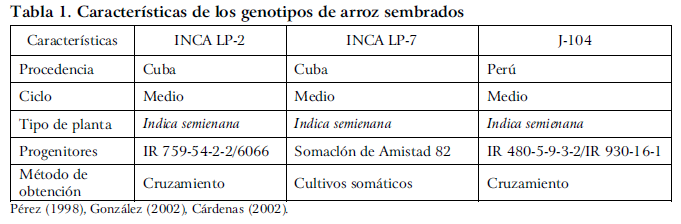
A study of interaction genotype-environment was realized in the Rice Experimental Station “Los Palacios” with the intention of evaluating the behavior of spotted seed on three rice varieties of medium cycle: INCA LP-2, INCA LP-7 and J-104 as control. The relation of this pathology with the grain emtiness and the weight of 1000 grains in both rainy and slightly rain periods was evaluated; random blocks design in field plots with three repetitions was used. Results showed that damage percents were different between periods and records were minor in the slightly rain one; the empty grain presented the same behavior, whereas the weight of 1000 healthy grains was major in this period; at the same time the spotted grains weighed less than the healthy ones in every studied. Regression analysis indicated that percentage of stained of the grains was related with the percentage of grain emptiness and the weight of the grains in both healthy and spotted. The variety INCA LP-7 presented the best behavior.
Article Details

This work is licensed under a Creative Commons Attribution-NonCommercial 4.0 International License.
Those authors who have publications with this journal accept the following terms of the License Attribution-NonCommercial 4.0 International (CC BY-NC 4.0):
You are free to:
- Share — copy and redistribute the material in any medium or format
- Adapt — remix, transform, and build upon the material
The licensor cannot revoke these freedoms as long as you follow the license terms.
Under the following terms:
- Attribution — You must give appropriate credit, provide a link to the license, and indicate if changes were made. You may do so in any reasonable manner, but not in any way that suggests the licensor endorses you or your use.
- NonCommercial — You may not use the material for commercial purposes.
- No additional restrictions — You may not apply legal terms or technological measures that legally restrict others from doing anything the license permits.
The journal is not responsible for the opinions and concepts expressed in the works, they are the sole responsibility of the authors. The Editor, with the assistance of the Editorial Committee, reserves the right to suggest or request advisable or necessary modifications. They are accepted to publish original scientific papers, research results of interest that have not been published or sent to another journal for the same purpose.
The mention of trademarks of equipment, instruments or specific materials is for identification purposes, and there is no promotional commitment in relation to them, neither by the authors nor by the publisher.
How to Cite
References
Aguilar, M.: Cultivo del arroz en el sur de España, Centro de Investigación e información Agraria. Sevilla, España, 2001.
Almaguel, Lérida; Adrid Santos; P. de la Torre; Idalia Cáceres; Jorge Hernández: «Dinámica de poblaciones e indicadores ecológicos del ácaro Steneotarsonemus spinki Smiley (acari: tarsonemidae) en arroz de riego en Cuba», I Congreso de Arroz de Riego y Secano del Área del Caribe, Resúmenes, Camagüey, Cuba, 1999, pp. 81 y 82.
Cárdenas, Regla M.; Lázara M. González; Yanet Parra; Deyanira Rivero; A. Cruz: «Influencia del manchado del grano de arroz (Oryza sativa Lin.) en la variedad J-104: nocividad y géneros de hongos presentes», Protección Vegetal, vol. 18, no. 2, 2003, pp.124-128.
Cárdenas, Regla M.; Noraida Pérez; Elizabeth Cristo: «Respuesta de variedades de arroz (Oryza sativa Lin.) a la piriculariosis (Pyricularia grisea Sacc.)», Congreso Científico del INCA (13: 2002, nov, 12-15, La Habana) Memoria CD-ROM: INCA, ISBN, 2002.
Castaño, J.: «Etiología del manchado de grano en arroz de secano en Colombia e Indonesia», Arroz, vol. 47, no. 413, 1998, pp. 24-32.
Cordero, V.; L. E. Rivero: «Principales enfermedades fungosas que inciden en el cultivo del arroz en Cuba», Instituto de Investigaciones del Arroz, MINAGRI, 2001.
Cuevas, F.; Noraida Pérez; G. Díaz; R. Polón: «Comportamiento del cultivo del arroz (Oryza sativa L.) en condiciones de montaña en Pinar del Río», II Encuentro Internacional de Arroz, Memorias, Instituto de Investigaciones del Arroz, 2002, pp. 113-118.
Estrada Giselle; Ileana Sandoval: «Incidencia de Curvularia spp. en el manchado del grano de arroz de algunas variedades de la provincia de Pinar del Río», Fitosanidad, vol. 5, no.4, 2001, pp. 3-5.
Estrada, Giselle; María O. López; Ileana Sandoval: «Nuevos registros de especies de Curvularia en semillas de arroz», II Encuentro Internacional de Arroz, Memorias, Instituto Investigaciones del Arroz, 2002, p. 173.
FEDEARROZ.: «50 años de FEDEARROZ», Arroz, vol. 46, no. 408, 1997, pp. 15-52.
González, María C.: «INCA LP-7: nueva variedad de arroz para suelos afectados por la salinidad», Cultivos Tropicales, vol. 23, no. 3, 2002, p. 89.
Guzmán, Myriam P.: «Evaluación de la presencia de patógenos en paddys de arroz», Correo, FEDEARROZ, año 10, no. 100, 1999, p. 5.
Hernández, A.: Nueva versión de clasificación genética de los suelos de Cuba, Instituto de Suelos, La Habana, 1999.
IRRI: Standard Evaluation System for Rice, fourth edition, 1996, pp.17-19.
Isidrón, Miriam; Yamila Rosales; A. Pifferrer; A. Cisneros; R. Benega; Carol Carvajal: «Caracterización de germoplasma de piña colectado en Cuba mediante prospección nacional: I. Localización, diversidad genética y situación actual», Cultivos Tropicales, vol. 24, no.1, 2003. pp. 65-71.
López, L.: «Arroz. Cultivos herbáceos», Cereales, Ediciones Mundiprensa, Madrid, 1991, p. 419.
Mew, T. W.; P. González: A Handbook of Rice Fungi, Sciences Publisher, 2002.
Morejón, R.; Sandra Díaz; Noraida Pérez: «Aplicación de técnica multivariadas en la clasificación morfoagronómica de genotipos de arroz obtenidos en la Estación Experimental Los Palacios», Cultivos Tropicales, vol. 22, no. 1, 2001, pp. 43-48.
Neninger, Hilda; Elsa I. Hidalgo; L. M. Barrios; María Puedo: «Hongos presentes en semillas de arroz (Oryza sativa L.) en Cuba», Fitosanidad vol. 7, no. 3, 2003, pp. 7-11.
Pantoja, A.; A. Ramírez; L. R Sanint: «Producción de arroz en América Latina. Área sembrada y costos», MIP en arroz. Manejo integrado de plagas, artrópodos, enfermedades y malezas, FLAR-CIATFEDEARROZ-FUNDACION POLAR, Caracas, 1997.
Pérez, J. A et al.: Genética y mejoramiento de las plantas tropicales, ENPES, La Habana, 1991.
Pérez, Zoraida; María C. González; R. I. Castro: «Validación de nuevas variedades cubanas de arroz (Oryza sativa L.) para la provincia de Pinar del Río». Cultivos Tropicales, vol. 23, no. 2, 2002, pp. 51-54.
Pérez, Zoraida: «Variedad de arroz INCA LP-2», Cultivos Tropicales, vol. 19, no. 3, 1998, p. 67.
Porceddu, E.: «Biodiversity: Scientific Aspect and Political Issues», Journal of Plant Pathology, vol. 83, no. 2, 2001, pp. 63 y 64.
Sandoval, Ileana; Tania Bonilla; María O. López; Giselle Estrada: «Sarocladium oryzae y otras especies fúngicas en los granos manchados de variedades afectadas por la pudrición de la vaina». II Encuentro Internacional de Arroz, Memorias, Instituto Investigaciones del Arroz, 2002, p. 166.
Wong, Wendy; Ileana Sandoval: «Incidencia de Phoma spp. en el manchado del grano de arroz de algunas variedades de las provincias de La Habana y Pinar del Río», Fitosanidad, vol. 5, no. 4, 2001, pp. 21-23.