
Los depredadores de tetranychus tumidus banks en Cuba
Article Sidebar
Main Article Content
Abstract
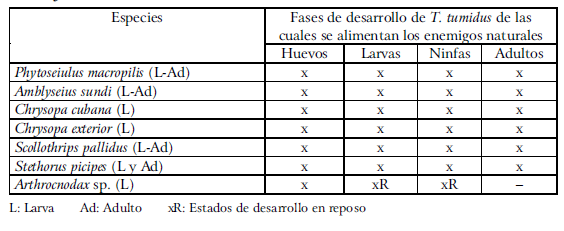
Tetranychus tumidus Banks is one of the spider mites more diffused on the banana tree foliage in the world, it damages foliar system and constitutes the third important plague for this cultivation in French Western India. An integrated management program is applied in Cuba from the decade of the 90´s, based in the use of agricultural warning services, forecasting, plant protection and the use of natural enemies (Phytoseiulus macropilis in nursery phase and application of Bacillus thuringiensis in that of development). The identification of natural depredators that feed upon banana red mites in Havana province was the objective of this work, which was realized by the analysis of samples taked weekly from 1986 to 1989, according to methodology of Pérez (1978). The organisms associated to the fitophagous were collected and classified. The nutritional habits of the most common depredators were carried out by means of the breeding of the red mite and their natural enemies, in a reason of 75 to 100 preys /depredator. Phytoseiulus macropilis (Banks), Amblyseius sundi Baker (Phytoseiidae), Chrysopa cubana Hagen, Ch. exterior Navás (Chrysopidae), Scolothrips pallidus (Beach) (Thripidae), Stethorus picipes (Casey) (Coccinellidae), were identified as depredators species in all the development phases of T. tumidus and Arthrocnodax sp. (Cecidomiidae) was only in the immature states of the red mite. Phytoseiidae (Acari) were the most numerous, followed by Cecidomiidae (Diptera), Coccinellidae (Coleoptera) and Thripidae (Thysanoptera).
Article Details

This work is licensed under a Creative Commons Attribution-NonCommercial 4.0 International License.
Those authors who have publications with this journal accept the following terms of the License Attribution-NonCommercial 4.0 International (CC BY-NC 4.0):
You are free to:
- Share — copy and redistribute the material in any medium or format
- Adapt — remix, transform, and build upon the material
The licensor cannot revoke these freedoms as long as you follow the license terms.
Under the following terms:
- Attribution — You must give appropriate credit, provide a link to the license, and indicate if changes were made. You may do so in any reasonable manner, but not in any way that suggests the licensor endorses you or your use.
- NonCommercial — You may not use the material for commercial purposes.
- No additional restrictions — You may not apply legal terms or technological measures that legally restrict others from doing anything the license permits.
The journal is not responsible for the opinions and concepts expressed in the works, they are the sole responsibility of the authors. The Editor, with the assistance of the Editorial Committee, reserves the right to suggest or request advisable or necessary modifications. They are accepted to publish original scientific papers, research results of interest that have not been published or sent to another journal for the same purpose.
The mention of trademarks of equipment, instruments or specific materials is for identification purposes, and there is no promotional commitment in relation to them, neither by the authors nor by the publisher.
How to Cite
References
Almaguel, Lérida; R. Pérez; Mayra Ramos; Zuleyka Martínez; J. Ovies; Bárbara Roselló; Misleibis Márquez; Isabel Suárez; Elina Massó; R. Chico; Ermita Feitó; J. Cortiñas: «Generalización en Cuba del programa de manejo integrado del ácaro rojo Tetranychus tumidus en plátano», Fitosanidad, vol. 4 (3-4):93-98, 2000.
De la Rosa, P. Julia; A. C. López: «Scollothrips pallidus (Bearch), un nuevo depredador del ácaro rojo Tetranychus tumidus Banks en Cuba», Ciencia y Técnica en la Agricultura, Serie Protección de Plantas 9(3), CIDA, MINAGRI, 1986.
Gómez, M.; J. A. Pino; V. Sánchez; O. Álvarez; Z. Peña; I. Varona: «Efectos de tres biorreguladores sobre Tetranychys tumidus (Banks)». III Simposio de Zoología, Palacio de Convenciones, La Habana, 1994, p. 46.
Gutiérrez, J.: «Les Tetranychidae de l’tle de la Réunion et quelquesuns de leurs prédateurs», L’Agronomic Tropicale 41(1):84-91,1986.
Hamstead, E. D.: «Greenhouse Integrated Control Studies of the TwoSpoted Spider Mite on Lima Beans with a Predaceous Mite Typhlodromus fallacis and Insecticides», Journal of Econ. Entomology 63(3):1027-28, 1970.
Helle, W.; M. W. Sabelis: Spider Mites. Their Biology, Natural Enemies and Control, University of Amsterdam, 1985.
Jeppson, L. R.; H. H. Keifer; E. W. Baker: Mites Injurious to Economic Plants, Berkeley, University of California Press, 1975.
Martínez, G. Zuleika; R. Pérez: «Acarofauna sobre el cultivo del plátano Musa sp. en la granja viandera Valle del Yabú». II Evento CientíficoTécnico de Sanidad Vegetal, Villa Clara, DGSV, 1976.
Pérez, A. R.: Metodología de trabajo para los laboratorios provinciales, Dirección General de Sanidad Vegetal, Laboratorio de Diagnóstico, 1978.
Prasad, V.: «Biology of the Predatory Mite Phytoseiulus macropilis in Hawaii (Acarina:Phytoseiidae)», Ann. Ent. Soc. 60:905-908, 1967.
Ramos L. Mayra: «Influencia de la disponibilidad de la presa sobre el desarrollo, reproducción, longevidad y consumo de Phytoseilus macropilis Banks (Acari:Phytoseiidae)». V Seminario de Acarología, III Simposio de Zoología, Palacio de Convenciones, La Habana, 1994, p. 56.
Raros, E. S.; F. H. Haramoto: «Biology of Stethorus siphonulus Kapur (Coccinellidae:Coleoptera) a Predator of Spider Mite in Hawaii», Proc. Hawaii Entomol. Soc. 1972, 21:457-465, 1974.
Rijo C. E.: «Aspectos de la biología de crisópidos y su posible utilización en la regulación de fitófagos», Instituto de Investigaciones de Sanidad Vegetal, MINAGRI, La Habana, sept., 1997.
Simón, S.: «Les acariens et les thrips sur bananier. Fruit.». Institut de Recherches sur les Fruits et Argumes (número especial), 72-76, 1990.