
Suma de temperaturas efectivas y potencial de multiplicación del ácaro del vaneado del arroz (steneotarsonemus spinki, smiley) en Cuba
Article Sidebar
Main Article Content
Abstract
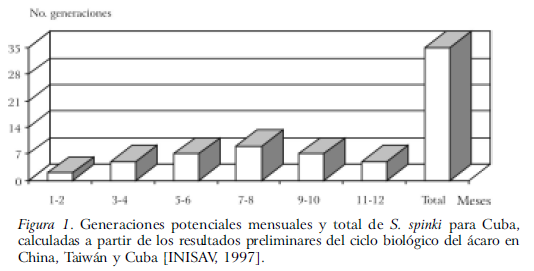
S. spinki was informed as a very harmful plague of the rice (Oryza sativa L.) for the first time in China, by the middle of the seventies. It was detected in Cuba at the end of 1997. The objective of this work was to determine the multiplication potential of this mite for the different territories where Production Rice Centers (CAI) are situated in Cuba. This work was realized starting from the results about the duration of mite life cycle, obtained by Lo and Ho (1979) in China, Cheng et al. (1980) in Taiwan, and Santos et al. (1998) for Cuban conditions. The sums of each tenth days average temperatures, the Sum of Effective Temperature (SET) and the annual generations (Livschitz and Salina 1968) were determined. According to the experimental results for Cuban conditions, SET was 62.03 ± 10.03 degrees/day, with a generations number of 48 to 55 in Havana and Granma respectively. Mite multiplies during the whole year, with maximal of 6 generations monthly in the spring campaign and less than 3 in winter, which facilitates an effective readjustment of sowings dates in Cuban western region, as measures to diminish the lost ones.
Article Details

This work is licensed under a Creative Commons Attribution-NonCommercial 4.0 International License.
Those authors who have publications with this journal accept the following terms of the License Attribution-NonCommercial 4.0 International (CC BY-NC 4.0):
You are free to:
- Share — copy and redistribute the material in any medium or format
- Adapt — remix, transform, and build upon the material
The licensor cannot revoke these freedoms as long as you follow the license terms.
Under the following terms:
- Attribution — You must give appropriate credit, provide a link to the license, and indicate if changes were made. You may do so in any reasonable manner, but not in any way that suggests the licensor endorses you or your use.
- NonCommercial — You may not use the material for commercial purposes.
- No additional restrictions — You may not apply legal terms or technological measures that legally restrict others from doing anything the license permits.
The journal is not responsible for the opinions and concepts expressed in the works, they are the sole responsibility of the authors. The Editor, with the assistance of the Editorial Committee, reserves the right to suggest or request advisable or necessary modifications. They are accepted to publish original scientific papers, research results of interest that have not been published or sent to another journal for the same purpose.
The mention of trademarks of equipment, instruments or specific materials is for identification purposes, and there is no promotional commitment in relation to them, neither by the authors nor by the publisher.
How to Cite
References
Agromet. Boletín Agrometeorológico Decenal, vol.18-20, ISMET, CITMA,
-1997.
Almaguel Rojas, Lérida: «Ácaros de importancia económica en Cuba». Boletín Técnico no. 2, CID-INISAV, La Habana, 1996.
Cheng, Ch.; H. Hsiao: «Bionomic of S. spinki Attacking Rice Plants in Taiwan», Recent Advances in Acarology 1:111-117, 1979.
Cheng, Ch.; W. Su & K. Ho: «Bionomic of the Rice Tarsonemid Mite (Steneotarsonemus spinki) and Its Relation to Rice Sterile-Grain Syndrome», A Review. Plant Prot. Bull, Taiwan, 22 (1):63-82, 1980.
INISAV: «Informe sobre el vaneado de la panícula y la pudrición de la vaina de arroz producido por el complejo del ácaro Steneotarsonemus spinki y el hongo Sarocladium oryzae», MINAGRI, La Habana, 1998.
Livschitz I. S.; A. Salinas: «Preliminares acerca de los ácaros tetránicos de Cuba», Centro Nacional Fitosanitario, Instituto del Libro, La Habana, 1968, pp. 28 y 29.
Lo, K. CH. & Ch. Ho: «Ecological Observations on Rice Tarsonemid Mite, Steneotarsonemus spinki (Acarina:Tarsonemidae)», J. Agric. Res. China 28(3):181-192,1979.
Pérez, R.; L. Almaguel; E. de la Torre; M. Domínguez: «Umbral mínimo de desarrollo de Tetranychus tumidus en el cultivo del plátano», MIP, Costa Rica, 44:26-28, 1997.
Reissky, W. H.; E. A. Heinnrechs; J. A. Letsinger; K. Moody; L. Fudler; T. W. Mew; T. Barrion: «Illustrated Guide to Management in Rice in Tropical Asia», INRI, 228-232, Filipinas, 1985.
Ramos M.; H. Rodríguez: «Steneotarsonemus spinki Smiley (Acari:Tarsonemidae). Nuevo Informe para Cuba», Rev. Protección Veg. 13(1):25-30,1998.
Santos, A.; Lérida Almaguel; P. de la Torre; J. Cortiñas; Idalia Cáceres: «Duración del ciclo de vida en condiciones controladas del ácaro Steneotarsonemus spinki (Acari:Tarsonemidae) en arroz (Oryza sativa L.) en Cuba», I Encuentro Internacional de Arroz, Palacio de Convenciones, La Habana, 1998, p. 187.
Zhang, B. D.; Z. H. Pan: «Preliminary Observations on the Biological Characteristics of Steneotarsonemus sp. [Chinese]», Insect Knowledge (Kunchong Zhishi), 1981, recd. 18:2, 55-56, 1983.