
Estudios del biocontrol de hongos del suelo con trichoderma harzianum y la combinación de la solarización en el clavel (dianthus barbatus)
Article Sidebar
Main Article Content
Abstract
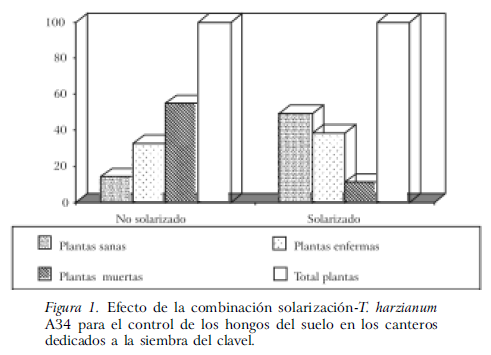
Carnation plants (Dianthus spp.) can be damaged by many important pathogens like soil fungi, which may be transmitted by vegetative materials and also by the soil, due to the possibility of these agents to survive in such substrates. Many of the carnation plants can be loosed during the transplanting period due to the presence in the soils of different species of fungi causing serious damages in this phase and in plantations. Phytophthora nicotianae was one of the principal agents of wilt disease on carnation plants (Dianthus barbatus), Rhizoctonia solani and Sclerotium rolfsii were also associated and all caused more than 50% of died plants in seedbeds. The application of Trichoderma harzianum A 34 strain biomass, combined with solarization was satisfactory for the fungal disease control. It was obtained in the first 15 days 54.8% of dead plant in untreated soils compared with the 15% in treated ones, thus confirming the usefulness of solarization-T. harzianum combination for the reduction of soil fungi in carnation plants or in other ornamentals plants which suffers the negative effects of these soil pathogens.
Article Details

This work is licensed under a Creative Commons Attribution-NonCommercial 4.0 International License.
Those authors who have publications with this journal accept the following terms of the License Attribution-NonCommercial 4.0 International (CC BY-NC 4.0):
You are free to:
- Share — copy and redistribute the material in any medium or format
- Adapt — remix, transform, and build upon the material
The licensor cannot revoke these freedoms as long as you follow the license terms.
Under the following terms:
- Attribution — You must give appropriate credit, provide a link to the license, and indicate if changes were made. You may do so in any reasonable manner, but not in any way that suggests the licensor endorses you or your use.
- NonCommercial — You may not use the material for commercial purposes.
- No additional restrictions — You may not apply legal terms or technological measures that legally restrict others from doing anything the license permits.
The journal is not responsible for the opinions and concepts expressed in the works, they are the sole responsibility of the authors. The Editor, with the assistance of the Editorial Committee, reserves the right to suggest or request advisable or necessary modifications. They are accepted to publish original scientific papers, research results of interest that have not been published or sent to another journal for the same purpose.
The mention of trademarks of equipment, instruments or specific materials is for identification purposes, and there is no promotional commitment in relation to them, neither by the authors nor by the publisher.
How to Cite
References
Arbeláez, G; Silvia Guzmán; J. León; M. González; J. C. Molina; J. Parra; J. F. Angulo; J. D. Álvarez: «Control integrado del marchitamiento vascular del clavel ocasionado por Fusarium oxysporum f. sp. dianthi», Agronomía Colombiana 10(1): 68-89, 1993.
Arbeláez, G.: «Control de Fusarium oxysporum and Phialophora cinerecens on Carnation by Combined Soil Treatment and Application of Antagonists», Acta Horticulturae 216: 77-84, 1987.
Baker, R.: «Measures to Control Fusarium and Phialophora Wilt Diseases of Carnation», Plant Disease 64:743-749, 1980.
Fernández-Larrea, Orienta; A. Calderón; M. Fraga: «Propuesta de metodología de reproducción de metodologías de cepas de Trichoderma spp. para el control de hongos fitopatógenos». Informe INISAV, 1992.
Garibaldi, A.; S. Rapetti: «Observazioni sul marcuimepedale del garofano», Colture Prottete, 4:17-20, 1975.
Rattink, H.: «Phytophthora Wilt of Carnation in the Netherlands», Neth. J. Pl. Path.85:83-84, 1979.
Sandoval, I.; M. O. López; T. Bonilla; Y. Tomas: «Hongos de suelo que atacan al clavel y antagonismo in vitro con Trichoderma spp.», Fitosanidad, vol. 2, no. 3 y 4, 41-43, 1998.
––––: «Captura y cuantificación de Phytophthora nicotianae en muestras de suelo de los cultivos de las flores y ornamentales», Fitosanidad, vol. 3, no. 2, 3-5, 1999.
Se-PRO: «Horticulture. Cultural Tips & Guidelines», Dianthus Technical Bulletins internet, 2002.
Tello, J. C.: «La podredumbre del cuello y de la base del tallo del clavel causada por Phytophthora de Bary en los cultivos españoles», Cuadernos de Fitopatología. Revista de Fitopatología y Entomología, año VII, 22:9-12, 1990.