
Efectividad de hongos entomopatógenos y bacillus thuringiensis sobre thrips palmi karny en el cultivo del pepino
Article Sidebar
Main Article Content
Abstract
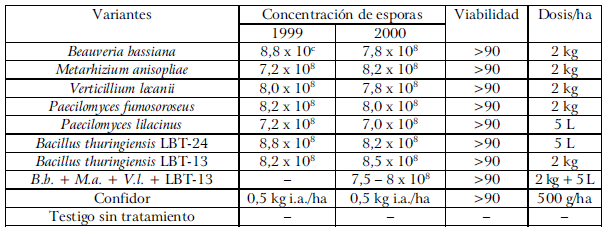
The effectiveness of different Bacillus thuringiensis and fungus entomopathogenic stains was evaluated under laboratory and field conditions for the control of Thrips palmi. In laboratory best efectiveneness results were obtained with Verticillium lecanii at 67.5 % of technical effectiveness on T. Palmi. In the field rehearsals and amplification the fungus entomopathogenic Beauveria bassiana (Bals) Vuill, M. anisopliae, V. lecanii, and Paecelomices fumosoroseus, and the strains of Bacillus turingiensis LBT-13 and LBT-24 showed good effectiveness T. Palmi, it has more than enough with values that they did not differ significantly with the standard Chinese Confidor to 0.5 Kg i.a. / ha and did over the control. Regarding the yields, mixtures variants of the different fungus with strains of B. Thuringiensis LBT – 13 and the standard reached better yields although the different variants did not show significant differences regarding the number of fruits and the yields expressed in t / ha. The cucumber growing was impacted abundantly by the natural enemies Orius insidiosus, Cycloneda sanguinea and Coleomegilla cubensis.
Article Details

This work is licensed under a Creative Commons Attribution-NonCommercial 4.0 International License.
Those authors who have publications with this journal accept the following terms of the License Attribution-NonCommercial 4.0 International (CC BY-NC 4.0):
You are free to:
- Share — copy and redistribute the material in any medium or format
- Adapt — remix, transform, and build upon the material
The licensor cannot revoke these freedoms as long as you follow the license terms.
Under the following terms:
- Attribution — You must give appropriate credit, provide a link to the license, and indicate if changes were made. You may do so in any reasonable manner, but not in any way that suggests the licensor endorses you or your use.
- NonCommercial — You may not use the material for commercial purposes.
- No additional restrictions — You may not apply legal terms or technological measures that legally restrict others from doing anything the license permits.
The journal is not responsible for the opinions and concepts expressed in the works, they are the sole responsibility of the authors. The Editor, with the assistance of the Editorial Committee, reserves the right to suggest or request advisable or necessary modifications. They are accepted to publish original scientific papers, research results of interest that have not been published or sent to another journal for the same purpose.
The mention of trademarks of equipment, instruments or specific materials is for identification purposes, and there is no promotional commitment in relation to them, neither by the authors nor by the publisher.
How to Cite
References
Anonymous: «European Plant Protection. Organization Data Sheets on Quarantine Organism. Thrips palmi (Karny)», EPPO. Bulletin 19 (175):717-720, 1979.
Castiñeiras, A.; J. E. Peña; R. Duncan; L. Osborne: «Potencial of Beauveria bassiana and Paeciilomyces fumosoroseus (Deuromicotina:Hyphomycetes) As Biological Conytrol Agents of Thrips palmi», Florida Entomologist 79 (3):458-461, sept. 1996.
Castellanos, L. G.; R. Padrón Padrón; G. Chávez; Ana Rodríguez; L. Rodríguez: «Alternativas biológicas de control de T. palmi en el cultivo de la papa». Informe Final de Proyecto, Lab. Prov. de Cienfuegos, 1999, p. 13.
Ciba Geygi: Manual para los ensayos de campo, 1981.
Dagnelie, P.: «Theorie et metodes statisques», Grembloux, Les Presses Agronomiques 2:242-250, 1984.
De Bon, B. H.; B. Rhino: «Lutte contre Thrips palmi (Karny) a la Martinique», L Agronomía Tropicale Francia 44 (2):129-136, 1989.
Etienne, J.; X. Van Watermuelen: «Thrips palmi (Karny) (Thysanoptera:Thripidae) et les autres ravageurs de l’aubergine en Guadeloupe». Proceedings of the 25th Caribbean Food Crops Society Annual Meeting, Jul. 1-6, 1989, Institut National de Recherche Agronomique (Antilles-Guyane). Guadalupe, 1991, pp. 398-410.
Franqui, R. A.; A. Pantoja; H. Ruig; A. E. Segarra Carmona: «Advances in the Control of Thrips palmi (Karny) (Thysanoptera:Thripidae) in Puerto Rico». Proceedings of the 25th Caribbean Food Crops Society Annual; Meeting Jul. 1-6, 1989, Institut National de Recherche Agronomique (Antilles-Guyane), Guadalupe, 1991, pp: 411-418.
Gillespie, A. T.: «The Potential of Entomogenous Fungi As Control Agents for Onion Thrips», BCPC Mareo no. 344 Biotechnology and Crop Improvement and Protection, 1986, pp. 237-243.
Jones, M. T.: «The Threat of Thrips palmi to Crop Production in the Caribbean Region». Proceeding of the VI Meeting of the Technical Advisory Committee of Plant Protection Directors of the Caribbean, Jun. 11-12. Inter-American Institute for Cooperation on Agriculture (IICA) St. Lucía, 1990, pp. 65-76.
Nagai, K.: «Effect of Insecticides on Orius sp., the Natural Enemy of Thrips palmi Karny», Japón, J. Appl. Ent. Zool., 24:321-324, 1990.
Saito, T.: «A Field Trial of An Entomopathogenic Fungus, Beauveria bassiana (Bals.) Vuill.», For Appl. Ent. Zool., Japón, 35: 80-81; 1991.
––––: «Control of Thrips palmi and Bemisia tabaci by a Micoinsecticidas Preparation of Verticillium lecanii». Proceeding of the Kanto-Tosan Plant Protection Society, 39:209-210, 1992.
Snedecor, G. W.: Métodos de estadística. Su aplicación a experimentos en agricultura y biología,: Acme Agency, Buenos Aires, 1948.
Vazquez, L. L.; E. Rodríguez; Isabel Pérez; H. Sariol; Sommy Fernández; Felicia Palacios; Roquelina Jiménez; Griseida Granda; Ilsa Rodríguez: «Ocurrencia de insectos de los géneros Thrips y Frankliniella (Thysanoptera:Thripidae) en agroecosistemas de cultivos anuales». VIII Congreso Latinoamericano y del Caribe de Manejo Integrado de Plagas. IX Taller Latinoamericano y del Caribe sobre Mosca Blanca y Geminivirus, Panamá, 2000, p. 35.
Wang, C. L.; Y. I. Chu: «Reading Methods of Southern Yellow Thrips, Thrips palmi Karny, in Laboratory», Plant Protection Bulletin , Taiwán, 28:407-411, 1986.