
Aspectos biológicos sobre heliothis virescens (fabricius) (lepidoptera:noctuidae) en la empresa municipal agropecuaria Antonio Guiteras de la zona norte de la provincia de las Tunas
Article Sidebar
Main Article Content
Abstract
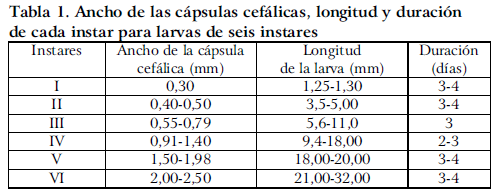
The most general characteristics in life cycle of Heliothis virescens at natural and laboratory conditions where observed in Antonio Guiteras farming areas, during three campaigns, to determine morphometry and time duration of metamorphosis states. Traditional methods were used for this study. Some data about life states dimensions and their duration were obtained. Our results differ from the informed ones before to other zones of the country, in all cases. Life cycle delayed from 33 to 37 days when larva showed five instars, with temperature and relative humidity ranges from 27.3 to 29.5°C and 71.1 to 88.5% respectively; while for those of six instars life cycle duration was from 37 to 44 days. The biggest population levels in the pest were among the months of March to April and the harmful period can delay from 13 to 22 days in each generation, in dependence of the instars number that present the larva. On the other hand, the smallest captures in trap of light took place in the month of October and the biggest in the months of February and March, being determined that the migrations of adults toward the cultivation begin four days before the first eggs and larva of the first instar.
Article Details

This work is licensed under a Creative Commons Attribution-NonCommercial 4.0 International License.
Those authors who have publications with this journal accept the following terms of the License Attribution-NonCommercial 4.0 International (CC BY-NC 4.0):
You are free to:
- Share — copy and redistribute the material in any medium or format
- Adapt — remix, transform, and build upon the material
The licensor cannot revoke these freedoms as long as you follow the license terms.
Under the following terms:
- Attribution — You must give appropriate credit, provide a link to the license, and indicate if changes were made. You may do so in any reasonable manner, but not in any way that suggests the licensor endorses you or your use.
- NonCommercial — You may not use the material for commercial purposes.
- No additional restrictions — You may not apply legal terms or technological measures that legally restrict others from doing anything the license permits.
The journal is not responsible for the opinions and concepts expressed in the works, they are the sole responsibility of the authors. The Editor, with the assistance of the Editorial Committee, reserves the right to suggest or request advisable or necessary modifications. They are accepted to publish original scientific papers, research results of interest that have not been published or sent to another journal for the same purpose.
The mention of trademarks of equipment, instruments or specific materials is for identification purposes, and there is no promotional commitment in relation to them, neither by the authors nor by the publisher.
How to Cite
References
Abraham, J.: «Comunicación personal». Inspector del Instituto de Meteorología, Estación Meteorológica de Intercambio Regional no. 358, CITMA, Puerto Padre, Las Tunas, 1993.
Ayala, J. L.; Elia R. Vera; W. Barceló: «Actividad del cogollero, Heliothis virescens (Fab.) en los períodos de intercosecha tabacalera», Rev. Centro Agrícola 15(4):48-54, 1988.
CNSV: Metodologías de señalización y pronóstico, Ciudad de La Habana, 1985.
Caballero, R.; J. Gómez; B. Cruz: «Ciclo biológico de Heliothis virescens (Fab.) (Lepidoptera:Noctuidae) bajo condiciones de laboratorio», 80 años de la Estación Agronómica de Santiago de las Vegas, INIFAT, La Habana, 1984, pp. 476-488.
Espino, M. E. et al.: Instructivo técnico para el cultivo del tabaco, SEDAGRI-AGRINFOR, MINAGRI, La Habana, 1998.
Gómez, J.: «Comunicación personal», CIAP Universidad Central Martha Abreu, Las Villas, 2002.
González, Nilda: «El cogollero del tabaco en Cuba, Heliothis virescens Fab. Consideraciones generales sobre el insecto». CIDA. INRA 3(7), 1976.
Guerra, C. Walkiria et al.: Estadística, Ed. Félix Varela, 1998.
Martínez, E.; J. M. Novo; F. Hernández: «Ciclo biológico de Heliothis virescens Fab. (Lepidoptera: Noctuidae) en condiciones de laboratorio no controladas», Centro Agrícola, año XI, no. 2, 39-45, 1984.
Méndez, B. A.: «Agroentomofauna principal y aspectos bioecológicos de las especies de importancia económica en la provincia de Las Tunas». Tesis doctoral, Universidad Central Martha Abreu, Las Villas, 2002.
Piedra, Felicia et al.: «Umbral económico de Heliothis virescens (Fab.) en tres variedades de tabaco en zonas de Cuba», Rev. Colombiana de Entomología 25(1-2):33-36, 1999.