
Hongos presentes en semillas de arroz (oryza satíva l.) en Cuba
Article Sidebar
Main Article Content
Abstract
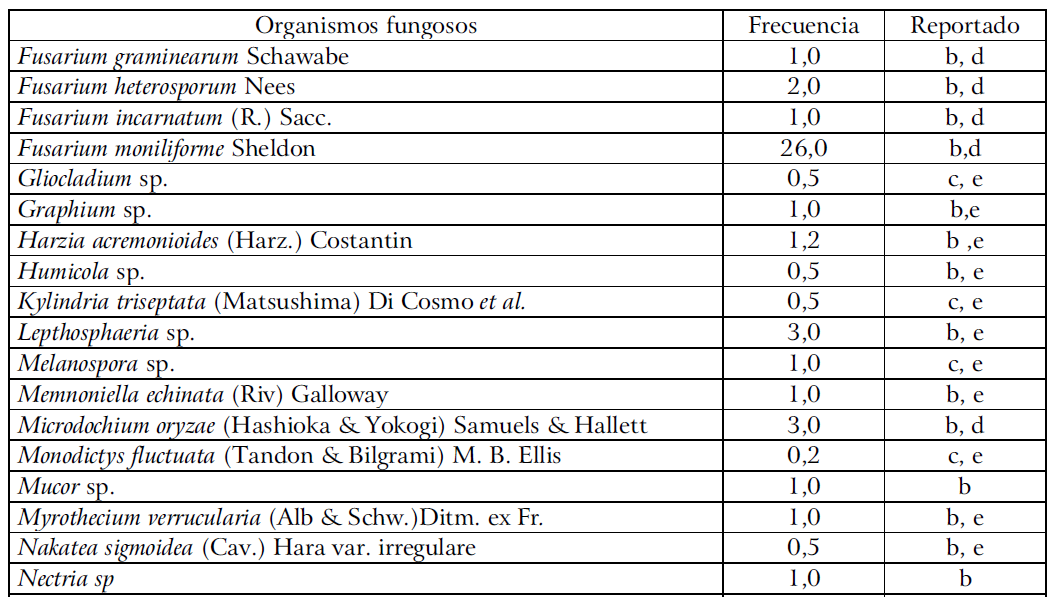
During 1997 to 2000, 154 samples of domestic seeds from sever provinces (Pinar of the Río, Habana, Cienfuegos, Sancti Spíritus, Ciego de Ávila, Camagüey, Granma and Santiago de Cuba) were processed and 341 samples from the Rice Research Institute were analized. Blotter test was employed as testing method and identification was carried out by taxonomic keys. 99 species belonging to 59 genera are reported. Of these, 54 species are not reported before in Cuba on rice seeds. There were Acrophialophora fusispora, Bipolaris bicolor, B. cynodontis, B. papendorfii, B. sorokiniana, Cephalosporium sp., Cerebella andropogonis, Cladosporium herbarum, C. oxysporum, Colletotrichum sp., Curvularia brachyspora, C. clavata, C. fallax, C. oryzae, C. penniseti, C. senegalensis, C. tuberculata, C. trifolii, Dorathomyces stemonitis, Ephelis oryzae, Exserohilum monoceras, Fusarium chlamydosporum, F. proliferatum, Gelasinospora sp., Gliocladium sp., Graphium sp, Harzia acremonioides, Humicola sp, Kylindria triseptata, Lepthosphaeria sp., Nakataea sigmoidea var, irregulare, Melanospora sp., Memnoniella echinata, Monodictys fluctuata, Myrothecium verrucaria, Nigrospora sphaerica, Phaeoisaria clematidis, Pithomyces chartarum, P. graminicola, P. maydicus, P. sacchari, Ramichloridium schulzerii, Scolecobasidium humicola, Scolecobasidiella avellanea, Scytalidium lignicola, Stachybotrys atra, Stachylidium bicolor, Stemphylium sp., Tetraploa aristata, Thermomyces lanuginosus, Tubercularia vulgaris, Verticillium sp, Ulocladium sp. y Zygosporium masonii. Of these ones, 20 are not reported on rice seeds anywere. It was showed also the ocurrence of these organisms in the samples.
Article Details

This work is licensed under a Creative Commons Attribution-NonCommercial 4.0 International License.
Those authors who have publications with this journal accept the following terms of the License Attribution-NonCommercial 4.0 International (CC BY-NC 4.0):
You are free to:
- Share — copy and redistribute the material in any medium or format
- Adapt — remix, transform, and build upon the material
The licensor cannot revoke these freedoms as long as you follow the license terms.
Under the following terms:
- Attribution — You must give appropriate credit, provide a link to the license, and indicate if changes were made. You may do so in any reasonable manner, but not in any way that suggests the licensor endorses you or your use.
- NonCommercial — You may not use the material for commercial purposes.
- No additional restrictions — You may not apply legal terms or technological measures that legally restrict others from doing anything the license permits.
The journal is not responsible for the opinions and concepts expressed in the works, they are the sole responsibility of the authors. The Editor, with the assistance of the Editorial Committee, reserves the right to suggest or request advisable or necessary modifications. They are accepted to publish original scientific papers, research results of interest that have not been published or sent to another journal for the same purpose.
The mention of trademarks of equipment, instruments or specific materials is for identification purposes, and there is no promotional commitment in relation to them, neither by the authors nor by the publisher.
How to Cite
References
Agarwal, P. C.; C. N. Mortesen; S. B. Mathur:1989. «Seed-borne Diseases and Seed Health Testing of Rice», Technical Bulletin no. 3, Phytopathological Papers no. 30, CAB, International Mycological Institute, 1989.
Anand, P.; R. Jagadiswari: «Interaction of Earhead Bug, Leptocorisa Acuta Thunb and Certain Pathogenic Fungi on Deterioration in Rice Grain Quality», Entomol. 25(1):55-60, 2000.
Benoit, M. A.; S. B. Mathur: «Identificación of Species of Curvularia on Rice Seed», The International Seed Testing Association. Series 2(B), 1970.
Bernal, B.; J. A. Díaz: «Incidence and Distribution of the Main Fungal Diseases of Pastures and Fodders at Two Habana Stations», Ciencia y Técnica en la Agricultura. Protección de Plantas. 11(1):99-112, 1988.
Bonman, J. M.: Compendium of Rice Diseases, The American Phytopathology Society, APS Press, 1992, p. 27.
Booth, C.: The Genus Fusarium, CMI, Kew, Surrey, Inglaterra, 1971.
––––: The Fusarium», CMI, Kew, Surrey, Inglaterra, 1977.
Carmichael, J. W.; W. B. Kendrick; I. L. Conners; L. Sigler: Genera of Hyphomycetes, The University of Alberta Press, 1980.
CBS: List of Cultures Fungi and Yeast, 33 rd Edition, 1994. Chidanbaram, P.; S. B. Mathur; P. Neergaard: «Identification of Seedborne Drechslera species»,. Friesia 10(3):165-207, 1973.
Ellis, M. B.: Dematiaceous Hyphomycetes, CMI, Kew, Surrey, 1971.
––––: More Dematiaceous Hyphomycetes, CMI, Kew, Surrey, 1976.
Fernández Roseñada, F.: «Catálogo de enfermedades de plantas cubanas», Ser. Agrícola no. 27, Inst. Invest. Tropicales, Academia de Ciencias de Cuba, 1973.
Groth, D.: Stackburn. Compendium of Rice Diseases. The American Phytopathology Society, p. 18-19, 1992.
Holulová-Jechová, Vera; A. Mercado Sierra. 1980. «Studies on Hyphomycetes from Cuba IV. Dematiaceous Hyphomycetes from the Province Pinar del Río», Ceska Mykologie. Separatum. Vol. 40, Praga, 1980, pp.142-164.
Lee, F. N.: Compendium of Rice Diseases, The American Phytopathology Society, 1992, pp.30-32.
Lee, S. C.; M. E. Alvenda; J. M. Bonman; E. A. Heinrichs: «Insects and Pathogens Associated with Rice Grain Dicoloration and Their Relationship in Philippines», Korean Journal of Plant Protection 25(2):107-112, 1986.
López Mesa, M. O.: «Contribución al estudio de la micobiota patógena de la caña de azúcar (Saccharum sp. híbrida) en Cuba y su diagnóstico». Resumen de la tesis presentada en opción al grado científico de Doctor en Ciencias Agrícolas, 1999.
Matsushima, T.: Icones Microfungorum Kobe, Japón, 1975.
Mercado Sierra, A.: «Hifomicetes demaciaceos de Cuba (1)», Acta Botánica Cubana, 1980a, pp. 1-5.
––––: «Lista preliminar de hifomicetos demaciaceos de la Estación Ecológica de Sierra del Rosario y zonas adyacentes», Acta Botánica Cubana no. 6: 1-6, 1981.
Mitov, N.: «Breve contribución al estudio de la microflora fitopatógena en Cuba», Serie Agrícola no.12, Academia de Ciencias de Cuba, 1969.
Nelson, P. E.; T. Toussoun; W. Marasas: Fusarium species. An Illustrated Manual for Identification, The Pennsylvania University Press and London, 1983.
Prot, J. C.: Compendium of Rice Diseases, The American Phytopathology Society, 1992, p 50.
Pupo, Elsie; Irma Heredia: «Lista de hongos asociados a semillas», Boletin Técnico no. 1, Instituto de Investigaciones de Sanidad Vegetal, Cuba.
Pupo, Elsie; Irma Heredia; A. Díaz: «Hongos presentes en las semillas de arroz y su influencia en la calidad de la semilla». I Encuentro Internacional de Arroz, Palacio de Convenciones, 9-11 de junio de 1998.
Rush, M. C.: Sheath Spot. Compendium of Rice Diseases, The American Phytopathology Society, 1992 .p. 23-24.
Sandoval, I.; M. O. López; T. Bonilla; Y. Tomás; J. M Santoyo; J. Parra: «Consideraciones sobre la enfermedad de la pudrición de la vaina por Sarocladium oryzae (Sawada) Gams & Hawks», I Encuentro Internacional de Arroz, Palacio de Convenciones, La Habana, 9 al 11 de junio de 1998.
Sjeyanandarajah, P.; S. N. Seneviratne: «Fungi Seed Borne in Rice (Oryza sativa) in Sri Lanka». Seed Science and Technology 19(3):561-569, 1991.
Sutton, B. C.:The Coelomycetes, CMI, Kew, Surrey, 1980.
Webster, R. K.; P. S. Gunnell: Compendium of Rice Diseases, The American Phytopathological Society, 1992.