
Ocimun basilicum l., nuevo hospedante en Cuba de pseudomonas cichorii
Article Sidebar
Main Article Content
Abstract
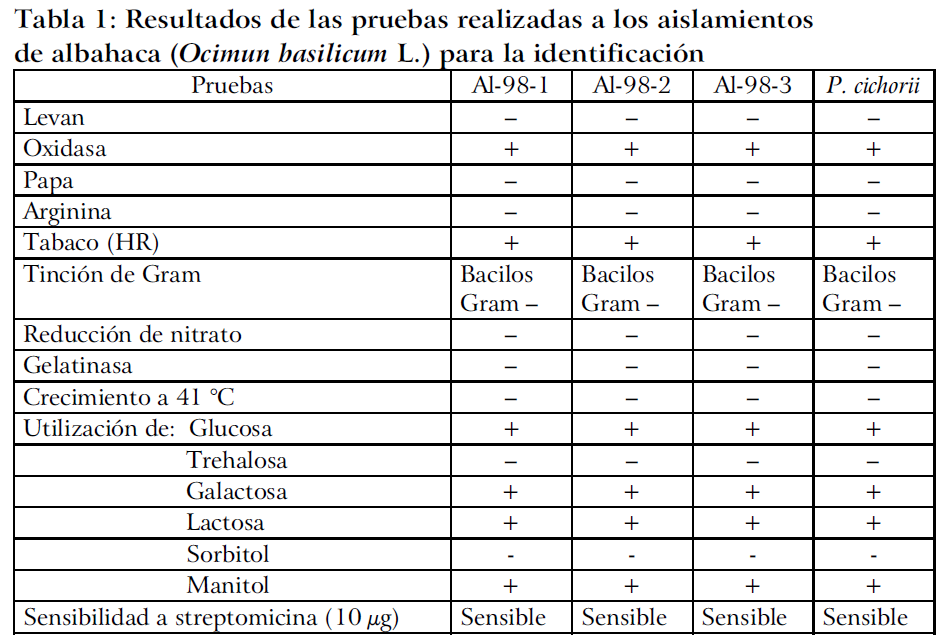
During 1998 wet brown spots appeared on leaves and stems of Ocimus basilicum plantations, in the experimental areas of Agricultural Sciences National Institute. Subsequent develop of symptoms caused plant rotting. Bacterial isolated obtained were analyzed by morphological, physiological, biochemical and pathogenicity tests. It was shown that causal agent was Pseudomonas cichorii. This is the first record of the disease for this crop in our country.
Article Details

This work is licensed under a Creative Commons Attribution-NonCommercial 4.0 International License.
Those authors who have publications with this journal accept the following terms of the License Attribution-NonCommercial 4.0 International (CC BY-NC 4.0):
You are free to:
- Share — copy and redistribute the material in any medium or format
- Adapt — remix, transform, and build upon the material
The licensor cannot revoke these freedoms as long as you follow the license terms.
Under the following terms:
- Attribution — You must give appropriate credit, provide a link to the license, and indicate if changes were made. You may do so in any reasonable manner, but not in any way that suggests the licensor endorses you or your use.
- NonCommercial — You may not use the material for commercial purposes.
- No additional restrictions — You may not apply legal terms or technological measures that legally restrict others from doing anything the license permits.
The journal is not responsible for the opinions and concepts expressed in the works, they are the sole responsibility of the authors. The Editor, with the assistance of the Editorial Committee, reserves the right to suggest or request advisable or necessary modifications. They are accepted to publish original scientific papers, research results of interest that have not been published or sent to another journal for the same purpose.
The mention of trademarks of equipment, instruments or specific materials is for identification purposes, and there is no promotional commitment in relation to them, neither by the authors nor by the publisher.
How to Cite
References
Almeida, M.; V. A. Malavolta: «Mandioquinha salsa, novo hospedeiro de Pseudomonas cichorii» Summa Phytopathologica 24:261, 1998.
Arencibia, Neyda: El cedro (Cedrela odorata), nuevo hospedante de Pseudomonas cichorii», Fitosanidad 4:23-27, 2000.
Castaño Zapata, J.: Prácticas de laboratorio de fitopatología, 2a. ed., MIPHEAD 95, El Zamorano, Honduras, 1994.
FITOMED: Plantas medicinales, Ed. Ciencias Médicas, La Habana, 1997.
Harrigan, W. F.; M. E. McCance: Laboratory Methods in Microbiology, Ed. León Academia, España, 1966.
Holcomb, G. E.; P. J. Cox: «Bacterial Leaf Spot of Basil: Pathogen Identification and Cultivar Evaluation», Lousiana Agriculture 39:2021, 1996.
King, E. D.; M. K. Wand; D. E. Rancy: «Two Simple Media for the Demonstration of Pyociaynin and Fluorescein», J. Lab. Clin. Med. 44:301-307, 1954.
Klement, Z. K. Rudolph; D. Sands: Methods in Phytobacteriology, Academic Kiado, Budapest, 1990.
Lelliot, R. A.; E. Billing; A. C. Hayward: «A Determinate Scheme for the Fluorescent Plant Pathogenic Pseudomonads», J. Appl. Bac. 29:470489, 1966.
Méndez, R.: «Paquete tecnológico integral sobre plantas medicinales», Forum Tecnológico sobre Manejo Integrado de Plantas, MIP 98, Matanzas, Cuba, 1998.
Misaghi, I.; R. O. Grogan: «Nutritional and Biochemical Comparisons of Plant Pathogenic and Saprophytic Fluorescent Pseudomonads», Phythopathology 59:1436-1450, 1969.
Palleroni, N. J.: «Genus Pseudomonas», Bergey´s. Manual of Systematic Bacteriology vol. 1, Baltimore, Londres 141-199, 1984.
Pérez, R.: «El tomate, nuevo hospedante de Pseudomonas cichorii». Resúmenes del I Forum Científico de Sanidad Vegetal, La Habana, 1979.
Rivera, N.; Z. Amat; M. Hevesi: «Pudrición foliar del pimiento en Cuba causada por Pseudomonas cichorii», Agrotecnia de Cuba 13(2):6772, 1981.
Sands, D. C.; M. N. Schroth; D. C. Hildebrand: «Taxonomy of Phytopathogenic Pseudomonads», J. Bact. 101:9-23, 1970.
Stefanova, M.; J. Ovies; N. Montero: «Aparición de Pseudomonas cichorii en plantas de Phaseolus lunatus», Cien. Tec. Agric. Protección de Plantas 10:61-70, 1987.
Thayer, P. L.: «The Effect of Temperature in Growth and Pathogenicity to Celery of Pseudomonas appi and Pseudomonas cichorii», Phytopathology 55:1365-1367, 1965.