
Influencia de los nutrientes sobre la velocidad de crecimiento de bacillus thuringiensis lbt-25
Article Sidebar
Main Article Content
Abstract
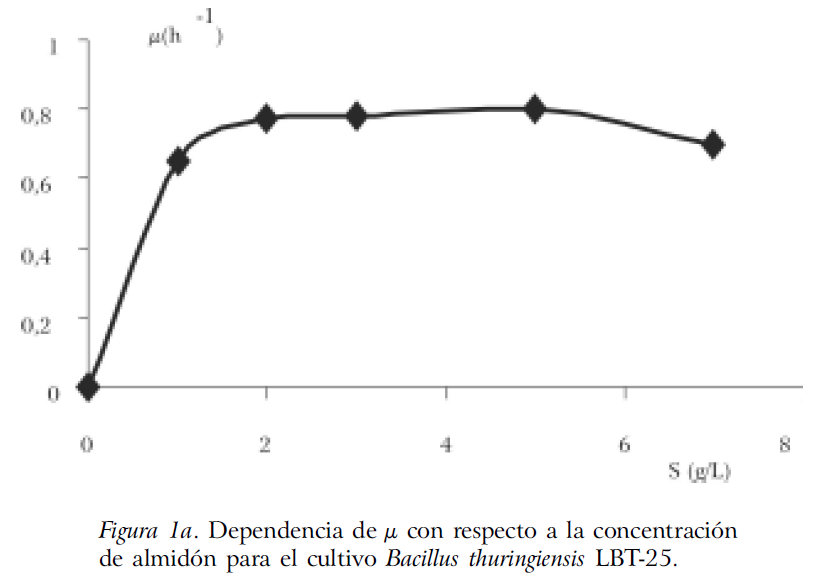
The necessary values were determined to optimize the cultural media M10 selected for the propagation of the Bacillus thuringiensis LBT-25 strain. It was used the pattern of not restricted growth and a 23 design. In the optimization of the M10 it should be taken like center of the experimental plan, concentrations of starch among 1-5 g/L; below 3 and 8 g/L for the soya flour and the yeast torula, respectively.
Article Details

This work is licensed under a Creative Commons Attribution-NonCommercial 4.0 International License.
Those authors who have publications with this journal accept the following terms of the License Attribution-NonCommercial 4.0 International (CC BY-NC 4.0):
You are free to:
- Share — copy and redistribute the material in any medium or format
- Adapt — remix, transform, and build upon the material
The licensor cannot revoke these freedoms as long as you follow the license terms.
Under the following terms:
- Attribution — You must give appropriate credit, provide a link to the license, and indicate if changes were made. You may do so in any reasonable manner, but not in any way that suggests the licensor endorses you or your use.
- NonCommercial — You may not use the material for commercial purposes.
- No additional restrictions — You may not apply legal terms or technological measures that legally restrict others from doing anything the license permits.
The journal is not responsible for the opinions and concepts expressed in the works, they are the sole responsibility of the authors. The Editor, with the assistance of the Editorial Committee, reserves the right to suggest or request advisable or necessary modifications. They are accepted to publish original scientific papers, research results of interest that have not been published or sent to another journal for the same purpose.
The mention of trademarks of equipment, instruments or specific materials is for identification purposes, and there is no promotional commitment in relation to them, neither by the authors nor by the publisher.
How to Cite
References
Agaisse, H. y Lereclus, D.: «How Does Bacillus thuringiensis Produce So Much Insecticidal Crystal Protein», J. Bacteriol. 177: 6027-6032, 1995.
Andrew´s: Substrate Inhibition Model of Cell Growth. Biochemical engineering. http: //www.cpi.edu/dept/chem.-eng/Biotech-Environ/ GrowPresent/inhib.htm. 2001.
Baum, J. M.; T. Malvar: «Regulation of Insecticidal Crystal Protein Production in Bacillus thuringiensis», Mol Microbiol. 18:1-12, 1995.
Beltrán, L.; S. Díaz; C. Verdugo; A. Zamora; G. Buitrago; N. Moreno: Culture Media Design for Fermentation of Bacillus thuringiensis. http://www.ibon.una1.edu.co/rr21.html. 2002.
Bravo, A; S. Sarabia; L. López; H. Ontiveros; C. Abarca; A. Ortiz; R. Quintero: «Characterization of Cry Genes in a Mexican Bacillus thuringiensis Strain Collection», Appl. Environ. Microbiol. vol. 64 (12):4965-4972, 1998.
Cerón, J.; A. Ortiz; R. Quintero; L. Guereca; A. Bravo: «Specific PCR Primers Directed to Identify CryI and CryIII Genes Within a Bacillus thuringiensis Strain Collection», Appl. Environ. Microbiol. vol.61(11):3826-3831, 1995.
Chávez, P. M. A.; J. Díaz; U. Pérez; J. Delfí: Temas de enzimología, t. 1, Edición Revolucionaria, La Habana, 1990.
Farrera, R. R.; F. Pérez-Guevara; M. de la Torre: «Carbon:Nitrogen Ratio Interacts with Initial Concentration of Total Solids of Insecticidal Crystal Protein and Spore Production in Bacillus thuringiensis HD-73», Appl. Microbiol. Biotechnol. 49:758-765, 1998.
Goldberg, I.: «Optimization of Medium for a High Yield Production of Spore Crystal Preparation of Bacillus thuringiensis Effective Against the Egyptian Cotton Leaf Worm Spodoptera litoralis Boisd», Biotechnol. Letters 2(10): 419-126, 1980.
Juárez-Peréz, V.; M. Ferrandis; R. Frutos: «PCR-Based Approach for Detection of Novel Bt. Cry Genes», Appl. Environ. Microbiol. vol. 63 (8):2997-3002, 1997.
Koch, J.: http: //www.helios.bto.edu.ac.uk/microbes/bt.htm, 1997.
Koller, C. N.; L. S. Bauer; R. M. Hollingworth: «Characterization of the pH-Mediated Solubility of Bacillus thuringiensis Var. San Diego. Native ä-endotoxin Crystals», Biochemical and Biophysical Research Communications 184(2).:692-699, 1992.
Núñez, R.: «Obtención del bioproducto IDO-225 para combatir derrames de petróleo en el mar». Tesis para optar por el título de Maestro en Ciencias Biológicas, 1998.
Pearson, D.; O. P. Ward: «Bio Insecticide Activity, Bacterial Cell Lyses and Proteolytic Activity in Cultures of Bacillus thuringiensis Subsp. Israelensis», J. Applied Bacteriol. 65(4):195-202, 1988.
Ramla, L.; A. S. Alí; M. W. Bassi: http://palmailis.mpob.gov.my/webpubs/ tt133.pdf. 2002.
Salama, H. S.; M. S. Foda; H. T. Dulmage; A. El-Sharaby: «Novel Fermentation Media for Production of Delta-Endotoxins from Bacillus thuringiensis», J. Invertebr. Pathol. 41:8-19, 1983.
Yudina, T. G.; O. V. Salamakha; E. V Olekhnovich; N. P. Rogstykh; N. S. Egorov: «Effect of Carbon Source on the Biological Activity and Morphology of Paraspore Crystal from Bacillus thuringiensis», Microbiology 61:402-407, 1992.