
Encuesta de los pseudocóccidos de Cuba. Resultados del periodo 2001-2002
Article Sidebar
Main Article Content
Abstract
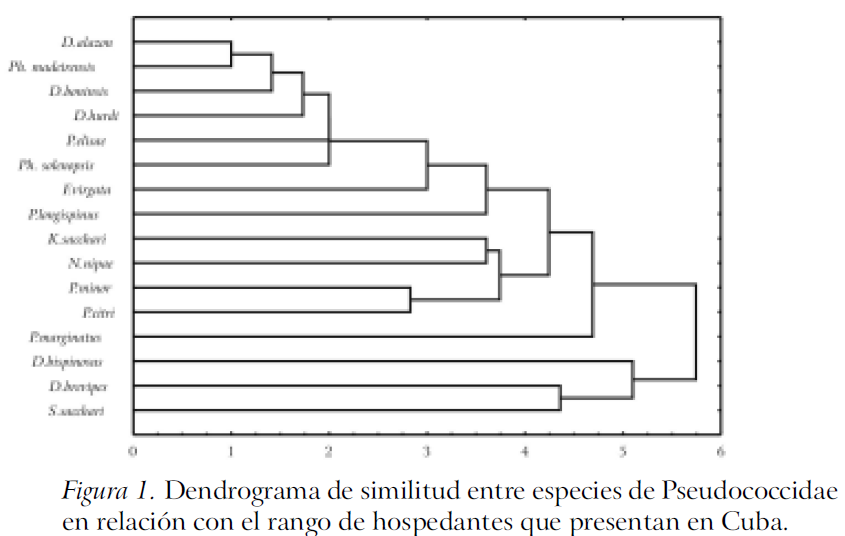
The Pink Hibiscus Mealybug, Maconellicoccus hirsutus (Green) is still a motive of concern in the Caribbean and particularly in Cuba. Our country which is still free from this noxious pest is developing a detection survey in order to mitigate its potential introduction risks. In this paper it is summarized the activity of the survey in the period comprised from year 2001-2002, in which 643 samples were processed. Up to date, the results indicate that M. hirsutus is not present in Cuba yet. On the other hand, it was confirmed the presence of 16 pseudococcid species, among which are: Dysmicoccus alazon Williams, D. boninsis (Kuwana), D. brevipes (Cockerell), D. hurdi McKenzie, D. bispinosus, Ferrisia virgata (Cock.), Kiritshenkella sacchari (Green) Nipaecoccus nipae (Maskell), Paracoccus marginatus W y G. de W., Phenacoccus solenopsis Tinsley, P. madeirensis Green), Planococcus citri (Risso), P. minor (Maskell), Pseudococcus elisae Borchsenius, P. longispinus (Targioni) y Saccharicoccus sacchari (Cockerell). The species D. hurdi And D. bispinosus are considered as new records to the country. S. sacchari, D. bispinosus and K. sacchari showed the highest interception rates, with 29, 20 and 15.4 % respectively, followed by N. nipae and D. brevipes, that were found mainly on sugarcane (Saccharum officinarum), plantain (Musa spp.), annonas (Annona spp.) and pineapple (Ananas comosus). It was determined the existence of 69 host plants for the family Pseudococcidae, which belong to 43 genera; 89 new host records were registered according to the host range of each species. A higher similarity degree was observed for the species: D. alazon, Ph. madeirensis, D. boninsis, D. hurdi and P. elisae, while the species S. sacchari, D. brevipes, D. bispinosus, and P. marginatus are less similar to the rest of the species encountered, although show some linkage among them.
Article Details

This work is licensed under a Creative Commons Attribution-NonCommercial 4.0 International License.
Those authors who have publications with this journal accept the following terms of the License Attribution-NonCommercial 4.0 International (CC BY-NC 4.0):
You are free to:
- Share — copy and redistribute the material in any medium or format
- Adapt — remix, transform, and build upon the material
The licensor cannot revoke these freedoms as long as you follow the license terms.
Under the following terms:
- Attribution — You must give appropriate credit, provide a link to the license, and indicate if changes were made. You may do so in any reasonable manner, but not in any way that suggests the licensor endorses you or your use.
- NonCommercial — You may not use the material for commercial purposes.
- No additional restrictions — You may not apply legal terms or technological measures that legally restrict others from doing anything the license permits.
The journal is not responsible for the opinions and concepts expressed in the works, they are the sole responsibility of the authors. The Editor, with the assistance of the Editorial Committee, reserves the right to suggest or request advisable or necessary modifications. They are accepted to publish original scientific papers, research results of interest that have not been published or sent to another journal for the same purpose.
The mention of trademarks of equipment, instruments or specific materials is for identification purposes, and there is no promotional commitment in relation to them, neither by the authors nor by the publisher.
How to Cite
References
Bruner, S. C.; L. C. Scaramuza; A. R. Otero: Catálogo de los insectos que atacan a las plantas económicas de Cuba, 2a. ed. revisada y aumentada, Instituto de Zoología, Academia de Ciencias de Cuba, La Habana, 1975.
Martínez, M. de los A.; M. Suris; I. Pérez; E. Blanco: «Biodiversidad de la fauna de pseudocóccidos: registro e identificación de nuevas especies, géneros y hospedantes en agroecosistemas cubanos». Trabajo presentado en opción al premio de Logro Científico de la Academia de Ciencias de Cuba, 2001.
Mendoza, F.; J. Gómez: Principales insectos que atacan a las plantas de importancia económica de Cuba, Ed. Pueblo y Educación, La Habana, 1982.
Pérez, I.; E. Blanco; A. M. Rodríguez: «Distribución y hospedantes de los principales géneros de Pseudococcidae detectados en la encuesta nacional». Memorias del IV Seminario de Sanidad Vegetal, Varadero, Matanzas, Cuba, 2001.
Pollard, G. V.: «Hibiscus Mealybug, Maconellicoccus hirsutus, in the Caribbean Sub-region: FAO’s Technical Assistance to the Solution of the Problem».
Watson, G.; L. Chandler: 1999. «Identificación de las cochinillas o piojillos harinosos de importancia en el Caribe», CAB International, Commonwealth Science Council, 1999.
Williams, D. J.; M. C. Granara de Willink: «Mealybugs of Central and South America», CAB International, 1992.
Williams, D. J.: «Four Related Species of Root Mealybugs of the Genus Rhizoecus from East and Southeast Asia of Importance at Quarantine Inspection (Hemiptera:Pseudococcidae)», Journal of Natural History 30:1391-1403, 1996.