
Evaluación del comportamiento de steneotarsonemus spinki en diferentes variedades de arroz durante los años 2000-2001
Article Sidebar
Main Article Content
Abstract
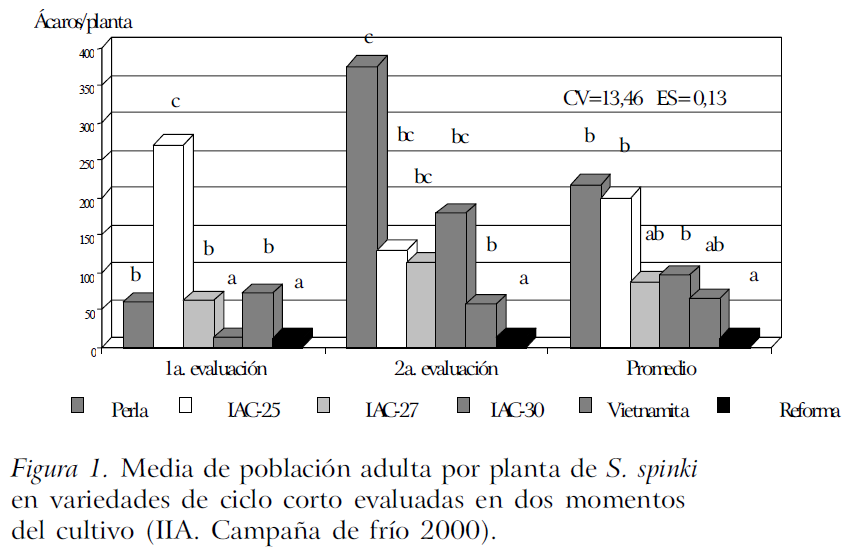
Since its detection in Cuba in 1997, Steneotarsonemus spinki Smiley (Acari: Tarsonemidae), is considered the most economic importance pest, for its association with high levels of emptiness grains and yields losses. The objective of this work was the screening of rice varietal resistance of this mites, wich induced sterility on rice, during 2000 in our country. A total of nine varieties were evaluated: six of short cycle (IACuba-25, IACuba-27, IACuba-30, Vietnamita y Reforma and the commercial variety Perla de Cuba) and three of half cycle (IACuba-28, IACuba-29 and J-104 as comparison pattern), in two experimental blocks and randomize with 3 replies. The number of mature mite inside leaf sheath was investigated in 2 moments, one at the beginning of the reproduction phase and the other before harvest, on 10 plants per reply. The experiment was repeated during 2001 with the best varieties. Integral analysis of best varieties behavior showed significant differences in the mite populations between the two years. IAC-28 showed the lowest population levels, with values between 2.4 and 1.7 mite/stem, which represented significant differences with the rest of varieties. The commercial variety of short cycle production (Perla) used as control, had the worst behavior during both evaluated years, with 40.1 and 78.3 mite/stem each year.
Article Details

This work is licensed under a Creative Commons Attribution-NonCommercial 4.0 International License.
Those authors who have publications with this journal accept the following terms of the License Attribution-NonCommercial 4.0 International (CC BY-NC 4.0):
You are free to:
- Share — copy and redistribute the material in any medium or format
- Adapt — remix, transform, and build upon the material
The licensor cannot revoke these freedoms as long as you follow the license terms.
Under the following terms:
- Attribution — You must give appropriate credit, provide a link to the license, and indicate if changes were made. You may do so in any reasonable manner, but not in any way that suggests the licensor endorses you or your use.
- NonCommercial — You may not use the material for commercial purposes.
- No additional restrictions — You may not apply legal terms or technological measures that legally restrict others from doing anything the license permits.
The journal is not responsible for the opinions and concepts expressed in the works, they are the sole responsibility of the authors. The Editor, with the assistance of the Editorial Committee, reserves the right to suggest or request advisable or necessary modifications. They are accepted to publish original scientific papers, research results of interest that have not been published or sent to another journal for the same purpose.
The mention of trademarks of equipment, instruments or specific materials is for identification purposes, and there is no promotional commitment in relation to them, neither by the authors nor by the publisher.
How to Cite
References
Almaguel, Lérida; J. Hernández; P. de la Torre; A. Santos; R. I. Cabrera; A. García; L. E. Rivero; Liudmila Báez; A. Ginarte: «Evaluación del comportamiento del ácaro Steneotarsonemus spinki (Acari:Tarsonemidae) en los estudios de regionalización desarrollados en Cuba», Fitosanidad 4 (1):15-19, 2000.
Lo, Ch.; Ch. Ho: «Ecological Observation on Rice Tarsonemid Mite, Steneotarsonemus spinki Smiley (Acari:Tarsonemidae)», Journal Agricultural Research 28 (3):181-192, China, 1979.
MINAGRI: «Informe sobre el vaneado de la panícula y la pudrición de la vaina de arroz producido por el complejo del ácaro Steneotarsonemus spinki y el hongo Sarocladium oryzae», La Habana, 1998.
Reissky, W. H.; E. Heinneechs; J. Letsinger; K. Moody; L. Fudler; T. Mew; T. Barrion: «Illustrated Guide to Management in Rice in Tropical Asia», INRI.228-232, Filipinas, 1985.
Ramos, Mayra; H. Rodríguez: «Steneotarsonemus spinki Smiley (Acari:Tarsonemidae): Nuevo Informe para Cuba», Revista de Protección Vegetal 13 (1):25-30, 1998.