
Thrips palmi karny en la agricultura cubana
Article Sidebar
Main Article Content
Abstract
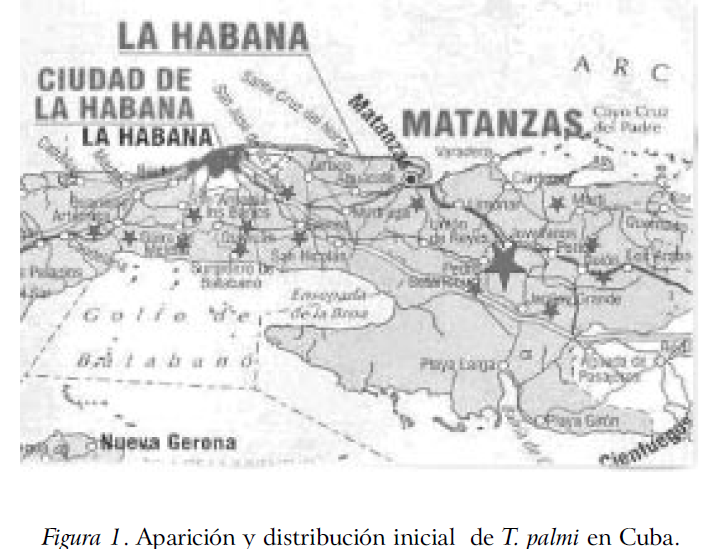
A survey system for detecting the presence of Thrips palmi Karny in crops, wild plants and weeds in Cuba was established with the aim to give response about the numerous interrogate according to the incidence of this pest. The diagnostics confirm was made in the Central Plant Quarantine Laboratory. A progressive expansion in the initial distribution was observed for different municipalities of Pinar del Río, Havana, Havana City and Matanzas provinces. At that period the incidence of T. palmi included a vast number of crops. The distribution to the east region occurs more slowly than the west regions in Cuba. The principal damages were found in the leaves and flowers of different species of plants. At the present the mostly infestation of T. palmi is find in potato and bean crops; nevertheless the light infestation category got the best proportion in relation with the total of affected areas, has been useless in the crops rest.
Article Details

This work is licensed under a Creative Commons Attribution-NonCommercial 4.0 International License.
Those authors who have publications with this journal accept the following terms of the License Attribution-NonCommercial 4.0 International (CC BY-NC 4.0):
You are free to:
- Share — copy and redistribute the material in any medium or format
- Adapt — remix, transform, and build upon the material
The licensor cannot revoke these freedoms as long as you follow the license terms.
Under the following terms:
- Attribution — You must give appropriate credit, provide a link to the license, and indicate if changes were made. You may do so in any reasonable manner, but not in any way that suggests the licensor endorses you or your use.
- NonCommercial — You may not use the material for commercial purposes.
- No additional restrictions — You may not apply legal terms or technological measures that legally restrict others from doing anything the license permits.
The journal is not responsible for the opinions and concepts expressed in the works, they are the sole responsibility of the authors. The Editor, with the assistance of the Editorial Committee, reserves the right to suggest or request advisable or necessary modifications. They are accepted to publish original scientific papers, research results of interest that have not been published or sent to another journal for the same purpose.
The mention of trademarks of equipment, instruments or specific materials is for identification purposes, and there is no promotional commitment in relation to them, neither by the authors nor by the publisher.
How to Cite
References
Cermeli, M.; A. Montagne: «Situación actual de Thrips palmi Karny (Thysanoptera:Thripidae) en Venezuela», Manejo Integrado de Plagas 29:22-23, Costa Rica, 1993.
Cermeli, M.; P. Morales; F. Godoy: «Plagas agrícolas introducidas en Venezuela y nativas poco conocidas en los últimos años». XVII Congreso Venezolano de Entomología. Maturín-Monagas, julio 2001, Venezuela, pp.16-25.
Denoyes, B.; D. Bordat; H. Bon de; P. Daly: «A New Pest of Vegetable Crops in Martinique:Thrips palmi (Karny)», Agronomie Tropicale 41 (2) 167-168, 1986.
FAO: «First Record of Thrips palmi in Continental United States», Plant Protection Bulletin, 39 (4), 188, 1981.
Honda, Y.; M. Kameya-Iwaki; K. Hanada; H. Tochihara; I. Tokashiki: «Occurrence of Tomato Spotted Wilt Virus in Watermelon in Japan», Technical Bulletin-ASPAC, Food and Fertilizer Technology Center No. 114, 14-19, 1989.
Kameya-Iwaki, M.; K. Hanada; Y. Honda; H. Tochihara: «A Watermelon Strain of Tomato Spotted Wilt Virus (TSWV-W) and Some Properties of Its Nucleucapsid (Abstract)». Proceedings of the 5th International Congress of Plant Pathology, 20-27 August 1988, Kyoto, Japón, 1988,
p. 65.Kawai, A.: «Studies on Population Ecology of Thrips palmi Karny. X. Differences in Population Growth on Various Crops», Japanese Journal of Applied Entomology y Zoology 30(1), 7-11, 1986.
Lewis, T.: «Flight and Dispersal», Thrips A Crop Pest, Institute of Arable Crops Research-Rothamsted, Harpenden, Herts,, Cab International, Inglaterra, 1997, pp. 175-196.
Nakazawa, K.: «New Thrips Pest in Japan», Sting 4, 16,1981.
Ovies, J.: «Intervención en la Mesa Redonda Instructiva: La Guerra Biológica de Estados Unidos contra Cuba», Tabloide Especial no. 29, 8 de diciembre, Juventud Rebelde, 2000.
Palenzuela, Emma: Guía climática abreviada para los especialistas de la agricultura, Instituto de Meteorología, Academia de Ciencias de Cuba, 1982.
Pantoja, A.; A. Segarra; H. Ruiz; S. Medina-Gaun: «Thrips palmi (Thysanoptera:Thripidae): a New Insect Pest for Puerto Rico», Journal of Agriculture of the University of Puerto Rico 72 (2), 327, 1988.
Roy, J. T.: Diccionario botánico de nombres vulgares cubanos, t. I y II, Estación Experimental Agronómica, Santiago de las Vegas, La Habana, 1962.
Salas, J.; M. Cermeli: «Manejo integrado del trips o piojito amarillo de la caraota Thrips palmi Karny en Venezuela», Fondo Nacional de Investigaciones Agropecuarias (FONAIAP), Ministerio de Agricultura y Cría, Venezuela, 1995.
Vázquez, L. L.; E. Rodríguez: «Plantas hospedantes de Thrips Palmi Karny (Thysanoptera:Thripidae) en Cuba», Fitosanidad 3 (3): 37-40,