
Pronóstico del Tizón Tardío (phytophthora infestant (mont.) de Bary) de la papa en Cuba. III relación entre los frentes fríos, la ocurrencia de períodos favorables y la aparición de los primeros brotes de la enfermedad
Article Sidebar
Main Article Content
Abstract
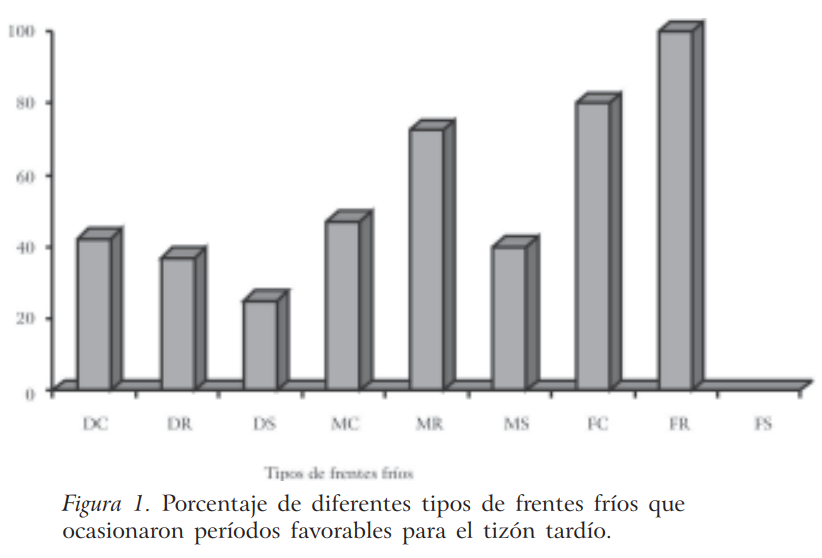
One of the most important climatic events in the cuban winter is cold fronts. They decrease temperature and increase the relative humidity and rains. These conditions make possible the occurrence and development of potato late blight. To know the relationship between these events and the disease, the following studies were carried out: classification and occurrence of the favorable periods and their incidence on diverse areas of the country where potato is grown; mathematics analyses of cold fronts-favorable periods occurrence relationship, as well as the relationship between cold fronts, favorable periods and apparition of the first symptoms of this disease. About fifty percent of cold fronts arriving in Cuba produce good conditions to the outbreak of the disease are present, however, because of the classification of these systems are conditioned by the intensity and features of winds, there isn’t a strong relation with any classification individually. There is a close relationship between the incidence of cold fronts, the occurrence of favorable periods for developing the disease and the detection of the first symptoms that it causes. We recommend classifying the cold fronts taking into account the agroecological requirements of relevant pest in Cuba.
Article Details

This work is licensed under a Creative Commons Attribution-NonCommercial 4.0 International License.
Those authors who have publications with this journal accept the following terms of the License Attribution-NonCommercial 4.0 International (CC BY-NC 4.0):
You are free to:
- Share — copy and redistribute the material in any medium or format
- Adapt — remix, transform, and build upon the material
The licensor cannot revoke these freedoms as long as you follow the license terms.
Under the following terms:
- Attribution — You must give appropriate credit, provide a link to the license, and indicate if changes were made. You may do so in any reasonable manner, but not in any way that suggests the licensor endorses you or your use.
- NonCommercial — You may not use the material for commercial purposes.
- No additional restrictions — You may not apply legal terms or technological measures that legally restrict others from doing anything the license permits.
The journal is not responsible for the opinions and concepts expressed in the works, they are the sole responsibility of the authors. The Editor, with the assistance of the Editorial Committee, reserves the right to suggest or request advisable or necessary modifications. They are accepted to publish original scientific papers, research results of interest that have not been published or sent to another journal for the same purpose.
The mention of trademarks of equipment, instruments or specific materials is for identification purposes, and there is no promotional commitment in relation to them, neither by the authors nor by the publisher.
How to Cite
References
Bourque, A. M. P.: «The Contribution of Modern Meteorology to Plant Disease Forecasting», Phytopathology, E. U., 55(9); sep. 1965.
De Weille, A. G.: «Laboratory Results Regarding Potato Bligth and Their Significance in the Epidemiology of Bligth», Eur. Potato Journal 6 (2):121-130, 1963.
Erwin, C. D.; O. K. Ribeiro: Phytophthora Diseases Worldwide, American Phytopathological Society, St. Paul, 1996.
Fry, E. W. et al.: «Historical and Recent Migrations of Phytophthora infestans: Chronology Pathways, and Implications», Plant Disease, E. U. 77:653-661, 1993.
Gómez, I. Guadalupe et al.: Manejo integrado del tizón tardío de la papa, La Habana, 1995.
González, P. Cecilia: «Precipitaciones asociadas a los frentes fríos», Boletín Hidroclimático Marino, La Habana, 1984a.
––––: «Algunas características de los sistemas frontales que produjeron precipitaciones notables en Cuba», Primer Seminario-Taller sobre Desastres Naturales, ACC, La Habana: ACC, 1984.
––––: «Climatología de los frentes fríos que han afectado a Cuba desde 1916-1917 hasta 1996-1997, ACC, La Habana, 1998.
Hirst, M. J.: «The Early History of Potato Late Blight Epidemic», Plant Pathology, Londres 4 (1): 44-50, 1955.
Keay, A. Margaret: «Delayed Sporulation of Phytophthora infestans on Infested Potato Shoots», Plant Pathology, Londres 2 (1): 68-71, 1953.
––––: «Further Observation on Delayed Sporulation of Phytophthora infestans on Infected Potato Shoots», Plant Pathology, Londres 3:8889, 1954.
Lapinel, B.: «Situaciones sinópticas predominantes sobre Cuba», Nuevo atlas nacional de Cuba, ACC, La Habana, 1989.
Lecha, B. L.; L. R. Paz; B. Lapinel: El clima de Cuba, Ed. Academia, La Habana, 1994.
Platt, H. W.; R. D. Peters; R. Hall: «Potato Late Blight-Pathogen Population in Canadá». Abstracts of Conference Papers, Posters and Demonstrations, 14-19 july, Netherlands: (s.n), 1996.
Sosa, H. Marina et.al.: Guía preliminar para los pronósticos del tiempo.Meteorología sinóptica, ACC, La Habana, 1984.