
Sigatoka negra causada por Mycosphaerella Fijiensis morelet en Cuba: impacto económico, resistencia de los clones y manejo de la enfermedad
Article Sidebar
Main Article Content
Abstract
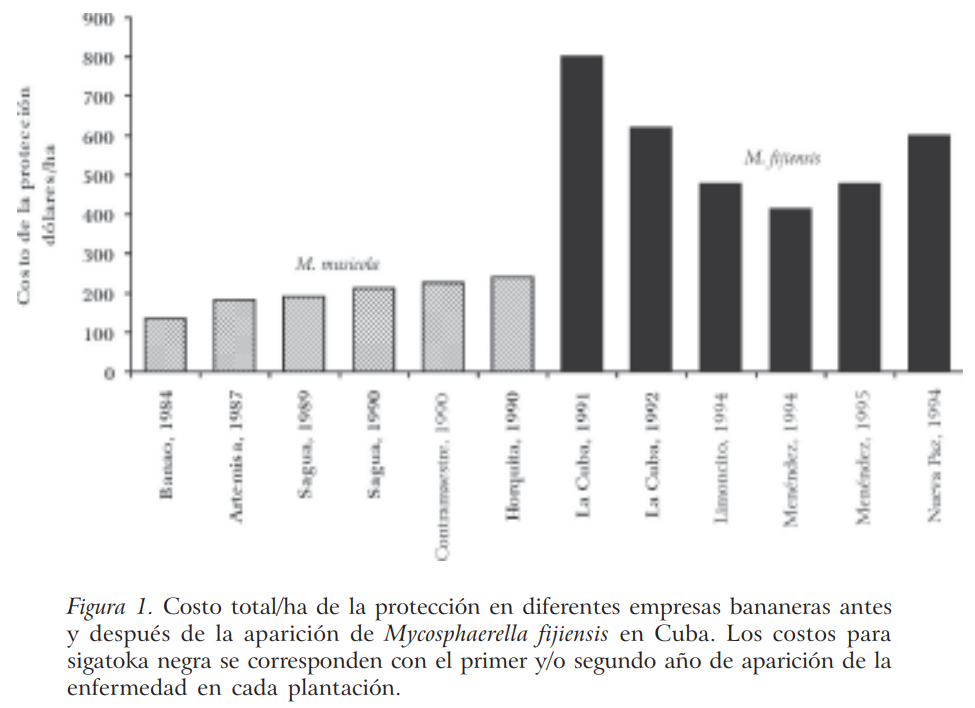
Black leaf streak/ Black Sigatoka disease (BS) caused by Mycosphaerella fijiensis, is the most harmful disease in Musa plantations in Cuba. Four years after its first report in 1990 the disease replaced Sigatoka disease (M. musicola) in most of the plantations of the country. During 1991 and 1992 until twenty three cycles of fungicides treatments/ year were carried out in Cavendish plantations and the costs of protection reached 15% of all costs of production. An integrated management system introduced in the main banana Cavendish plantations, based on cultural practices and bio-climatic forecasting of treatments with emulsions of systemic fungicides in oil, allowed to reduce the number of applications to thirteen till fifteen cycles/year and the costs of protection in a 40%. BS has caused an important impact on susceptible banana and plantain production in Cuba. In 1989 there were more than 40 thousand ha of plantains (AAB) and 14 thousand ha of Cavendish cultivars submitted to protection; at the end of 1995 they had been reduced in a 69 and a 51% respectively. In 1994, the cultivars FHIA 18, FHIA 03, FHIA 1-1, FHIA 2 and FHIA 21 with partial resistance to BS were introduced. At present there are 10 thousand of these cultivars planted and the imports of fungicides has been reduced in 80%. An inverse correlation between BS severity in the cultivar FHIA 18 and the K content and the rate of K/ (K+Ca+Mg) in soil has been observed. There are in progress studies of genetic variability of M. fijiensis populations with the objective of determine shifts in pathogenicity determined by the extensive plantation of resistant cultivars.
Article Details

This work is licensed under a Creative Commons Attribution-NonCommercial 4.0 International License.
Those authors who have publications with this journal accept the following terms of the License Attribution-NonCommercial 4.0 International (CC BY-NC 4.0):
You are free to:
- Share — copy and redistribute the material in any medium or format
- Adapt — remix, transform, and build upon the material
The licensor cannot revoke these freedoms as long as you follow the license terms.
Under the following terms:
- Attribution — You must give appropriate credit, provide a link to the license, and indicate if changes were made. You may do so in any reasonable manner, but not in any way that suggests the licensor endorses you or your use.
- NonCommercial — You may not use the material for commercial purposes.
- No additional restrictions — You may not apply legal terms or technological measures that legally restrict others from doing anything the license permits.
The journal is not responsible for the opinions and concepts expressed in the works, they are the sole responsibility of the authors. The Editor, with the assistance of the Editorial Committee, reserves the right to suggest or request advisable or necessary modifications. They are accepted to publish original scientific papers, research results of interest that have not been published or sent to another journal for the same purpose.
The mention of trademarks of equipment, instruments or specific materials is for identification purposes, and there is no promotional commitment in relation to them, neither by the authors nor by the publisher.
How to Cite
References
Anónimo: «Informe de la presencia desigatoka negra en Perú». Informe del Taller Manejo Integrado de la Sigatoka Negra del Plátano y el Banano, FAO-SENASA, TCP/PER/6610, Pucallpa, 20-23 de enero de 1997.
FAO: Production Yearbook 2001, vol. 55, Roma, 2001.
Firman, I. D.: «Susceptibility of Banana Cultivars to Fungus Diseases in Fiji», Trop. Agric., Trin. 49, 189-196, 1972.
Fouré, E.: «Stratégies de lutte contre la Cercosporiose noire des bananiers et des plantains provoquée par Mycosphaerella fijiensis Morelet. L’avertissement biologique an Cameroun. Evaluation des possibilités d’amélioration», Fruits 43 (5): 269-274, 1988.
Fouré, E.; M. Grisoni; R. Zurfluh: «Les Cercosporioses du bananier et leurs traitements. Comportement des variétés. II. Etude de la sensibilité des bananiers et plantains á Mycosphaerella fijiensis Morelet et des quelques caractéristiques biologiques de la maladie des raies noires au Gabon», Fruits 39: 365-378, 1984.
Fouré, E.; A. Melioum Pefoura; X. Mourichon: «Etude de la sensibilité variétale des bananiers et des plantains à Mycosphaerella fijiensis Morelet au Cameroun Caractérisation de la résistance au champ des bananiers appartenant a divers groups génétiques», Fruits 45: 339-345, 1990.
Frison, E. A.; S. Sharrock: «The Economic, Social and Nutritional Importance of Banana in the World», Abstracts of Papers of the International Symposium Bananas and Food Security, Douala Cameroon, 10-14 November, 1998.
Ganry, J.; J. P. Meyer: «La lutte contrôlée contre le Cercospora aux Antilles. Application de techniques d’observation et numération de la maladie», Fruits 27:767-774, 1972.
Hernández, A.; L. Pérez: «Reaction of Banana and Plantain Cultivars to Black Sigatoka Disease Caused by Mycosphaerella fijiensis, Morelet. Epidemiological Components of the Resistance», Fitosanidad 5 (3): 9-15, 2001.
Maciel-Cordeiro, Z. J., Pires de Matos, A. and de Oliveira e Silva, S., 1998. «Black Sigatoka confirmed in Brazil». INFOMUSA. 7: 31.
Mancebo, J.: «Les productions bananières au Repúblique Dominicaine. Abstracts of the International Symposium on Bananas and Food Security», Douala Cameroon 10-14 November, 1998.
Martinez, G.; R. Pargas; E. Manzanilla; M. Mu: «Report on Black Sigatoka Status in Venezuela in 1997», INFOMUSA 7: 31-32, 1998.
Meredith, D. S.; J. S. Lawrence: «Black Leaf Streak of Bananas (Mycosphaerella fijiensis). Susceptibility of Cultivars», Tropical Agriculture Trinidad 47: 275-287, 1970.
Monteverde, E. E.: «The Black Sigatoka Disease of Bananas and Plantains», Tropical Fruits Newsletter 20 (5-6), 1996.
Mourichon, X.; R. A. Fullerton: «Geographical Distribution of the Two species Mycosphaerella musicola Leach (Cercospora musae) and M. fijiensis (C. fijiensis), Respectively Agents of Sigatoka Disease and Black Leaf Streak Disease in Bananas and Plantains», Fruits 45:213-218, 1990.
Peng, H. X.; K. Sivasithamparam; D. W. Turner: «Chlamydospore Germination and Fusarium Wilt of Banana Plantlets in Suppressive and Conducive Soils Are Affected by Physical and Chemical Factors», Soil Biology and Biochemistry 31:1363-1374, 1999.
Pérez, L.: «Epifitiología de la mancha de la hoja del plátano (sigatoka) causada por Mycosphaerella musicola. Factores que influyen en el período de incubación y el desarrollo de la enfermedad en Cuba», Agrotecnia de Cuba 15 (1): 55-64, 1983.
Pérez, L.: «Sistema de pronóstico climático fenológico de los tratamientos contra la mancha de la hoja (sigatoka) causada por Mycosphaerella musicola en plátano fruta (Musa acuminata AAA)», Agrotecnia de Cuba 21(2): 35-46, 1989.
Pérez, L.: «Black Sigatoka Disease Control in Banana and Plantains Plantations in Cuba. Management of the Disease Based on an Integrated Approach», INFOMUSA, vol. 7 (1): 27-30, 1998.
Pérez L.; C. Torres; M. Delgado; F. Mauri: «Resistencia de diferentes clones de plátano a la Sigatoka causada por Mycosphaerella musicola Leach», Agrotecnia de Cuba 13 (2): 51-66, 1981.
Pérez, L.; F. Mauri; B. Barranco; G. García: «Efficacy of EBI’s Fungicides in the Control of Mycosphaerella fijiensis Morelet on Banana and Plantains with Treatments Based on Stage of Evolution of the Disease (Biological Warnings) in Cuba», Proceedings of the International Congress of Plant Pathology, Montreal, 1993a.
Pérez, L.; F. Mauri; A. Hernández; A. Porras: «Efficacy of a Biological Warning System for Timing Fungicide Treatments for the Control of Black Sigatoka Disease (Mycosphaerella fijiensis Morelet) in Banana Plantations in Cuba», Proceedings of the 6th International Congress of Plant Pathology, Montreal, 1993b.
Pérez, L.; A. Hernández; A., Porras; E. Abreu; A. Guzmán; J. Montero; A. Méndez; H. Martínez; A. Aguirre; R. Pupo: «Generalización del manejo integrado de sigatoka negra en bananos y plátanos. Balance de cuatro años de su aplicación en áreas de producción», XII Fórum de Ciencia y Técnica, 1997.
Pérez, L.; F. Mauri; A. Hernández; E. Abreu; A. Porras: «Epidemiología de la sigatoka negra (Mycosphaerella fijiensis Morelet) en Cuba. Pronóstico bioclimático de los tratamientos en bananos (Musa acuminata AAA)», Revista Mexicana de Fitopatología. 18 (1): 1526, 2000a.
Pérez, L.; A. Hernández; A. Porras: «Epidemiología de la sigatoka negra (Mycosphaerella fijiensis Morelet) en Cuba. Pronóstico bioclimático de los tratamientos en plátanos (Musa spp. AAB)», Revista Mexicana de Fitopatología 18: 27-35, 2000b.
Pérez, L.; A. Hernández; L. Hernández; M. Pérez: «Effect of Trifloxystrobin and Azoxystrobin on the Control of Black Sigatoka (Mycosphaerella fijiensis Morelet) on Banana and Plantains», Crop Protection 21:17-23, 2002.
Ploetz, R. C.; X. Mourichon: «First Report of Black Sigatoka in Florida», Plant Disease 83: 300, 1999.
Porras, A.; L. Pérez: «Efecto de la temperatura en el crecimiento de los tubos germinativos de las ascósporas de Mycosphaerella spp. causantes de Sigatoka en plátanos. Cálculo de las sumas de velocidades de desarrollo para el pronóstico de los tratamientos a partir de la temperatura máxima y mínima diarias en Cuba», INFOMUSA. 6 (2): 27-31, 1997.
Stover, R. H.; N. W. Simmonds: Bananas, Longman Scientific & Technical. Longman Group., Inglaterra, 1987.
Stover, R. H.: «Sigatoka Leaf Spots of Bananas and Plantains», Plant Disease Reporter 64: 750-756, 1980.
Vakili, N. G.: «Response of Musa acuminata Species and Edible Cultivars to Infection by Mycosphaerella musicola», Trop. Agric., Trin. 45: 13-22, 1968.
Vidal, A.: «Sigatoka negra en Cuba. En nuevos focos de plagas y enfermedades», Boletín Fitosanitario de la FAO 40: (1-2), 1992.