
Dinámica de población e indicadores ecológicos del ácaro Steneotarsonemus spinki Smiley 1968 (Acari:Tarsonemidae) en arroz de riego en Cuba
Article Sidebar
Main Article Content
Abstract
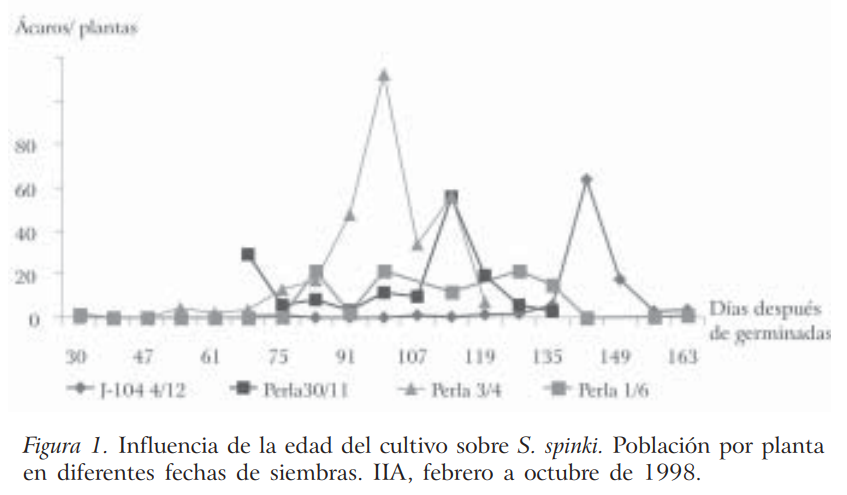
- spinki is known as economic important pest in rice (Oryza sativa L.) from the decade of ¨70s in the countries of the tropical Asia. At the end of 1997 it was detected in plantations of rice of the western region of Cuba, linked to the mushroom Sarocladium oryzae and a sintomatology characterized by a strong empty and spotted of the panicle and the leaf flag. The objective of this work was to study its population’s behavior in connection with different factors biotic and a biotic under the conditions of Cuba. In general, the works were carried out on cultivating Perla from Cuba, in plantation with watering in areas of the IIA, Havana from 11/1997 up to 2/1999. The behavior of this mite was determined by the phase phenology and the planting dates. The maximum population coincided with the emersion phase or exit of the panicle and it was bigger in the plantations germinated in March and July; among the 105 to 110 days in that of November; 91 at 100 in that of March, at the 80 in that of June and the J-104, variety of longer cycle, 63.6 mite / it plants to the 135 days. Two moments of minimum expression of growth were presented, of December to March for inferior temperatures to 240 C, and of July to September for the direct mortality that they cause the rains above the 60 mm in the dozen. The population of mites predators was 0 to 3.3 for plants, maximum at the end of the cycle of the summer planting; the entomophatogens exercised little influence. The necrosis and wither in the rachis of the panicle, it evidences interruption in the mechanism of circulation of the nutrients, in the moment of the flowering. Direct lesions were observed on the floral organ, the grain in formation, atrophies and blockade of the growth that they can be associated to the injection of toxic saliva during the feeding. The mite has not been detected starting from the maturation of the grain. Population’s structure is similar for adults, juvenile and eggs; at the end of the cycle, they decrease the females, the males increase, related with the dissemination and survival of the species. They prevail in the sheath of the leaves 3 and 4 starting from the 90 days of having germinated the plants. They are vulnerable to the negative effects of the atmosphere from the germination until end of ahijamiento and during the embroiling of the spike”, in this last one it can express their maximum capacity of dissemination of the mushroom S. oryzae.
Article Details

This work is licensed under a Creative Commons Attribution-NonCommercial 4.0 International License.
Those authors who have publications with this journal accept the following terms of the License Attribution-NonCommercial 4.0 International (CC BY-NC 4.0):
You are free to:
- Share — copy and redistribute the material in any medium or format
- Adapt — remix, transform, and build upon the material
The licensor cannot revoke these freedoms as long as you follow the license terms.
Under the following terms:
- Attribution — You must give appropriate credit, provide a link to the license, and indicate if changes were made. You may do so in any reasonable manner, but not in any way that suggests the licensor endorses you or your use.
- NonCommercial — You may not use the material for commercial purposes.
- No additional restrictions — You may not apply legal terms or technological measures that legally restrict others from doing anything the license permits.
The journal is not responsible for the opinions and concepts expressed in the works, they are the sole responsibility of the authors. The Editor, with the assistance of the Editorial Committee, reserves the right to suggest or request advisable or necessary modifications. They are accepted to publish original scientific papers, research results of interest that have not been published or sent to another journal for the same purpose.
The mention of trademarks of equipment, instruments or specific materials is for identification purposes, and there is no promotional commitment in relation to them, neither by the authors nor by the publisher.
How to Cite
References
Agromet. Boletín Agrometeorológico decenal, ISMET, CITMA, vol. 2023, 1997-2000.
Almaguel Rojas, Lérida: «Ácaros de importancia económica en Cuba», Boletín Técnico no. 2, La Habana, CID-INISAV, 1996.
Almaguel, Lérida; E. Botta; P. de la Torre et al.: «Bases ecológicas para el control de Steneotarsonemus spinki (Acari:Tarsonemidae) en el arroz (Oryza sativa L.)», II Encuentro Internacional de Arroz, La Habana, 2002.
Almaguel, Lérida; L. E. Rivero; M. Ramos et al.: «Comportamiento y pruebas preliminares de control del ácaro del vaneado del arroz Steneotarsonemus spinki (Acari: Tarsonemidae)», I Encuentro Internacional de Arroz, La Habana, 1998.
Cabrera, R. I.; J. Hernández; A. García; Y. Páez et al.: «Microorganismos patógenos del ácaro Steneotarsonemus spinki (Acari:Tarsonemidae) en Cuba», I Encuentro Internacional de Arroz, La Habana, 1998.
Cheng, Ch.; W. Su; K. Ho: «Bionomics of the Rice Tarsonemid Mite (Steneotarsonemus spinki) and its Relation to Rice Sterile-Grain Syndrome», A Review. Plant Prot. Bull.,Taiwán 22 (1): 63-82.1980.
Cheng, Ch.; K. C. Hsiao: «Bionomics of S. spinki Attacking Rice Plants in Taiwan», Recent Advances in Acarology I:111-117, 1979.
Fang, H. Ch.: «Studies on the Occurrence of Rice Tarsonemid Mite (Steneotarsonemus spinki) in Relation to Meteorological Factors and Its Control», Res. Bull. Taiwan Dist. Agric. Improve. Stn. 14:3949,1980.
INISAV: «Informe sobre el vaneado de la panícula y la pudrición de la vaina de arroz producido por el complejo del ácaro Steneotarsonemus spinki y el hongo Sarocladium oryzae, MINAGRI, La Habana, 1998.
Lo K., Ch.; Ch. Ch. Ho: «Ecological Observations on Rice Tarsonemid Mite, Steneotarsonemus spinki (Acarina:Tarsonemidae)», J. Agric.Res. China 28(3):181-192, 1979.
Ramos, M.; H. Rodríguez: Steneotarsonemus spinki Smiley (Acari: Tarsonemidae): nuevo informe para Cuba», Rev. Protección Veg. 13 (1):25-30,1998.
Ramos M.; H. Rodríguez; R. Chico: Ácaros biorreguladores (Acari: Gamasina) asociados a Steneotarsonemus spinki Smiley (Acari: Tarsonemidae) en el cultivo del arroz en Cuba», I Encuentro Internacional de Arroz, La Habana, 1998.
Reissky, W. H.; E. A. Heinnrechs; J. A. Letsinger; K. Moody; L. Fudler; T. W. Mew; T. Barrion: «Illustrated Guide to Management in Rice in Tropical Asia», INRI 228-232, Philippines, 1985.
Sandoval, I.; T. Bonilla: «El manchado del grano y la transmisión de Sarocladium oryzae (Sawada) Gams & Hawks. a través de las semillas de diferentes variedades de arroz», I Congreso Internacional de Arroz de Riego y Secano del Área del Caribe, Universidad de Camagüey, 1999.
Santos, A.; Lérida Almaguel; P. de la Torre; J. Cortiñas; Idalia Cáceres: «Duración del ciclo de vida en condiciones controladas del ácaro Steneotarsonemus spinki (Acari:Tarsonemidae) en arroz (Oryza sativa L.) en Cuba», I Encuentro Internacional de Arroz, La Habana, 1998.
Smiley, R. L. «Further Studies in the Tarsonemidae (Acarina)», Proceedings of the Entomological Soc. of Washington 69(2):127146, 1967.
Socorro, M.; L. Almaguel.: Informe de la misión técnica sobre el cultivo del arroz a la República Popular China, del 1-15 de noviembre de 1997.
Wei, L.Y. ; Y. S. Chow: «Preliminary Studies on Parasite of the Tarsonemid mite, Steneotarsonemus spinki Smiley», Plant. Prot. Bull.,Taiwán 22(1): 11-15, 1980.