
Enemigos naturales asociados a poblaciones de Paracoccus Marginatus William and granara de willink (homoptera: pseudococcidae) en Cuba
Article Sidebar
Main Article Content
Abstract
Paracoccus marginatus Williams and Granara de Willink is native specie from Mexico and Central America, also it was reported in Florida (USA).
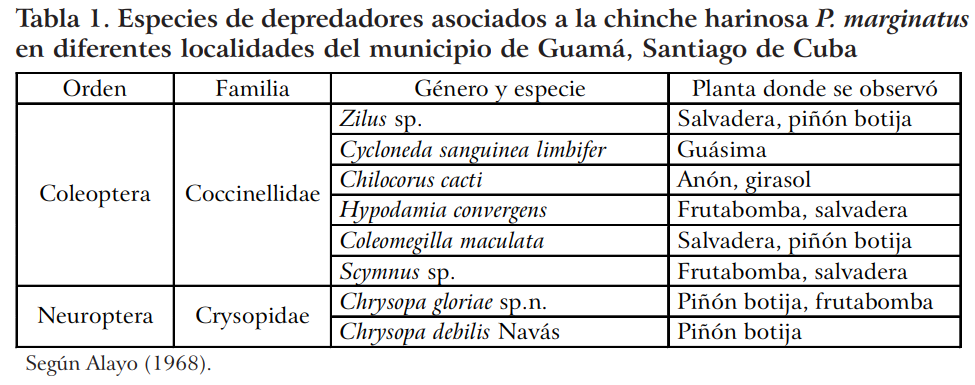
P. marginatus is known as papaya mealybug and it’s present in different crops, it considered a polyphagous specie and in its turn cause important damages in several plants, forestry, fruits, ornamentals, vegetables and other plants. For to know the natural enemies associated of P. marginatus in Santiago de Cuba province, samples were collected in different locations from that province. The samples were sent to Province Plant Health Laboratory to firstly confirm the presence of the scale insect through exemplary assembly, after proceeded to associate individual identification. Six coccinelids and two chrysopids species were determined in Santiago de Cuba province, all as predators, besides four species to concern Hymenoptera Order and two species to belong Diptera Order were identified as pest parasitoids.
Article Details

This work is licensed under a Creative Commons Attribution-NonCommercial 4.0 International License.
Those authors who have publications with this journal accept the following terms of the License Attribution-NonCommercial 4.0 International (CC BY-NC 4.0):
You are free to:
- Share — copy and redistribute the material in any medium or format
- Adapt — remix, transform, and build upon the material
The licensor cannot revoke these freedoms as long as you follow the license terms.
Under the following terms:
- Attribution — You must give appropriate credit, provide a link to the license, and indicate if changes were made. You may do so in any reasonable manner, but not in any way that suggests the licensor endorses you or your use.
- NonCommercial — You may not use the material for commercial purposes.
- No additional restrictions — You may not apply legal terms or technological measures that legally restrict others from doing anything the license permits.
The journal is not responsible for the opinions and concepts expressed in the works, they are the sole responsibility of the authors. The Editor, with the assistance of the Editorial Committee, reserves the right to suggest or request advisable or necessary modifications. They are accepted to publish original scientific papers, research results of interest that have not been published or sent to another journal for the same purpose.
The mention of trademarks of equipment, instruments or specific materials is for identification purposes, and there is no promotional commitment in relation to them, neither by the authors nor by the publisher.
How to Cite
References
Alayo, P.: «Los neurópteros de Cuba», Serie B. Poeyana, Academia de Ciencias de Cuba, La Habana, 1968.
Alayo, P.; L. R. Hernández: Introducción al estudio de los himenópteros de Cuba. Superfamilia Chalcidoidea, Academia de Ciencias de Cuba, La Habana, 1978.
Bruner, S. C.; L. C. Scaramuza; A. B. Otero: Catálogo de los insectos que atacan a las plantas de importancia económica en Cuba, 2a. ed., A. C. C. , 1945, p. 245.
Cross, A. E.; J. S. Noyes: Dossier on Anagyrus kamali Moursi, an Exotic natural Enemy for Biological Control of the Hibiscus Mealybug in the Caribbean, International Institute of Biological Control, Caribbean and Latin America Station, Gordon Street, Curepe. Trinidad and Tobago. West Indies, 1998,
Domínguez, F.: Plantas y enfermedades de las plantas cultivadas, Edición Revolución. La Habana, 1968, p. 272.
Greathead, D. J.: «Parasitoids in Classical Biological Control», Insect parasitoids, 13th Symposium of the Royal Entomological Society of London, Academic Press, Londres, 1986.
McAuley, Susan; J. Redding: «USDA Proposes Release of Foreing Wasps to Suppress Papaya Mealybug». http://www.aphis.usda.gov. APHIS Press Releases, june 29, Washington, E.U.
Mc Kenzie, H. L.: Mealybugs of California with Taxonomy, Biology and Control of North American Species (Homoptera:Coccoidea: Pseudococcideae) , California, University of California Press , E.U., 1967.
Moore, D.: «Agents Used for Biological Control of Mealybugs (Pseudococcidae)», Biocontrol News and Information, december, Inglaterra, 1988.
Noyes, J. S. (1998). «Mealybug parasitoids. Technology Transfer Workshop “Biological Control of Pink Hibiscus Mealybug” », Handouts. University of the Virgin Islands St. Thomas, U.S. Virgin Islands, june 1-4, 1998.
Quezada, R. T.: «Los parásitos de la Superfamilia Chalcidoidea», Boletín Técnico no. 9, Centro Nacional de Tecnología Agropecuaria, Santa Tecla, El Salvador, C. A., 1974.
Rodríguez, I.; M. A. Martínez: «Nuevo método de montaje para Pseudocóccidos», Boletín de Divulgación Resultados y Noticias del Trabajo Científico no. 2, MES, Cuba, 1992.
Vázquez, L.; E. Blanco: «Las chinches harinosas (Homoptera: Pseudococcidae) como plagas actuales en la subregión Caribe», conferencia impartida en el Curso Internacional de Sanidad Vegetal (CISAV 99), celebrado en La Habana, junio 1999, Instituto de investigaciones de Sanidad Vegetal.
Williams, D. J.; M. Granara de Willink: Mealybugs of Central and South America, CAB. International Wallingford., 1992.