
Evaluación de producto de Bacillus Thuringiensis para el control de la Varroasis
Article Sidebar
Main Article Content
Abstract
Varroa jacobsoni Oud is considered most important pest for apiculture in the world. Its control is realized using chemical agents as flumetrin (bayvarol, 4%), which generate resistance and residually problems in colmenas products. That is why; this product cannot be applied in honey cosecha season. Since 1996, this parasite was detected in our country in Havana and Matanzas provinces. In El Vidrio apiarium, located in La Lisa, nine colmenas were selected to demonstrate acaricide effect of a biological product of Bacillus thuringiensis with respect to formic acid, attend to quantity of desprendidas varroas and effect stability. Can be appreciate that only one B. thuringiensis application were maintained highest values in conteos of death mites.
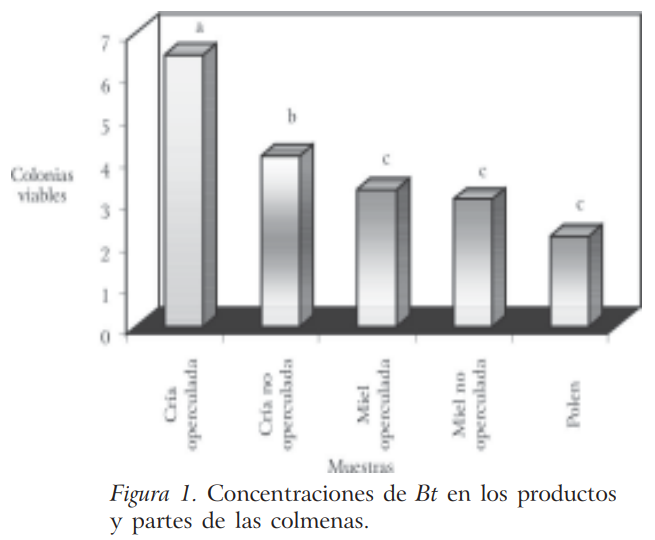
Sin embargo, with five applications of formic acid was obtained an irregular behaviour; most amounts of collected varroas were observed at 24 hours and at fourth application. After one year of application of the product in apiariums of National Botanical Garden, was determined the presence of the bacterium and its concentration in different parts of colmenas. Most concentration of viable spores were detected in operculated cría, follows of non-operculated and pollen. In honey non operculated was find minor concentration, which not surpassed 104 spores/mL. Those values are inside permissible range in honey Cuban normas for microorganisms presence.
Article Details

This work is licensed under a Creative Commons Attribution-NonCommercial 4.0 International License.
Those authors who have publications with this journal accept the following terms of the License Attribution-NonCommercial 4.0 International (CC BY-NC 4.0):
You are free to:
- Share — copy and redistribute the material in any medium or format
- Adapt — remix, transform, and build upon the material
The licensor cannot revoke these freedoms as long as you follow the license terms.
Under the following terms:
- Attribution — You must give appropriate credit, provide a link to the license, and indicate if changes were made. You may do so in any reasonable manner, but not in any way that suggests the licensor endorses you or your use.
- NonCommercial — You may not use the material for commercial purposes.
- No additional restrictions — You may not apply legal terms or technological measures that legally restrict others from doing anything the license permits.
The journal is not responsible for the opinions and concepts expressed in the works, they are the sole responsibility of the authors. The Editor, with the assistance of the Editorial Committee, reserves the right to suggest or request advisable or necessary modifications. They are accepted to publish original scientific papers, research results of interest that have not been published or sent to another journal for the same purpose.
The mention of trademarks of equipment, instruments or specific materials is for identification purposes, and there is no promotional commitment in relation to them, neither by the authors nor by the publisher.
How to Cite
References
Almaguel Rojas, Lérida: «Ácaros de importancia económica en Cuba», Boletín Técnico no. 2, CID INISAV, La Habana, 1996.
Bergy’s Manual of Determinative Bacteriology, 1984, pp. 530-536.
Bracey, S.; F. Fischer: «Initial Results of the Field Treatment of Honeybee Colonies Infested with Varroa jacobsoni using Acid in Hot Climates», Am. Bee J. 129:735-737, 1989.
Cantwell, G.E.; T. Lehnert; J. Fowler: «Are Biological Insecticides Harmful to the Honey Bee?», Am. Bee J. 112: 255-258, 1989.
Carreras, Bertha; Orietta Fernández-Larrea: «Identificación serológica de B. thuringiensis utilizando la técnica del DOT-ORO», Rev. Protección Vegetal 10:213-215, 1995.
Cobos, A.: «La varroasis en Andalucía», Albariza 1 (4): 49, 1986.
DeBarjac, H.; E. Frachon: «Classification of Bacillus thuringiensis strains», Entomophaga 35, 1990, pp. 233-240.
Galán J. L.; S. S. García; M. E. Santos; I. Quintero: Producción de B. thuringiensis en avances recientes en la biotecnología de Bacillus thuringiensis., Ed. Ciencia Universitaria, Universidad de Nuevo León, Monterrey, México., 1996, pp. 139-155.
Harrigan, W. F.; M. Mc Camce, M.: Métodos de laboratorio en microbiología, Ed. Acad. León. España, 1968, pp. 441-463.
Higes, M.; J. Llorente; A. Sanz, J. L. Pérez: «Rotenona. Eficacia acaricida en el control de la varroasis», Vida Apícola no.95, pp.45-48.
Imdorf, A.; J. D. Charrier; C. Maquelen; V. Kiicherman: «Alternative Varroa Control», American Bee Journal, 136 (3):189-193, 1996.
Krieg, A.: «Effectiveness of Beta Exotoxins on Tetranychus telarius (Acarina)», Jornal of Inv. Patholo. 12:478, 1968.
Márquez, María Elena: «Caracterización de un aislado de Bt (Berliner) con efecto acaricida», Rev. Protección Vegetal 12 (2): 89-932, 1997.
Miller, L. T.; T. Berger: «Bacteria Identification by Gas Chromatography of Whole Cell Fatty Acid», Hewlett-Packard Application Note: 228241, 1985.
Neal, J. W., Jr.; R. K. Lindquist; K. M. Gott; M. L. Casey: «Activity of the Thermostable B-exotoxin of B thuringiensis Berliner on T. urticae and T. cinnabarinus», J. Agric. Entomol. 4(1):33-40, 1989.
Ohba, M.: «Identification of Flagellar (H) Antigenic Subfactors in Bacillus thuringiensis H Serotypes 10, 18 and 24 Isolated in Japan», Letters Appl. Microbiol. 23(5):287-289, 1996.
Payne, J. R.; A. Bagley: «B. thuringiensis Isolates Controlling Acarides», US Patent International Publication, Number 5425510, 1995.
Pérez-Santiago; G. Valenzuela; R. González; M. Celina: «Empleo de aceite de orégano para el control de V. jacobsoni, parásito de abejas melíferas», XXXV Congreso Nacional de Entomología, Memorias, 2000.
Sánchez, U.; O. García; A. León; M. Márquez; O. Fernández: Comunicación personal, 1996.
Tony Stat: Paquete de programas para el procesamiento estadístico, Fac. Biología, Universidad de La Habana, 1985.
Trujillo, F. J. : Comunicación personal, 1996.
Vicado Mejía, E.: Uso del ácido fórmico y el timol en el control del ácaro V. jacobsoni en Yucatán, XIII Seminario Americano de Apicultura, Memorias, 26-28 de agosto, Durango, México, 1999.