
Efectividad de insecticidas químicos en el control de thrips palmi karny en el cultivo de la papa
Article Sidebar
Main Article Content
Abstract
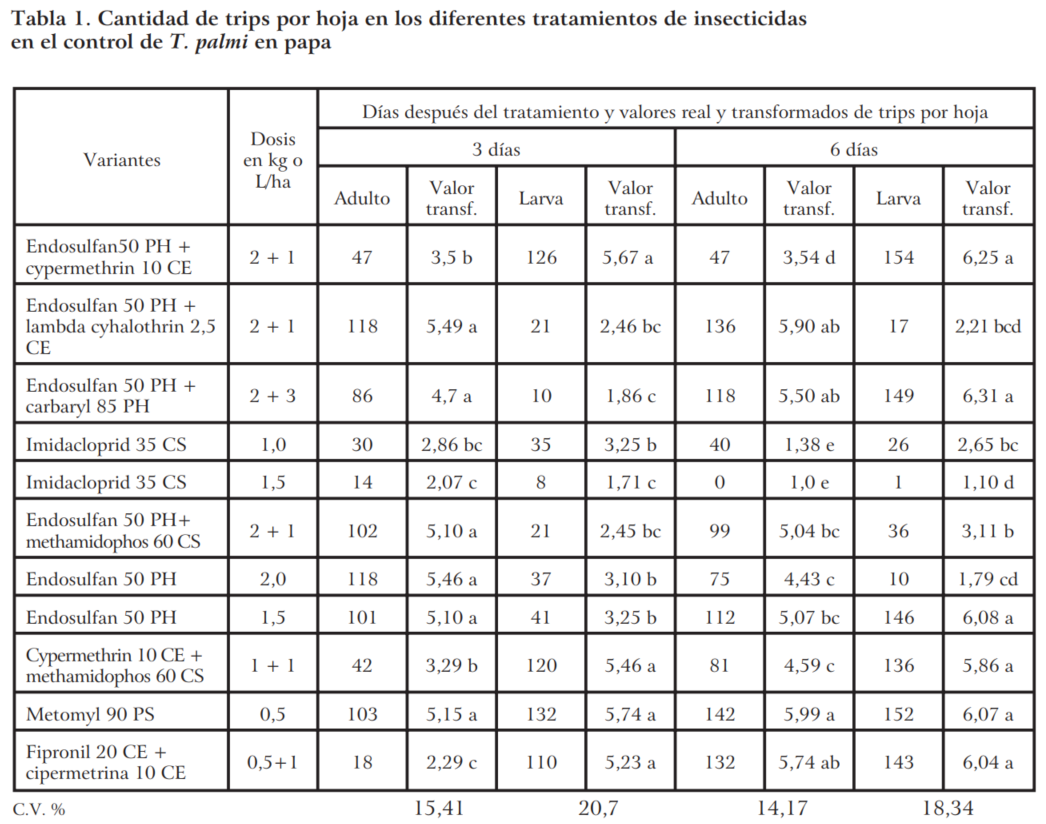
Thrips palmi Karny has become a serious pest problem in many crops, specially on potato (Solanum tuberosum L.) in Cuba. The farmer in order to control the pest has been using different pesticides, but in many cases, they don’t have good results. In order to know the efficacy of most commonly applied insecticides in potato crops was carried out a field experiment. The compounds evaluated were: endosulfan 50 WP + cypermethrin 10 EC a 2 + 1 kg/ha, endosulfan 50 WP + lambda cyhalothrin 2.5 EC a 2 + 1 kg/ha, endosulfan 50 WP + carbaryl 85 WP a 2 + 2 kg/ha, imidacloprid 35 SC a 1 y 1,5 kg/ha, endosulfan 50 WP + methamidophos 60 SC a 2 + 1 kg/ha, endosulfan 50 WP a 1,5 y 2,0 kg/ha, cypermethrin 10 EC + methamidophos 60 SC a 1 + 1 kg/ha, acetamiprid 20 WP a 0,2 kg/ha, metomyl 90 PS a 0,5 kg/ha, fipronil 20 EC + cipermetrina 10 EC a 0,5 + 1,0 g./ha The results indicate the compounds with greater percentage of efficiency for the control of T. palmi were imidacloprid 35 SC (1.0 and 1.5 l/ha) over adults and nymphs and fipronil 20 SC + cypermethrin 10 EC (0.5 + 1.5 l/ha) over nymphs, at three days from the application only. At sixth day imidacloprid 35 SC at high dosage was effectively only.
Article Details

This work is licensed under a Creative Commons Attribution-NonCommercial 4.0 International License.
Those authors who have publications with this journal accept the following terms of the License Attribution-NonCommercial 4.0 International (CC BY-NC 4.0):
You are free to:
- Share — copy and redistribute the material in any medium or format
- Adapt — remix, transform, and build upon the material
The licensor cannot revoke these freedoms as long as you follow the license terms.
Under the following terms:
- Attribution — You must give appropriate credit, provide a link to the license, and indicate if changes were made. You may do so in any reasonable manner, but not in any way that suggests the licensor endorses you or your use.
- NonCommercial — You may not use the material for commercial purposes.
- No additional restrictions — You may not apply legal terms or technological measures that legally restrict others from doing anything the license permits.
The journal is not responsible for the opinions and concepts expressed in the works, they are the sole responsibility of the authors. The Editor, with the assistance of the Editorial Committee, reserves the right to suggest or request advisable or necessary modifications. They are accepted to publish original scientific papers, research results of interest that have not been published or sent to another journal for the same purpose.
The mention of trademarks of equipment, instruments or specific materials is for identification purposes, and there is no promotional commitment in relation to them, neither by the authors nor by the publisher.
How to Cite
References
Abbott, W. S.: «A Methods of Computing the Effectiveness of An Insecticide (1925)», Unterstenhoefer. Las bases para ensayos fitosanitarios de campo, Pflanzewnschutz-Nachvrichten, Bayer 16-3, 1963.
ANON: «Potato. Pest.», Annual Report 1986, Mauritius Sugar Industry Research, 1987b.
Cermeli, M. A.; F. Montagne y Gooy: «Resultados preliminares en el control químico de Thrips palmi (Thysanoptera:Tripidae) en caraotas Phaseolus vulgaris L.», Bol. Entomol. Venez. N. S. 8 (1). 1993.
Díaz, F.; J. J. Espinal; J. de la Rosa: «Propuesta de estrategia de manejo de Thrips palmi (Karny) en la República Dominicana», Seminario Taller Estrategia para el Control del Thrips palmi, ISA, Santiago, República Dominicana, 1989.
Etienne, J.; X. van Watermuelen: «Effects of Insecticedes, Predation and Precipitation on Populations of Thrips palmi on Aubergine (Eggplant) in Guadalupe», Florida Entomologist 73 (2), 1990.
Guyot Guyot, J.: «Revue bibliographique et premières observations en Guadelupe sur Thrips palmi Karny», Agronomie 8 (7) 1988.
Hirose, Y.: «Pest Status and Biological Control of Thrips palmi in Southeast Asia», Talekar, N. S. (ed.): Thrips in Southeast Asia: Proceeding of a Regional Consultation Workshop, Bankok,Tailandia, 13 March 1991, Tainan, Taiwan; Asian Vegetable Research and Development Center, 1991.
Kawai, A.: «Control of Thrips palmi Karny in Japan», Jarq 24, 1990.
Kawai, A.; C. Kitamura: «Studies on Population Ecology of Thrips palmi Karny. Evaluation of Effectiveness of Control Methods Using a Simulation Models», Appl. Ent. Zool. (JP), v. 22(3) 1987.
Nagai, K.: «Effects of a Juvenile Hormone Mimic Material, 4-phenoxyphenyl (RS)-2-(Z-pyridyloxy) Propyl Ether, on Thrips palmi Karny (Thysanoptera:Thripidae) and Its Predator Orius sp. (Hemiptera:Anthocoridae)», Appl. Ent. Zool. (JP), v.25(2), 1990.
Nemoto, H.: «Pest Management Systems for Eggplant Arthropods: a Plant to Control Pest Resurgence Resulting from the Destruction of Natural Enemies», Jarq, v. 29(1), 1995.
Salas, J.; M. Cermeli: «Manejo integrado del trips o piojito amarillo de la caraota Thrips palmi Karny en Venezuela», Fondo Nacional de Investigaciones Agropecuarias (FONAIAP), Ministerio de Agricultura y Cría, Venezuela. 1995.
Walker, A. K.: «Pest Status», Thrips palmi, a Literature Survey whit an Annotated Bibliography, Ed. D. J. Girling. International Institute of Biological Control.