
Utilización de la resina XAD-2 en el análisis de plaguicidas en agua
Article Sidebar
Main Article Content
Abstract
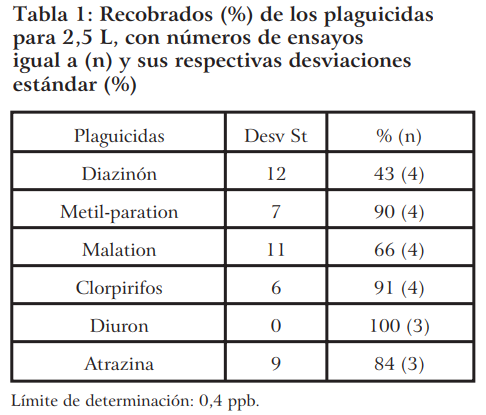
Solid phase extraction using Solid-phase extraction using XAD-2 resin to concentrate pesticides present in water samples was used. The work was done with pesticides, which can constitute a contamination risk for water. Residues level were determinate using gas chromatography with a NPD detector and for thin layer chromatography, to obtain good recovery and reproducibility. Was demonstrating to be an alternative method and permit considerable economy of solvent
Article Details

This work is licensed under a Creative Commons Attribution-NonCommercial 4.0 International License.
Those authors who have publications with this journal accept the following terms of the License Attribution-NonCommercial 4.0 International (CC BY-NC 4.0):
You are free to:
- Share — copy and redistribute the material in any medium or format
- Adapt — remix, transform, and build upon the material
The licensor cannot revoke these freedoms as long as you follow the license terms.
Under the following terms:
- Attribution — You must give appropriate credit, provide a link to the license, and indicate if changes were made. You may do so in any reasonable manner, but not in any way that suggests the licensor endorses you or your use.
- NonCommercial — You may not use the material for commercial purposes.
- No additional restrictions — You may not apply legal terms or technological measures that legally restrict others from doing anything the license permits.
The journal is not responsible for the opinions and concepts expressed in the works, they are the sole responsibility of the authors. The Editor, with the assistance of the Editorial Committee, reserves the right to suggest or request advisable or necessary modifications. They are accepted to publish original scientific papers, research results of interest that have not been published or sent to another journal for the same purpose.
The mention of trademarks of equipment, instruments or specific materials is for identification purposes, and there is no promotional commitment in relation to them, neither by the authors nor by the publisher.
How to Cite
References
Chirou, S.; A. Valverde; A. Fernández; D. Automatic Barceló: «Sample Preparation for Monitoring Ground Water Pollution by Carbamate Insecticidas and they Transformation Products», Journal of AOAC International 78(6):1346-1352, 1995.
Dierksmeier, G.: «Plaguicidas, residuos, efectos y presencia en el medio», Tesis de Doctorado, 1995.
EEC 80/778. Pesticides: Drinking Water Regulations, 1980.
Font, G.; J. J. C. Mañes; Y. Picó: «Solid-Phase Extraction in Muti Residue Pesticide Analysis of Water», Journal of Chromatograph 642: 135-161, 1993.
IAEA: «Determination of Selected Organophosphorus Contaminants in Estuaries and Coastal Water», Training course on Pesticide Analysis of Amarican Participants, IAEA-MEL/MESL, PPUNA, Costa Rica, 1-25, 1997.
Liska, L.; J. Krupcik; P. A. Leclercq: «The Use of Solid Sorbents for Directs Accumulation of Organic Compounds from Water Matrices. A Review of Solid-phase Extraction Technique», Journal of High Resolution Chromatography 12: 577-590, 1989.
Lista Oficial de Plaguicidas Autorizados: República de Cuba. Registro Central de Plaguicidas. 1995/96.
Lode, O.; O. Eklo; B. Hole; A. Svensen; A. Johnsen: «Pesticides in Precipitation in Norway», Science of the Total Environment 161: 421 -431, 1995.
Tolosa I. J.; W. Readman; L. E. Mee: «Comparison of the Performance of Solid-Phase Extraction Techniques in Recovering Organophosphosrous an Organochlorine Compounds from Water», Journal of Chromatography A, 725, 93-106, 1996.