
Movimiento de algunos plaguicidas en el suelo
Article Sidebar
Main Article Content
Abstract
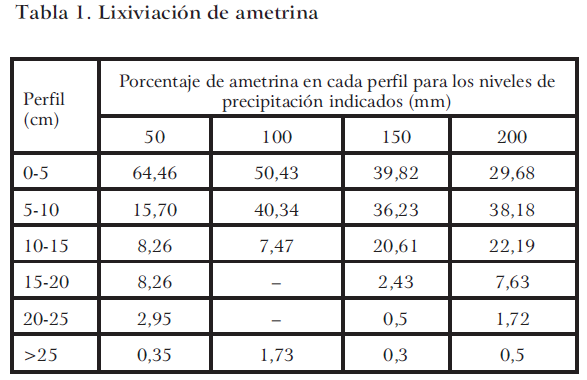
It was assessed the leaching and capillary upward movement of some pesticides directly applied to the soil. These compounds were: atrazine, ametryn, bromacil, propiconazole, disulfoton and metalaxyl. The leaching behaviour was investigated for ametryn, atrazine, bromacil, propiconazole and metalaxyl in the Red Ferralitic soil, while the last one and disulfoton were investigated likewise in the Ferralitic Cuarcitic soil. The upward capillary movement was assessed only in the Red Ferralitic soil for bromacil, ametryn and atrazine, while these last two pesticides and diuron were used to investigate the run-off in the same soil. The fundamental features of the Red Ferralitic soil were: organic matter content: 1,95%-2,1%; pH 6,6. The corresponding values for the Ferralitic Cuarcitic soil were: 1,98% and 7,3. The analytical determinations were carried out by reliable chromatographic methods for each pesticide. The leaching of ametryn was moderate while that of atrazine was strong, though this movement does not pose a significant threat of contamination to the underground water. Disulfoton leached moderately while suffered a strong degradation during the experiment. Propiconazole did not move in the soil, while metalaxyl and bromacil leached strongly in both investigated soils. The upward capillary movement was weak for ametryn and strong for both atrazine and bromacil. Finally, the run-off for atrazine was stronger than for ametryn and diuron, but in general the behaviour was not significant.
Article Details

This work is licensed under a Creative Commons Attribution-NonCommercial 4.0 International License.
Those authors who have publications with this journal accept the following terms of the License Attribution-NonCommercial 4.0 International (CC BY-NC 4.0):
You are free to:
- Share — copy and redistribute the material in any medium or format
- Adapt — remix, transform, and build upon the material
The licensor cannot revoke these freedoms as long as you follow the license terms.
Under the following terms:
- Attribution — You must give appropriate credit, provide a link to the license, and indicate if changes were made. You may do so in any reasonable manner, but not in any way that suggests the licensor endorses you or your use.
- NonCommercial — You may not use the material for commercial purposes.
- No additional restrictions — You may not apply legal terms or technological measures that legally restrict others from doing anything the license permits.
The journal is not responsible for the opinions and concepts expressed in the works, they are the sole responsibility of the authors. The Editor, with the assistance of the Editorial Committee, reserves the right to suggest or request advisable or necessary modifications. They are accepted to publish original scientific papers, research results of interest that have not been published or sent to another journal for the same purpose.
The mention of trademarks of equipment, instruments or specific materials is for identification purposes, and there is no promotional commitment in relation to them, neither by the authors nor by the publisher.