
Estrategias de lucha para evitar epidemias provocadas por la enfermedad Pata Prieta del tabaco en cuba
Article Sidebar
Main Article Content
Abstract
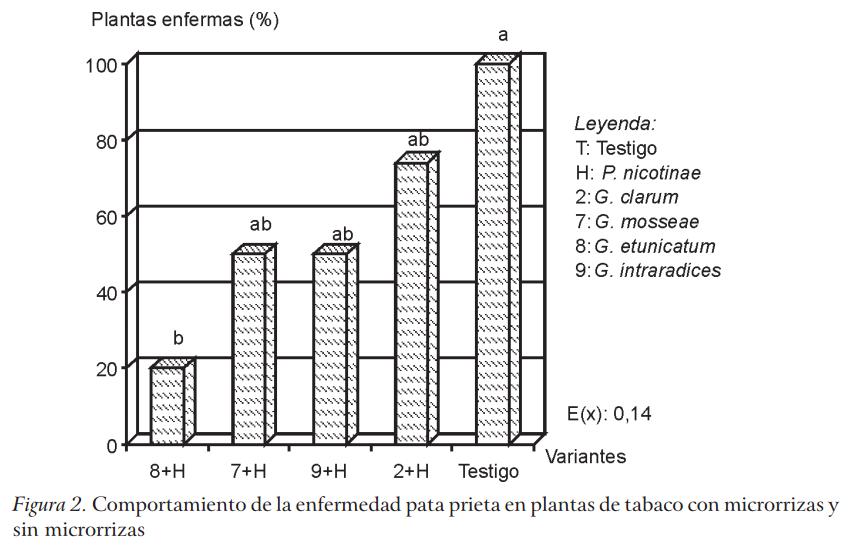
The black shank disease caused by the Phytophthora nicotianae fungus, is one of the main diseases that still affects tobacco cultivation in different areas of the world, in which loss of UDS 18 908 000 have been reported. Cuba is also involved in this problem, and from the beginning of this last century, this is a vital problem for tobacco’s agriculture. In order to avoid the risk of epidemics with their consistent economic lost, different studies about control alternatives were done that could allow establish a management of the disease, and diminish the risk of epidemics mainly in the seedbeds. A simple method, using tobacco leafs to the detection and quantification of the pathogen in soil was made. The role of the biotic and abiotic factors in the development of the epidemics was determined. The effectiveness of the different control methods was studied, such as field selection, solarization, crop rotation, the use of Trichoderma harzianum according to the level of soil infestation and Glomus spp. It was determined that the selection of areas for the seedbeds, and the crops rotation, contributed to reduce the affectation in the cultivation. Soil solarization for 30 days and the use of Glomus spp. were efficient to control the disease. The bait method was optimal to quantificate the soil infestation level before culture began, and to establish strategies in which the use of Trichoderma and fungicides applications were included. These results have allowed to establish the management of the disease, the reduction of the risk of epidemics, and lost in cultivation.
Article Details

This work is licensed under a Creative Commons Attribution-NonCommercial 4.0 International License.
Those authors who have publications with this journal accept the following terms of the License Attribution-NonCommercial 4.0 International (CC BY-NC 4.0):
You are free to:
- Share — copy and redistribute the material in any medium or format
- Adapt — remix, transform, and build upon the material
The licensor cannot revoke these freedoms as long as you follow the license terms.
Under the following terms:
- Attribution — You must give appropriate credit, provide a link to the license, and indicate if changes were made. You may do so in any reasonable manner, but not in any way that suggests the licensor endorses you or your use.
- NonCommercial — You may not use the material for commercial purposes.
- No additional restrictions — You may not apply legal terms or technological measures that legally restrict others from doing anything the license permits.
The journal is not responsible for the opinions and concepts expressed in the works, they are the sole responsibility of the authors. The Editor, with the assistance of the Editorial Committee, reserves the right to suggest or request advisable or necessary modifications. They are accepted to publish original scientific papers, research results of interest that have not been published or sent to another journal for the same purpose.
The mention of trademarks of equipment, instruments or specific materials is for identification purposes, and there is no promotional commitment in relation to them, neither by the authors nor by the publisher.
How to Cite
References
Blancard, D.: «Integrated Control and Tobacco Cultivation», Coresta. 2: 12-15,1995.
Bouhot, D.: «Recherches sur l’ecologie des champignons parasites dans le sol. V. Une technique selective d’estimation du potentiel infectieux des sols, terreaux et subtrats infestes par Pythium spp. Etudes qualitatives», Ann. Phytopathologie 7, 1975.
Camporota, P.: «Recherches sur l’ecologie des champignons parasites dans le sol. XV. Choix d’ une plante piege et caracterisation des souches de Rhizoctonia solani pour la mesure du potentiel infectieux des sols et substrats», Ann. Phytopathol 12:31-44. 1980.
CNSV: «Registro e información estadística fitosanitaria de los cultivos», Modelo 20-04. MINAGRI, La Habana, 1995.
Cuba. MINAGRI: «Instructivo técnico del cultivo del tabaco», La Habana, 1983.
––––: «Informe del grupo cultivo del tabaco», La Habana,1988.
––––: «Informe del grupo cultivo del tabaco», La Habana, 1997.
De Vay, J. E.: «Historical Review and Principles of Soil Solarization», Abstracts of First International Conference on Solarization, Amman-Jordan, (s.n.), 1990.
Espino, M. E.: Cuban’s Cigar Tobacco, T.F.H. Publication, Inc., Estados Unidos, 1996.
Fortnum, B. A.: Black Shank Control, South Carolina Tobacco Growers Guide, South Carolina: Alemson Extension, 1996.
Graham, J. H.; J. A. Menge: «Influence of Vesicular-Arbuscular Mycorrhizae and soil Phosphorus on Take-All Disease of Wheat», Plant Pathology 72 (1): 95-98, Inglaterra, 1982.
Jiang, J.; D. C. Erwin. «The Effects of Nutrients on Germination of Cold-Treated Oospores of Phytophthora cactorum in Vitro», Mycol. 97: 239-298, 1993.
Juárez-Palacios, C. et al.: «Thermal Sensitivity of Three Species of Phytophthora and the Effect of Soil Solarization on their Survival», Plant Disease 75: 1160-1164, Estados Unidos, 1991.
Katan, J., J. E. De Vay; A. Greenberger: «The Biological Control Induced by Soil Solarization», Vascular Wilt Diseases of Plants. Basic studies and control, Berlin: Springer-Verlag, 1989.
Kannwischer, M. E.; D. I. Mitchell: «The Influence of a Fungicide on the Epidemiology of Black Shank of Tobacco», (abstr.). Pro. Ann. Phytopathol. Soc. 3: 338, 1978.
Kucharek, T.: «Tobacco Disease Losses (Black Shank)», The proceeding of the tobacco worker’s Conference January 9-12, Florida: Inn. Busch Gardens Tampa, 1995.
Lucas, G. B.: Enfermedades del tabaco, Ediciones Revolucionarias, La Habana, 1965.
Shew, H. D.; G. B. Lucas: Compendium of Tobacco Diseases, American Phytopathological Society, St. Paul, Minn., 1991.
Todd, F. A.: «Flue-Cured Tobacco Producing a Healthy Crop», North Carolina: Parker Graphics, 1981.
Vidhyasekaran, P.: «Mycorrhiza Induced Resistance, a Mechanism for Management of Crop Diseases. Current Trends in Mycorrhizal Research», Proceeding of the National Conference on Mycorrhiza /B. L.
Jalali and H. J. Chand, India: Haryana Agricultural University, 1990.