
Impacto del manejo integrado de plagas en la recuperación de los enemigos naturales en el cultivo de la papa (solanum tuberosum l.)
Article Sidebar
Main Article Content
Abstract
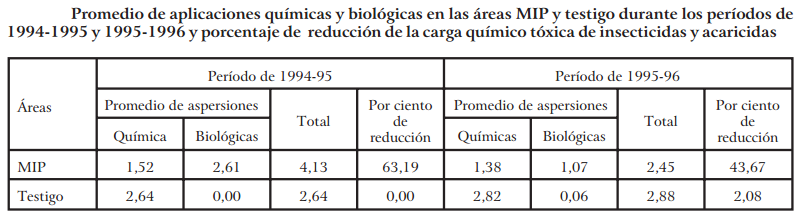
During the campaigns 1993-94, 1994-95 and 1995-96 were validated a flexible system of integrated handling of plagues in the cultivation of the potato in several places pilots in Havana, Cienfuegos and Ciego de Ávila province. The results demonstrated the feasibility of the application of the system in the different regions. The component insects and noxious acari admitted with effectiveness the application of tactical of biological fight, what allowed to diminish the chemical load to the cultivation and the manifestation and important natural enemies’ preservation completely decimated in the conventional systems as they are the coccinélidos depredadores (Cycloneda limbifer Csy., Coleomegilla cubensis Csy.) and the parasitoides himenópteros (Lysiphlebus testaceipes (Cress.),Encarsia spp., Heteroschema spp., Opius sp.)
Article Details

This work is licensed under a Creative Commons Attribution-NonCommercial 4.0 International License.
Those authors who have publications with this journal accept the following terms of the License Attribution-NonCommercial 4.0 International (CC BY-NC 4.0):
You are free to:
- Share — copy and redistribute the material in any medium or format
- Adapt — remix, transform, and build upon the material
The licensor cannot revoke these freedoms as long as you follow the license terms.
Under the following terms:
- Attribution — You must give appropriate credit, provide a link to the license, and indicate if changes were made. You may do so in any reasonable manner, but not in any way that suggests the licensor endorses you or your use.
- NonCommercial — You may not use the material for commercial purposes.
- No additional restrictions — You may not apply legal terms or technological measures that legally restrict others from doing anything the license permits.
The journal is not responsible for the opinions and concepts expressed in the works, they are the sole responsibility of the authors. The Editor, with the assistance of the Editorial Committee, reserves the right to suggest or request advisable or necessary modifications. They are accepted to publish original scientific papers, research results of interest that have not been published or sent to another journal for the same purpose.
The mention of trademarks of equipment, instruments or specific materials is for identification purposes, and there is no promotional commitment in relation to them, neither by the authors nor by the publisher.
How to Cite
References
Alayo, P.: Catálogo de los Himenópteros de Cuba, Dirección de Publicaciones de la ACC, La Habana, 1970.
Alayo, P.; L. R. Hernández: Introducción al estudio de los Himenópteros de Cuba, Dirección de Publicaciones de la ACC, La Habana, 1978.
Fernández, E.; C. Murguido; E. Candanedo: «Manejo integrado de plagas», Primer Seminario de Refrescamiento del Curso Internacional de Papa para Alumnos de América Latina y El Caribe, IAC-Holanda y MINAGRI,19 de febrero al 1 de marzo, La Habana, 1996.
Garrido, A.; J. Tarancon; T. del Busto: «Toxicidad de algunos plaguicidas en laboratorio sobre el parásito de áfidos Lysiphlebus testaceipes (Cresson) (Hym.: Aphididae)», Cong. N. SECH, Córdoba, 21- 25 de abril, 973-981, 1986.
Gómez, J.; R. Liens: «Fluctuación poblacional de Myzus persicae Sulz. (Homoptera, Aphidiidae) Durante una cosecha de papas en la región de Remedios, Cuba», Centro Agrícola 4 (2), 1977.
Hansen, M.: Escape del círculo vicioso de los plaguicidas. El reemplazo de los plaguicidas en los países en vías de desarrollo, Consumer Policy Institute, Consumers Union, New York, 1990.
Hardee, D. P., P. J. O’Brien; G. W. Elsen; G. L. Snodgrass: «Emergence and Survival of the Parasitoid Lysiphlebus testaceipes from Aphis gossypii Exposed to Aphicides». Southwestern Entomol., 15: 211- 216, 1990.
Hoy, M. A.: «Commentary: The Importance of Biological Control in US Agriculture», J. Sust. Agric., 1: 59-79, 1990.
Hughes, R. D.: «Biological Control in the Open Field», Aphis, Their biology, Natural Enemies and Control, vol, C (Eds. Minks, A. K. I Harrewijn, P.) Elsevier, Amsterdam, 167-198, 1989.
Izquierdo, J. I.; M. Longley: «Efecto de los plaguicidas sobre parasitoides de áfidos (Himenoptera: Aphidiidae)», Phytoma España 55: 34 -41, 1994.
Jiménez, S.: «Estudio bioecológico de Myzus persicae (Sulzer) en papa», Informe al Problema Principal Estatal 04, Instituto de Investigaciones de Sanidad Vegetal, Ministerio de la Agricultura, Cuba, 1980.
Jiménez, S. «Metodología para la señalización de los áfidos de la papa». Centro Nacional de Sanidad Vegetal, Ministerio de la Agricultura, La Habana, 1985.
La Rosa, Julia: «Abundancia poblacional y distribución en las plantas de papa de Aphis gossypii y Myzus persicae y sus enemigos naturales», IV Taller sobre Diagnóstico de Plagas, Sociedad Cubana de Zoología, Academia de Ciencias de Cuba, 1993.
Mendoza, F.; J. Gómez: Principales insectos que atacan a las plantas económicas de Cuba, Ed. Pueblo y Educación, La Habana, 1982.
Murguido, C.; D. Pla: «Metodología para la señalización de los minadores de las hojas de la papa», Centro Nacional de Sanidad Vegetal, Ministerio de la Agricultura, La Habana, 1992.