
Efecto de verticillium lecanii y beauveria bassiana sobre cotesia americanus (lepeletier) (hymenoptera:braconidae), parasitoide de larvas de la primavera de la yuca (erinnyis ello l.)
Article Sidebar
Main Article Content
Abstract
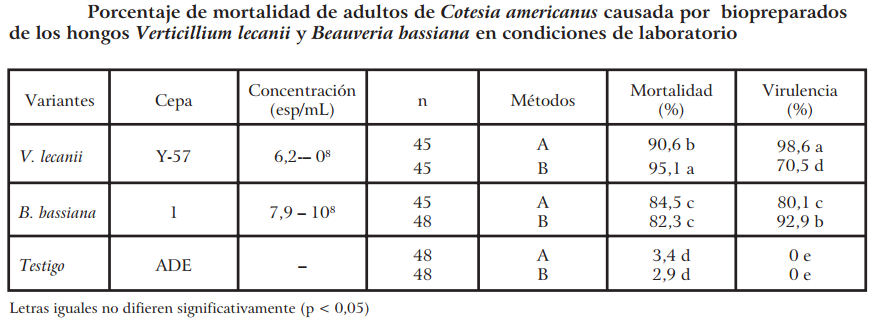
In order to determine the biopesticide effect of entomopathogenous fungi, Verticillium lecanii and Beauveria bassiana on adults of Cotesia americanus (Hymenoptera:Braconidae), parasitoid of the cassava moth (Erinnyis ello), laboratory tests were made by indirect methods: «cotton» spraying and filter paper spraying. It is shown that both fungi caused a 95,1% and 84,5% mortality to the parasitoid, respectively. Additionally, a high virulence of the fungi on the adult parasitoid could be proved (98,6% and 92,9%, respectively) and also different responses of these insects according to the methods and the entomopathogens used (p < 0,05). The parasitoid death occurred within 3-5 days after the contact with the sprayed surfaces and the fungus sporulation appeared in the humid chambers after 7-8 days. The results suggested that it is inconvenient to use these biopesticides in crops associated or adjacent to cassava protected with natural enemy conservation and management.
Article Details

This work is licensed under a Creative Commons Attribution-NonCommercial 4.0 International License.
Those authors who have publications with this journal accept the following terms of the License Attribution-NonCommercial 4.0 International (CC BY-NC 4.0):
You are free to:
- Share — copy and redistribute the material in any medium or format
- Adapt — remix, transform, and build upon the material
The licensor cannot revoke these freedoms as long as you follow the license terms.
Under the following terms:
- Attribution — You must give appropriate credit, provide a link to the license, and indicate if changes were made. You may do so in any reasonable manner, but not in any way that suggests the licensor endorses you or your use.
- NonCommercial — You may not use the material for commercial purposes.
- No additional restrictions — You may not apply legal terms or technological measures that legally restrict others from doing anything the license permits.
The journal is not responsible for the opinions and concepts expressed in the works, they are the sole responsibility of the authors. The Editor, with the assistance of the Editorial Committee, reserves the right to suggest or request advisable or necessary modifications. They are accepted to publish original scientific papers, research results of interest that have not been published or sent to another journal for the same purpose.
The mention of trademarks of equipment, instruments or specific materials is for identification purposes, and there is no promotional commitment in relation to them, neither by the authors nor by the publisher.
How to Cite
References
Anónimo: Manual para ensayos de campo en protección vegetal, Documenta CIBA-GEIGY, Basilea, Suiza, 1981, pp.33-34.
Burkova, L. A.; L. P. Krasavina: «Toxicidad de los biopreparados para los insectos útiles», Phytoma 85: 9-10, España, 1987.
Folegatti, M. E.; S. B. Alves; P. S. Machado: «Patogenicidad do fungo Metarhizium anisopliae (Metsch) Sorok para pupas e adultos de Apanteles flavipes (Cam.)», Pesquisa Agropecuaria Brasileira. 24 (2): 247-251, 1990.
Izquierdo, J.; J. Fortuny: «Validación de metodologías en la evaluación toxicológica de plaguicidas sobre fauna benéfica», Phytoma 92: 42-44, España, 1997.
Vázquez, L. L.; J. A. Castellanos: «Desarrollo del control biológico de plagas en la agricultura cubana», AgroEnfoque, 91: 14-15, Lima, Perú, 1997.
Viñuela, E.; J. A. Jacas; V. Marco; A. Adan; F. Budia: «Los efectos de, los plaguicidas sobre los organismos beneficiosos en agricultura y el grupo de trabajo de OILB plaguicidas y organismos beneficiosos. Insecticidas y acaricidas», Phytoma 55: 18-25, España, 1993.