
Evaluación de diferentes atrayentes e insecticidas para cebo formicida
Article Sidebar
Main Article Content
Abstract
Evaluation of different attractive and insecticides to formicide bait. The ant (Hymenoptera: Formicidae), like Solenopsis geminata (F.) and Paratrechina fulva Mayr., both are considerate at present insect with social, ecological and economic significance. Due to the typical habit of it, the fight against those ant results very difficult and for this
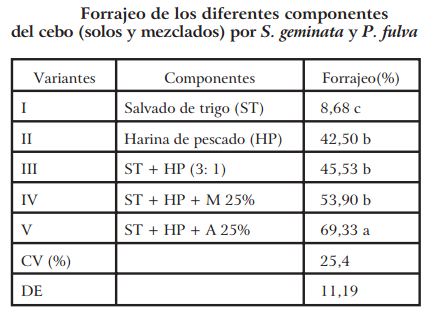
reason there are studies about insecticides bait as more viable alternative. Like attractive was evaluated different sugary solution (sugar, and molasses), as solid components (attractive and support), the wheat bran and fish flour, was used Carbaryl 80 WP as insecticide molecule. The trials of acceptation of the bait components and their effectiveness to both ant species were carrying out under Varadero Golf Field conditions in Matanzas. In relation to the attractiveness the better option of bait composition (p <0.05) was wheat bran + fish flour + sugar (63,33%). The insecticide bait effectiveness after five days to applied was 50% (under pluviometric affectations), it results suggest the potentiality of this bait in the fight against those insects.
Article Details

This work is licensed under a Creative Commons Attribution-NonCommercial 4.0 International License.
Those authors who have publications with this journal accept the following terms of the License Attribution-NonCommercial 4.0 International (CC BY-NC 4.0):
You are free to:
- Share — copy and redistribute the material in any medium or format
- Adapt — remix, transform, and build upon the material
The licensor cannot revoke these freedoms as long as you follow the license terms.
Under the following terms:
- Attribution — You must give appropriate credit, provide a link to the license, and indicate if changes were made. You may do so in any reasonable manner, but not in any way that suggests the licensor endorses you or your use.
- NonCommercial — You may not use the material for commercial purposes.
- No additional restrictions — You may not apply legal terms or technological measures that legally restrict others from doing anything the license permits.
The journal is not responsible for the opinions and concepts expressed in the works, they are the sole responsibility of the authors. The Editor, with the assistance of the Editorial Committee, reserves the right to suggest or request advisable or necessary modifications. They are accepted to publish original scientific papers, research results of interest that have not been published or sent to another journal for the same purpose.
The mention of trademarks of equipment, instruments or specific materials is for identification purposes, and there is no promotional commitment in relation to them, neither by the authors nor by the publisher.
How to Cite
References
Fontenla, J. L.; L. L. Vázquez; L. R. Hernández: «Un comentario sobre las hormigas locas (Paratrechina) cubanas, con énfasis en P. fulva», Cocuyo, La Habana, 2: 6-7, 1995.
Haines, I.; J. B. Haines. «Toxic Bait for the Control of Anoplolepsis longipes (Jerdon) (Hymenoptera: Formicidae). I-The Basic Attractant Carrier, Its Production and Weathering Properties», Bull. Entomol. Res, Inglaterra, 69 (1): 65-75. 1979.
Jeanne, R. L.; D. W. Davidson: «Population Regulation in Social Insects», Ecological Entomology, ed. B. Huffaker and L. Raabb. Berkeley, California, pp. 559-587,1984.
Mendoza, F.; J. Gómez: Principales insectos que atacan a las plantas económicas de Cuba, Ed. Pueblo y Educación, La Habana, 1982.
Registro Central de Plaguicidas. «Lista Oficial de Plaguicidas Autorizados», Centro Nacional de Sanidad Vegetal, Ministerio de la Agricultura, La Habana, 2000.
Wilson, E. O.: The Insect Societies, Cambridge, The Belknap Press of Harvard University, 1971.
Zenner de Polania, I.; N. Ruiz: «Uso de cebos contra la hormiga loca Nylanderia fulva (Mayr) (Hymenoptera:Formicidae)», Revista Colombiana de Entomología 8 (1-2): 24-31, 1982.
––––: «Hábitos alimenticios y relaciones simbióticas de la hormiga loca (Nylanderia fulva Mayr.) con otros artrópodos», Revista Colombiana de Entomología 1: 3-10, 1985.