
Hormigas invasoras y vagabundas de Cuba
Article Sidebar
Main Article Content
Abstract
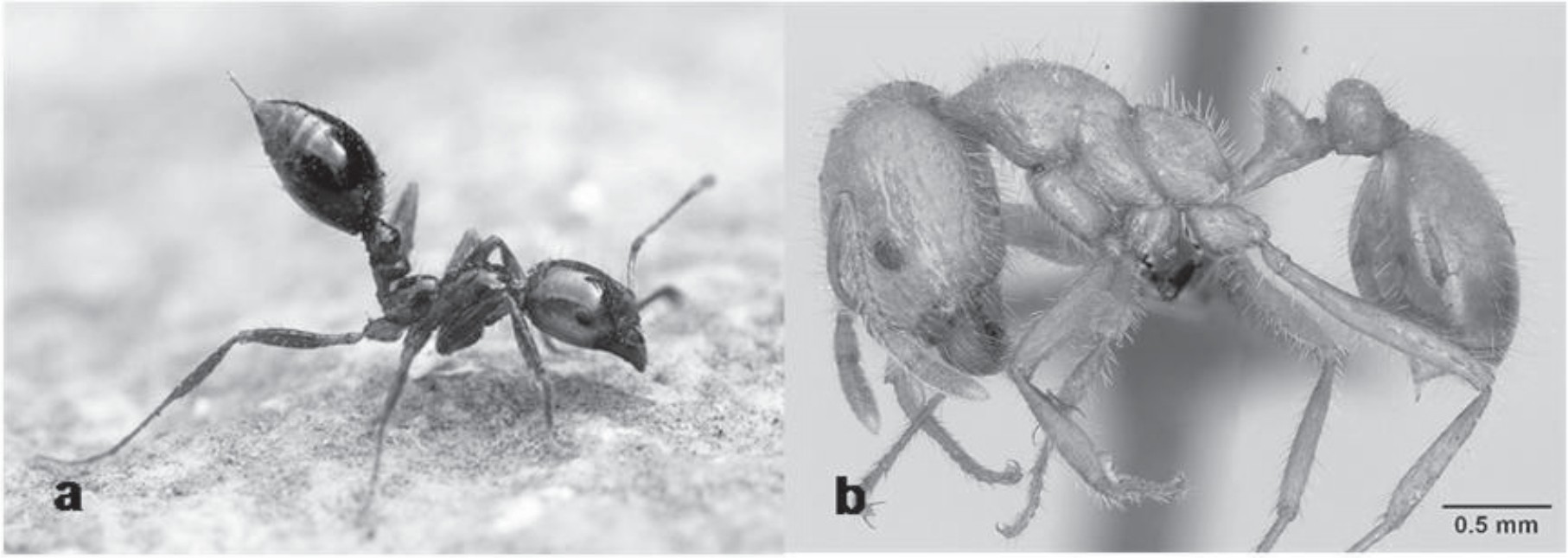
Invasive and tramps ants are recognized as main causes of disruption in biological communities, as well as they are potential or actual risk to biodiversity in different ecosystems. In this article Cuban invasive and tramp species of ants are referred, and some comments about worldwide effects of these ants are exposed. In addition, it is given a taxonomic key for the identification of two remarkable invasive ant species, Solenopsis invicta Buren and Linepithema humile Mayr. These ants are not already recorded from Cuba, although they are distributed in some nearby geographical areas.
Article Details

This work is licensed under a Creative Commons Attribution-NonCommercial 4.0 International License.
Those authors who have publications with this journal accept the following terms of the License Attribution-NonCommercial 4.0 International (CC BY-NC 4.0):
You are free to:
- Share — copy and redistribute the material in any medium or format
- Adapt — remix, transform, and build upon the material
The licensor cannot revoke these freedoms as long as you follow the license terms.
Under the following terms:
- Attribution — You must give appropriate credit, provide a link to the license, and indicate if changes were made. You may do so in any reasonable manner, but not in any way that suggests the licensor endorses you or your use.
- NonCommercial — You may not use the material for commercial purposes.
- No additional restrictions — You may not apply legal terms or technological measures that legally restrict others from doing anything the license permits.
The journal is not responsible for the opinions and concepts expressed in the works, they are the sole responsibility of the authors. The Editor, with the assistance of the Editorial Committee, reserves the right to suggest or request advisable or necessary modifications. They are accepted to publish original scientific papers, research results of interest that have not been published or sent to another journal for the same purpose.
The mention of trademarks of equipment, instruments or specific materials is for identification purposes, and there is no promotional commitment in relation to them, neither by the authors nor by the publisher.
How to Cite
References
Abbott, K. L.: «Supercolonies of the Invasive Yellow Crazy Ant, Anoplolepis gracilipes, on a Oceanic Island: Forager Patterns, Density and Biomass», Insectes Sociaux 52 (3): 266-273, Alemania, 2005.
Abbott, K. L.; Green, T. Peter: «Collapse of an Ant-Scale Mutualism in a Rainforest Current on Christmas Island», Oikos 116 (7): 1 238-1 246, Colombia, 2007.
Alfonso, J.; Y. Matienzo: «Las hormigas: Consideraciones ecológicas como base para su manejo en sistemas agrícolas», Memorias del Curso Internacional Producción y Conservación de Artrópodos Benéficos en Cuba, Instituto de Investigaciones de Sanidad Vegetal, La Habana, Cuba.
Alfonso, J.; Y. Matienzo; L. L. Vázquez: «Fauna de hormigas (Hymenoptera: Formicidae) asociadas a un sistema de producción agrícola urbano», Fitosanidad 14 (3): 153-158, La Habana, 2010.
Brandao, C. R.; R. S. Paiva: «The Galapagos ant Fauna and the Attributes of Colonizing Species», Exotic Ants, West View Press, San Francisco, EE. UU., 1994, pp. 1-10.
Bruner, S. C.; L. C. Scaramuzza; A. R. Otero: Catálogo de los insectos que atacan a las plantas económicas de Cuba, Instituto de Zoología, La Habana, 1975.
Castellón, M. C; A. Morales; L. Morales; N. Maza; D. Rodríguez; J. Alcázar: F. Cisneros: «Componentes para el manejo integrado del camote», Manejo integrado del gorgojo del camote o tetúan el boniato Cylas formicarius Fab. en Cuba, Centro Internacional de la Papa, Lima, Perú, 2001.
Castiñeiras, A.; S. Caballero; G. Rego; M. Gonzalez: «Efectividad técnico económica del empleo de la hormiga leona Pheidole megacephala (F.) en el control del tetuán del boniato Cylas formicarius elegantulus», Protección de Plantas, Suplemento, La Habana, 1982, pp. 101-109.
Castiñeiras, A.; S. Monteagudo; M. González: «Observaciones sobre Wasmannia auropunctata (Hymenoptera: Formicidae) en cultivos de cafeto y cítricos en Cuba», Protección Vegetal 2 (3): 234-238, Cuba, 1987.
Castiñeiras, A.; E. Ponce: «Efectividad de la utilización de Pheidole megacephala (Hymenoptera: Formicidae) en la lucha biológica contra Cosmopolites sordidus», Protección de Plantas 1 (2): 15-21,Cuba, 1991.
Chacon De Ulloa, P.: Hormigas urbanas. Introducción a las hormigas de la Región Neotropical, ,Instituto de Investigación de Recursos Biológicos Alexander Von Humboldt, Bogotá, Colombia, 2003, pp, 351-362.
Davidson, A.; M. L. Michael; A. Jennions; B. Adrienne: «The Most Studied ant Species Are Either Trampy or European», Ecology Letters 14: 419-431, EE. UU., 2011.
Davis, J. L.; R. K. Vander Meer; S. D. Porter: «Red Imported Fire Ants Expand Their Range Across the West Indies», Flo. Entomol. 84: 735-736, EE. UU., 2001.
Dayrup, M.: «An Updated List of Florida Ants (Hymenoptera: Formicidae)», Flo. Entomol. 86: 43-48, EE. UU., 2003.
Della, L.: «Hormigas de importancia económica en la región Neotropical», Introducción a las hormigas de la Región Neotropical, Instituto de Investigación de Recursos Biológicos Alexander Von Humboldt, Bogotá, Colombia, 2003, pp. 337-350.
Diario Libre: «Hormigas atacan Haití», martes 15 de julio de 2008, http://www.murdererworld.com/hormigas-gigantes-atacan-haiti (consul- tado en junio de 2011).
Fontenla J. L.: «Mirmecocenosis (Hymenoptera: Formicidae) de la caña de azúcar, cítricos y cafeto en Cuba», AvaCient 3: 26-31, México, 1993.
Fontenla, J. L.: «Reflexiones sobre las hormigas vagabundas de Cuba», Cocuyo, 3: 11-22, Cuba, 1995.
Fontenla, J. L.; L. L. Vázquez; L. R. Hernández: «Un comentario sobre las hormigas locas (Paratrechina) cubanas, con énfasis en P. fulva», Cocuyo 2: 6-7, Cuba, 1995.
Fontenla, J. L.: «Mirmecofauna del Jardín Botánico Nacional», Cocuyo 8: 8-10, Cuba, 1999.
Forys, E.; C. R. Allen: «The Impacts of Sprawl on Biodiversity: the ant Fauna of the Lower Florida Keys», Ecology and Society 10: 25-31, Canadá, 2005.
Holway, D. A.; L. Lach; A. V. Suarez; N. D. Tsutsui; J. Ted: «The Causes and Consequences of ant Invasions», Annu. Rev. Ecol. Syst. 33: 181-233, EE. UU., 2002,
Invasive Ants Home Page: http://www.landcareresearch.co.nz/ research/biocons/invertebrates/Ants/invasive_ants/index.asp (consultado en junio de 2011).
Jansson, R. K.: «Biological Control of Cylas spp. in Sweet Potato Pest Management. A Global Perspective», Westview Press, Boulder, Colorado, EE. UU., 1991, 169-201.
Loope, L. L.; P. D. Krushelnycky: «Current and Potential Ant Impacts in the Pacific Region», Proc. Hawaiian Entomol. Soc. 39: 69-73, EE. UU, 2007.
Lowe, S.; M. Browne; S. Boudjelas; M. Poorter: «100 de las especies exóticas invasoras más dañinas del mundo», Selección del Global Invasive Species Database, Aliens, www.issg.org/booklet.pdf (consultado en diciembre de 2010).
Matienzo, Y.; J. Alfonso; L. L. Vázquez: «Caracterización de la mirmecofauna y su relación con las prácticas adoptadas en un sistema de producción agrícola urbano», Fitosanidad 14 (4): 219-227. La Habana, 2010.
Matt, W.: «Ant Mega-Colony Takes Over World», Earth News (BBC News). http://www.news.bbc.co.uk/earth/hi/earth_news/newsid_8127000/8127519.stm (consultado en: julio de 2009).
McGlynn, T. P.: «The Worldwide Transfer of Ants: Geographical Distribution and Ecological Invasions», J. Biogeogr. 26: 535-548, EE. UU., 1999.
Morrison, L. W.; S. D. Porter; E. Daniels; M. D. Korzukhin: «Potential Global Range Expansion of the Invasive Fire Ant, Solenopsis invicta», Biol. Invas. 6: 183-191, EE. UU., 2004.
Olaya, L. A.; P. Chacón de Ulloa: «Hormigas asociadas a centros hospitalarios del Valle del Cauca», Memorias del XXXVI Congreso de la Asociación Colombiana de Ciencias Biológicas, Cartagena, Colombia, 2001.
Olaya, L. A.: «Hormigas asociadas a centros hospitalarios del Valle del Cauca y su papel potencial como vectores de infecciones nosocomiales», Tesis de Maestría, Universidad del Valle, Cali, Colombia, 2002.
Ovisa, J. «Manejo integrado del cultivo del café», Informe final, ICT- INSAV, Academia de Ciencias de Cuba, 1990.
Passera, L.: «Characteristics of Tramp Species», Exotic Ants, West View Press, San Francisco, EE. UU., 1994, pp. 23-43.
Roche, R.; S. Abreu: «Control del picudo negro del plátano, Cosmopolites sordidus por la hormiga Tetramorium guineense», Cienc. Biol. 17: 41-50, Colombia, 1983.
Rojas, P.: «El papel de las hormigas (Hymenoptera: Formicidae) en la dinámica edáfica», Ecología del suelo en la selva tropical húmeda de México, Instituto de Ecología, A. C., Instituto de Biología y Facultad de Ciencias, UNAM, Xalapa, México, 2003.
Sarty, M.; K. L. Abbott; P. J. Lester: «Community Level Impacts of an Ant Invader and Food Mediated Coexistence», Insectes Sociaux, 54: 166-173, Alemania, 2007.
Vázquez, L. L.; E, Fernández; J. Lauzardo; T. García; J. Alfonso; R. Ramírez: «Manejo agroecológico de plagas en fincas de la agricultura urbana (MAPFAU)», Ed. Cidisav, INISAV, La Habana, 2005.
Vázquez, L. L.; Y. Matienzo; J. Alfonso; D. Moreno; A. Álvarez: «Diversidad de especies de hormigas (Hymenoptera: Formicidae) en cafetales afectados por Hypothenemus hampei Ferrari (Coleoptera: Curculionidae: Scolytinae)», Fitosanidad 13 (3): 163-168, La Habana, 2009.
Villareal, H.; M. Álvarez; F. Córdoba; G. Fagua; F. Gast; H. Mendoza; M. Ospina; M. Umaña: «Manual de métodos para el desarrollo de inventarios de biodiversidad», Instituto de Investigación de Recursos Biológicos Alexander Von Humboldt, Bogotá, Colombia, 2006.
Whay, M. J.; K. C. Koo: «Role of Ants in Pest Management», Ann. Rev. Ent., 37: 479-503, EE. UU., 1992.
Wetterer, J. K.; R, Wetterer: «Ants (Hymenoptera: Formicidae) of Bermuda», Flo. Entomol. 87: 212-221, EE. UU., 2004.
Wetterer, J. K.; R. Snelling: «The Red Imported Fire Ant, Solenopsis invicta, in the Virgin Islands (Hymenoptera: Formicidae)», Flo. Entomol. 89: 431-434, EE. UU., 2006.
Wiliams, D. F.: Exotic ants. Biology, Impact, and Control of Introduced Species, West View Press, Boulder, San Francisco, Oxford, EE. UU.,1994.
Wilson, E. O.: «Early Ant Plagues in the New World», Nature 433: 32, Reino Unido, 2005.
Zenner-Polanía, I.: «Biological Aspects of the hormiga loca Paratrechina fulva (Mayr) in Colombia», Applied Myrmecology: A World Perspective, Westview Press, EE. UU., 1990, pp. 291-297.
Sitios webs de las fotos
Linepithema humile http://www.antweb.org/description.do?name=linepithema &rank=genus&project=worldants
Solenopsis invicta http://www.google.com.cu/search?q=solenopsis+invicta&hl=es&prmd=imvnsfd&tbm=isch&tbo=u&source=univ&sa=X&ei=xnHzTrb3M5HsOcrL8LQB&ved=0CDkQsAQ&biw= 1262&bih=583
Solenopsis geminata http://es.wikipedia.org/wiki/Archivo:Solenopsis_geminata_casent0104935_dorsal_1.jpg

Forelius pruinosus http://www.antweb.org/description.do?name=pruinosus&genus=forelius&rank=species&project=ohioants