
Fitonematodos asociados a cereza (Malpighia punicifolia L.) en la provincia de Granma, Cuba
Article Sidebar
Main Article Content
Abstract
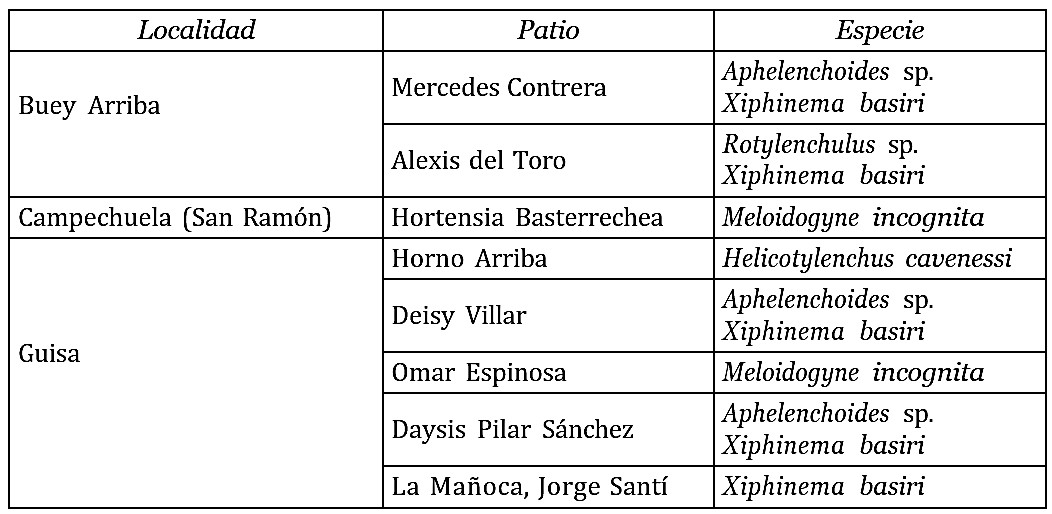
Malpighia punicifolia L. is appreciated for the bittersweet taste and vitamin C content of theirs fruits. Because of this it is commonly find in yards of Granma province. In consideration to nocivity of some fitonematode species in this crop and the lack of reports in Cuba, species associated had been identified in samples from three municipalities of Granma: Guisa (6), Campechuela (1) and Buey Arriba (4). Aphelenchoides sp., Helicotylenchus cavenessi Sher, Meloidogyne incognita (Kofoid & White) Chitwood and Xiphinema basiri Siddiqi were observed in eight samples. Detection of these four species in Granma province represents the first knowledge of associated fitonematodes on M. punicifolia crop in Cuba.
Article Details

This work is licensed under a Creative Commons Attribution-NonCommercial 4.0 International License.
Those authors who have publications with this journal accept the following terms of the License Attribution-NonCommercial 4.0 International (CC BY-NC 4.0):
You are free to:
- Share — copy and redistribute the material in any medium or format
- Adapt — remix, transform, and build upon the material
The licensor cannot revoke these freedoms as long as you follow the license terms.
Under the following terms:
- Attribution — You must give appropriate credit, provide a link to the license, and indicate if changes were made. You may do so in any reasonable manner, but not in any way that suggests the licensor endorses you or your use.
- NonCommercial — You may not use the material for commercial purposes.
- No additional restrictions — You may not apply legal terms or technological measures that legally restrict others from doing anything the license permits.
The journal is not responsible for the opinions and concepts expressed in the works, they are the sole responsibility of the authors. The Editor, with the assistance of the Editorial Committee, reserves the right to suggest or request advisable or necessary modifications. They are accepted to publish original scientific papers, research results of interest that have not been published or sent to another journal for the same purpose.
The mention of trademarks of equipment, instruments or specific materials is for identification purposes, and there is no promotional commitment in relation to them, neither by the authors nor by the publisher.
How to Cite
References
Almarales, M.; H. Gandarilla: «Citrus sinensis (L.) Osbeck, nuevo hospedante de Xiphinema basiri Siddiqi en Cuba», Fitosanidad 15 (3): 185-186, Cuba, 2011.
Babu, R. S.; T. S. Muthukrishnan: «Studies on the Pathogenicity of Xiphinema basiri on Tomato and Brinjal», Nematol. Medit. 18 (1): 7, Italia, 1990.
CAB International: Crop Protection Compendium, Wallingford, Inglaterra, 2007.
Crozzli, R.: «Nematodes of Tropical Fruit Crops in Venezuela», Integrated Management of Fruit Crops and Forest Nematodes, Springer, Holanda, 2009, pp. 63-83.
Cunha, D. da; J. R. Pereira; W. dos Santos Soares; F. Ramos: «Hospedability of Malphighia punicifolia L. to Meloidogyne javanica and M. arenaria, starin 2», Pesquisa Agropecuária Tropical 28 (2): 77-82, 2007.
Fernández, E.: «Los nematodos del género Meloidogyne Goeldi en el cultivo de la guayaba (Psidium guajava L.) y su control», tesis en opción al grado científico de Doctor en Ciencias Agrícolas, Instituto Superior de Ciencias Agropecuarias de La Habana, Centro Nacional de Sanidad Agropecuaria, La Habana, 1991.
Fernández, M.; J. Ortega: Lista de nemátodos fitoparasíticos de Cuba, Ed. Científico-Técnica, La Habana, 1986.
Franco, A.; J. da Ponte: «Acerola, Malpighia glabra L., um novo hospedeiro de nematóides das galhas», Nematologia Brasileira 13: 181-183, 1989.
Hunt, D. J.; M. Luc; R. H. Manzanilla: «Identification, Morphology and Biology of Plant Parasitic Nematodes», Plant Parasitic Nematodes in Subtropical and Tropical Agriculture, 2.ª ed., sección 11, CABI Publishing, Inglaterra, 2005, pp. 11-52.
Hunt, D. J; Z. A. Handoo: «Taxonomy, Identification and Principal Species», Root-knot Nematodes, CAB International, 2009, pp. 55-97.
Loof, P. A. A.; M. Luc: «A Revised Polytomous Key for the Identification of Species of the Genus Xiphinema Cobb, 1913 (Nematoda: Longidoridae) with Exclusion of the American-Group», Systematic Parasitology 16: 35-66, Alemania, 1990.
Loof, P. A. A.; M. Luc: «A Revised Polytomous Key for the Identification of Species of the Genus Xiphinema Cobb, 1913 (Nematoda: Longidoridae) with Exclusion of the American-Group: Supplement I», Systematic Parasitology 24: 185-189, Alemania, 1993.
Loof, P. A. A.; M. Luc; P. Baujard: «A Revised Polytomous Key for the Identification of Species of the Genus Xiphinema Cobb, 1913 (Nematoda: Longidoridae) with Exclusion of the American-Group, Supplement 2», Systematic Parasitology 33: 23-29, Alemania, 1996.
Morton, J.: «Fruits of warm climates», http://www.hort.purdue.edu/newcrop/morton/barbados_cherry.html1987, Barbados Cherry, pp. 204-207, Miami, EE. UU., 1987.
Paramonov, A. A.: Fundamentos de fitohelmintología, t. 1, Academia de Ciencias, Moscú, 1962.
Roig, J. T.: Diccionario botánico de nombres vulgares cubanos, tt. I y II, 3.ª. ed., Editora del Consejo de Universidades, La Habana, 1965.
Sher, S. A: «Revision of the Hoplolaiminae (Nematoda). VI. Helicotylenchus Steiner 1945», Nematologica 12 (1): 1-56, Inglaterra, 1966.