
Inhibición del crecimiento in vitro de Fusarium sp. aislado de chile habanero (Capsicum chinensis) con hongos antagonistas
Article Sidebar
Main Article Content
Abstract
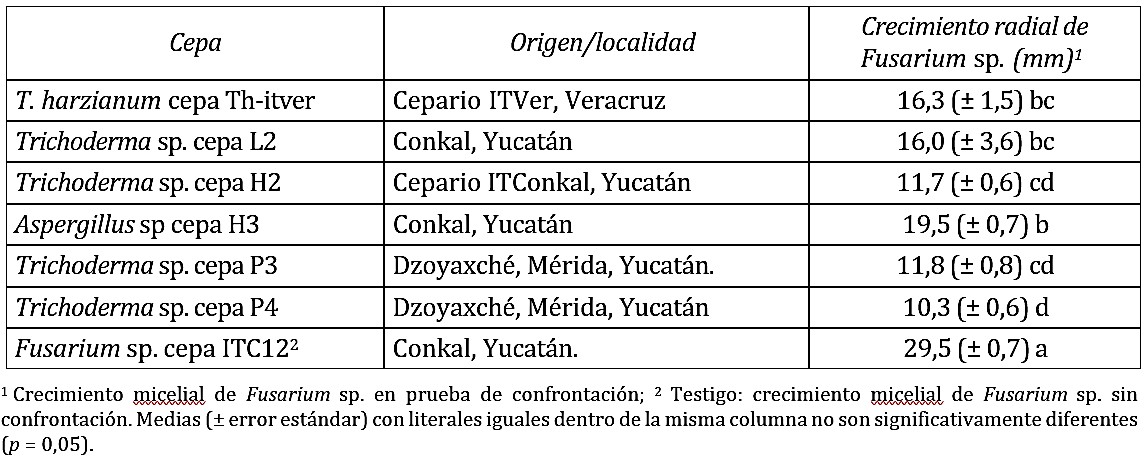
Fusarium species are causal agents of plant diseases causing symptoms in root, stem and leaf in different crops included pepper. Antagonists such as the fungus Trichoderma are an alternative in the control of plant pathogens fungi. The percentage of radial growth inhibition of Fusarium sp. isolated from habanero pepper (Capsicum chinensis Jacq.) by fungal antagonists was evaluated. For the bioassay were evaluated two reference strains Trichoderma harzianum, named Th-itver and Trichoderma sp. H2; three natives isolates (L2, P3 and P4) isolated from soil samples of Yucatán, México, identified as Trichoderma; and H3 native strain, identified as belonging to the genus Aspergillus. The evaluation was carried out by dual confrontation test in potato-dextrose-agar (PDA). All Trichoderma strains inhibited the radial growth of Fusarium sp. from 40 to 82%. The growth inhibition zone caused by Trichoderma H2 (82.2 %) was higher compared to that caused by the rest of the isolates. The isolates H2, P3 and P4 showed the ability for growing on the pathogen suggesting that the mechanism of antagonistic activity is by parasitism.
Article Details

This work is licensed under a Creative Commons Attribution-NonCommercial 4.0 International License.
Those authors who have publications with this journal accept the following terms of the License Attribution-NonCommercial 4.0 International (CC BY-NC 4.0):
You are free to:
- Share — copy and redistribute the material in any medium or format
- Adapt — remix, transform, and build upon the material
The licensor cannot revoke these freedoms as long as you follow the license terms.
Under the following terms:
- Attribution — You must give appropriate credit, provide a link to the license, and indicate if changes were made. You may do so in any reasonable manner, but not in any way that suggests the licensor endorses you or your use.
- NonCommercial — You may not use the material for commercial purposes.
- No additional restrictions — You may not apply legal terms or technological measures that legally restrict others from doing anything the license permits.
The journal is not responsible for the opinions and concepts expressed in the works, they are the sole responsibility of the authors. The Editor, with the assistance of the Editorial Committee, reserves the right to suggest or request advisable or necessary modifications. They are accepted to publish original scientific papers, research results of interest that have not been published or sent to another journal for the same purpose.
The mention of trademarks of equipment, instruments or specific materials is for identification purposes, and there is no promotional commitment in relation to them, neither by the authors nor by the publisher.
How to Cite
References
Abdel-Fattah, G. M.; M. Shabana; A. E. Ismail; Y. M. Rashad: «Trichoderma harzianum: a Biocontrol Agent Against Bipolaris oryzae», Mycopathologia 164: 81-89, Holanda, 2007.
Avelar-Mejía, J. J.; M. Galindo-Oliva; A. Lara-Herrera1; J. J. Llamas- Llamas; M. Luna-Flores; M. A. Salas-Luevano; M. Cabral-Enciso: «Hongos asociados con la enfermedad miada de perro en el cultivo de chile», Revista Mexicana de Ciencias Agrícolas, 2 (1): 155-160, México, 2011.
Barnett, H. L.; B. B. Hunter: Ilustrated Genera of Imperfect Fungi», 3rd ed., Burgess Publishing, Minnesita, EE. UU., 1999.
Bell, D. K.; H. D. Well; C. R. Markham: «In vitro Antagonism of Trichoderma Species Against Six Fungal Plant Pathogens», Phytopathology 72: 379-382, EE. UU., 1982.
Benítez, T; A. M. Rincón; M. C. Limón; A. C. Codón: «Biocontrol Mechanisms of Trichoderma strains», International Microbiology 7: 249-260, España, 2004.
Chakraborty, M. R.; N. C. Chatterjee: «Control of Fusarium Wilt of Solanum melongena by Trichoderma spp. », Biología Plantarum 52: 582-586, Holanda, 2008.
Cubillos, J. G.; A. Páez; L. Mejía: «Evaluación de la capacidad biocontroladora de Trichoderma harzianum Rifai contra Fusarium solani (Mart.) Sacc. asociado al complejo Secadera en Maracuyá, bajo condiciones de invernadero», Rev. Fac. Nal. Agr. Medellín 64 (1): 5821-5830, Colombia, 2011.
Escobar, P.; J. Montealegre; R. Herrera: «Respuesta in vitro de cepas de Trichoderma harzianum frente a Fe3+, salinidad, pH y temperatura, con el fin de ser utilizadas en control biológico de Rhizoctonia solani y Fusarium solani en tomate», Boletín Micológico 19: 95-102, Chile, 2004.
Gray, L. E.; L. A. Achenbach: «Severity of Foliar Symptoms and Root and Crown Rot of Soybean Inoculated with Various Isolates and Inoculum Rates of Fusarium solani», Plant Dis. 80: 1197-1199, EE. UU., 1996.
Hasan, M. M.; S. M. E. Rahman; G. H. Kim; E. Abdallah; D. H. Oh: «Antagonistic Potentiality of Trichoderma harzianum Towards Seed- Borne Fungal Pathogens of Winter Wheat cv. Protiva In Vitro and In Vivo», J. Microbiol. Biotechnol. 22 (5): 585-591, Corea del Sur, 2012.
Herrera, E.; I. M. Bacab; J. Cristóbal; J. M. Tun; E, Ruiz: «Patogenicidad de Fusarium solani (Mart.) Sacc. y Alternaria alternata (Fries) Keissler en Thevetia peruviana (Pers.) K. Schum. y su control in vitro», Fitosanidad 15 (4): 231-236, Cuba, 2011.
Mastouri, F.; T. Björkman; G. E. Harman: «Seed Treatment with Trichoderma harzianum Alleviates Biotic, Abiotic, and Physiological Stresses in Germinating Seeds and Seedlings», Phytopathology, 100 (11): 1213-1221, EE. UU., 2010.
Paez, M. E.; N. A. Sanabria: «Evaluation of the Antagonistic Capacity of Trichoderma koningii Above Fusarium oxysporum f. sp. lycopersici», Rev. Fav. Agron. 24 (1): 27-31, Venezuela, 2007.
Pérez, L.; A. Batlle; J. Chacón; V. Montenegro: «Eficacia de Trichoderma harzianum a34 en el biocontrol de Fusarium oxysporum f. sp. cubense, agente causal de la marchitez por Fusarium o mal de panamá de los bananos en Cuba», Fitosanidad 13 (4): 259-263, Cuba, 2009.
Quiroz-Sarmiento, V. R.; R. Ferrera-Cerrato; A. Alarcón; M. E. Lara- Hernández: «Antagonismo in vitro de cepas de Aspergillus y Trichoderma hacia hongos filamentosos que afectan el cultivo de ajo», Revista Mexicana de Micología 26: 27-34, México, 2008.
Sharman, P: «Complexity Complexity of Trichoderma- Fusarium Interaction and Manifestation of Biological Control», Australian Journal of Crop Science 5 (8): 1027-1038, Australia, 2011.
Vásquez-López, A.; B. Tlapal-Bolaños; M. J. Yáñez-Morales; R. Pérez- Pacheco; M. Quintos-Escalante: «Etiología de la marchitez del chile de agua (Capsicum annuum L.) en Oaxaca, México», Rev. Fitotec. Mex. 32 (2): 127-134, México, 2009.