
Efecto antialimentario de aceites esenciales de plantas aromáticas sobre Heliothis virescens y Spodoptera frugiperda
Article Sidebar
Main Article Content
Abstract
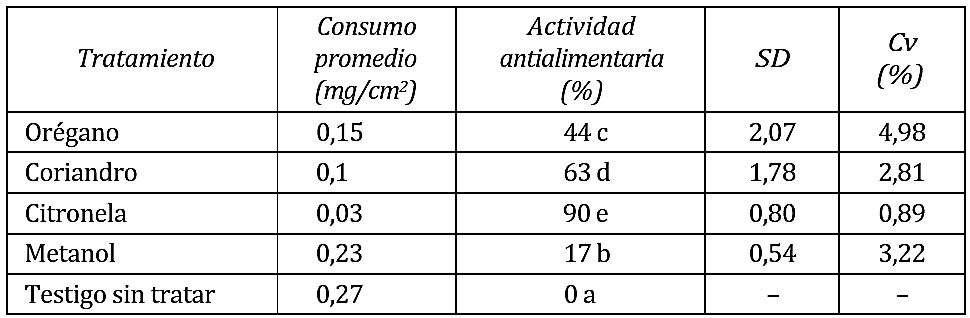
The essentials oils of Cymbopogon nardus, Plecthanthus amboinicus, Mentha spicata and Coriandrum sativum were characterized and studied theirs antifeedant effect on Heliothis virescens and Spodoptera frugiperda. C. nardus and C. sativum essential oils significantly inhibited the feeding larvae of H. virescens while the volatiles of P. amboinicus and M. spicata were effective against S. frugiperda larvae. C. nardus also controlled S. frugiperda larvae but its phytotoxicity avoids evaluating its antifeedant effect.
Article Details

This work is licensed under a Creative Commons Attribution-NonCommercial 4.0 International License.
Those authors who have publications with this journal accept the following terms of the License Attribution-NonCommercial 4.0 International (CC BY-NC 4.0):
You are free to:
- Share — copy and redistribute the material in any medium or format
- Adapt — remix, transform, and build upon the material
The licensor cannot revoke these freedoms as long as you follow the license terms.
Under the following terms:
- Attribution — You must give appropriate credit, provide a link to the license, and indicate if changes were made. You may do so in any reasonable manner, but not in any way that suggests the licensor endorses you or your use.
- NonCommercial — You may not use the material for commercial purposes.
- No additional restrictions — You may not apply legal terms or technological measures that legally restrict others from doing anything the license permits.
The journal is not responsible for the opinions and concepts expressed in the works, they are the sole responsibility of the authors. The Editor, with the assistance of the Editorial Committee, reserves the right to suggest or request advisable or necessary modifications. They are accepted to publish original scientific papers, research results of interest that have not been published or sent to another journal for the same purpose.
The mention of trademarks of equipment, instruments or specific materials is for identification purposes, and there is no promotional commitment in relation to them, neither by the authors nor by the publisher.
How to Cite
References
Adams, R. P.: Identification of Essential Oil Components by Gas Chromatography/Mass Spectroscopy, Allured Publishing, Carol Stream, IL. EE. UU., 1995, pp. 69-351.
Akhila, A.: Essential oil-Bearing grasses. The genus Cymbopogom, Medicinal and Aromatic Plants- Industrial Pro_les, CRC Press, EE. UU., 2010.
Bathal, S. S.; D. Singh; R. S. Dhillon: «Effect of Crude Root Oils of Inula racemosa and Saussurea lappa on Feeding, survival and development of Spodoptera litura (Lepidoptera: Noctuidae) larvae» Eur. J. Entomol. 90 (2): 239-240, República Checa, 1993.
Cano, E. A.; P. Martín; M. E. Ocete; R. del Tío; J. L. Ramírez: «Ensayos sobre la actividad antialimentaria de extractos de Melia azederach L. y Mentha suaveolens Ehrh. frente a los noctuidos plaga Spodoptera littoralis (Boisd.) y Spodoptera exigua (Hubner) (Lepidoptera: Noctuidae)», Bol. San. Veg. Plagas 22 (1): 133-140, España, 1996.
International Standard-ISO 6571-1984 (E) «Pices, Condiments and Herbs. Determination of Volatile Oil Content», www.aenor.es/.../ NORMALIZACION/NORMASNACIONALES/...ISO_11163=2010.pdf (consulta: 6 de septiembre de 2012).
Isman, M. B.: «Plant Essential Oil for Pest and Disease Management», Crop. Protection 19: (8-10): 603-608, EE. UU., 2000.
Isman, M. B.: «Botanical Insecticides, Deterrents, and Repellents in Modern Agriculture and an Increasingly Regulated World», Annu. Rev. Entomol. 51: 45-66, EE. UU., 2006.
Isman, M. B.; S. Miresmailli; C. Machial: «Commercial Opportunities for Pesticides Based on Plant Essential Oils in Agriculture, Industry and Consumer Products», Phytochem. Rev. 10 (2): 197-204, Alemania, 2011.
Larocque, N.; C. Vincent; A. Belanger; J. P. Bourassa: «Effects of Tansy Essential Oil from Tanacetum vulgare on Biology of Oblique- Banded Leafroller, Choristoneura rosaceana», J. Chem. Ecol. 25 (6): 1319-1330, Alemania, 1999.
Maggi, M. E.: «Insecticidas naturales. 2004», www.monografías.com/ trabajos18/insecticidas-naturales (consulta: 4 de septiembre de 2008).
Marimuth, S; G. Gurusubramanian; S. S. Krishna: «Effect of Exposure of Eggs to Vapours from Essential Oils on Egg Mortality, Development and Adult Emergence in Earias vittella (F.) (Lepidoptera: Noctuidae)», Biol. Agr. Horticult. 14 (4): 303-307, India, 1997.
Mkolo, N. M.; J. O. Olowoyo; K. B. Sako; S. T. R. Mdakane; M. M. A. Milonga; S. R. Magano: «Repellency and Toxicity of Essential Oils of Mentha piperita and Mentha spicata on Larvae and Adult of Amblyomma hebraeum (Acari: Ixodidae)», Science Journal of Microbiology vol. (2011): 1-7. Sur África. 2011, http://www. sjpub.org/sjmb/N.M.%20Mkoloa%20et%20al.pdf.
Naumann, K.; M. B. Isman: «Evaluation of Neem Azadirachta indica Seed Extracts and Oils as Oviposition Deterrents to Noctuid Moths», Entomol. Exp. Appl. 76 (2): 115-120, EE. UU., 1995.
Nerio, L. S.; J. Olivero-Verbel; E. Stashenko: «Repellent Activity of Essential Oils: A Review», Bioresource Technology 101 (1): 372-378, EE. UU., 2010.
Papachristos, D. P.; K. I. Karamanoli; D. C. Stamopoulos; U. Menkissoglu- Spiroudi: «The Relationship Between the Chemical Compositionn of Three Essential Oils and Their Insecticidal Activity Against Acanthoscelides obtectus (Say)», Pest. Manag. Sci. 60 (5): 514-520, EE. UU., 2004.
Park, S. J.; S. G. Lee; S. C. Shin; B. J. Lee; Y. J. Ahn: «Larvicidal and Antifeeding Activities of Oriental Medicinal Plant Extracts Against four Species of Forest Insect Pests», Appl. Entomol. and Zool. 32 (4): 601-608, Alemania, 1997.
Pascual, M. J.; A. López: Insecticidas de origen natural y protección integrada y ecológica en agricultura, Consejería de Medio Ambiente, Agricultura y Agua, España, 1997.
Pascual, M. J.: Volatile Activity of Plant Essential Oils Against Stored- Product Beetle Pest. Advances in Stored Product Protection, 8th International Working Conference on Stored Product Protection York, Inglaterra, 22-26 julio de 2002. Chemical and Physical Control, 648- 650, 2003.
Peterson, C.; J. Coats: «Insect Repellents - Past, Present and Future», Pesticide Outlook 12 (4): 154-158, August, 2001, Inglaterra.
Rodríguez, C.: «Extensión y capacitación en el uso de plaguicidas botánicos», Memorias del I Taller Latinoamericano sobre Bioplaguicidas, El Zamorano, Honduras, 1996.
Roig, J. T.: Plantas medicinales, aromáticas y venenosas en Cuba, Ediciones de Ciencia y Técnica, La Habana, 1974.
Salunke, B. K.; K. Prakash; K. S. Vishwakarma; V. L. Maheshwari: «Plant Metabolites: an Alternative and Sustainable Approach Towards Post Harvest Pest Management in Pulses», Physiological and Molecular Biology of Plants 15 (3): 185-197, Alemania, 2009.
Simmonds, M. S. J.: «Actividad antiinsecto en plantas insecticidas y modificadoras del comportamiento», Insecticidas de origen natural y protección integrada y ecológica en agricultura, Serie Congreso 10, Consejería de Medio Ambiente, Agricultura y Agua, España, 1997.
Singh, G., S. Maurya, M. P. de Lampasona, C. Catalan: «Studies on Essential Oils, Part 41. Chemical Composition, Antifungal, Antioxidant and Sprout Suppressant Activities of Coriander (Coriandrum sativum) Essential Oil and its Oleoresin», Flavour and Fragrance Journal 21 (3): 472-479, EE. UU., 2006.
Sokoviæ, M. D.; J. Vukojeviæ; P. D. Marin; D. D. Brkiæ; V. Vajs; L. J. van Griensven: «Chemical Composition of Essential Oils of Thymus and Mentha Species and Their Antifungal Activities», Molecules 14 (1): 238-249, Suiza, 2009.
Stein, S.; Y. Mrokhin; D. Tchekhovskoi; G. Mallard: «The NIST Mass Spectral Search Program for the NIST/EPA/NIH Mass Spectral Library», Version 2.0 build Oct. 8, 2008.
Verma, R. S.; L. Rahman; R. K. Verma; A. Chauhan; A. K. Yadav; A. Singh: «Essential Oil Composition of Menthol Mint (Mentha arvensis) and Peppermint (Mentha piperita) Cultivars at Different Stages of Plant Growth from Kumaon Region of Western Himalaya», International Journal of Medicinal and Aromatic Plants 1 (1): 13-18, India, 2010.
Znini, M.; M. Bouklah; L. Majidi; S. Kharchouf; A. Aouniti; A. Bouyanzer; B. Hammouti; J. Costa; S. S. Al-Dyab: «Chemical Composition and Inhibitory Effect of Mentha Spicata Essential Oil on the Corrosion of Steel in Molar Hydrochloric Acid», Int. J. Electrochem. Sci. 6 (3): 691-704, Serbia, 2011.