
Evaluation of herbicides in pineapple (Ananas comosus L.) var. MD2 for weed control in red ferralitic soils
Article Sidebar
Main Article Content
Abstract
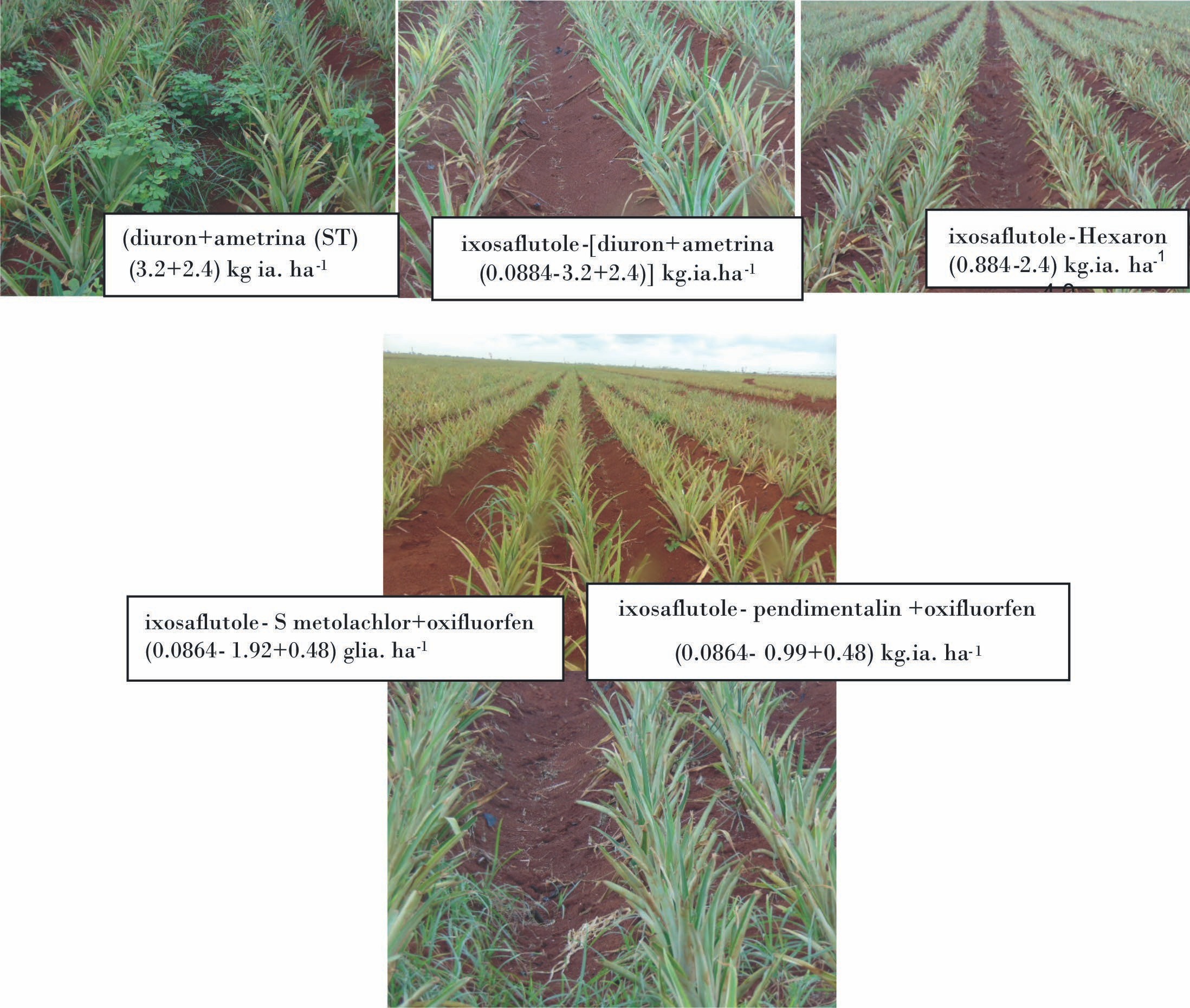
The selectivity of the MD2 pineapple variety and the effectiveness on weeds of the herbicides Hexaron 60 GD (diuron + hexasinona) at (0.12, 0.24 and 0.48) kg • ia • ha-1, S were evaluated -metolachlor 96 CS at (1.92, 2.88 and 3.84) kg • ia • ha-1, pendimentalin 33 CS at (0.66, 0.99 and 1.32) kg • ia • ha-1 and oxyfluorfen CE 24 at (0.24, 0.36 and 0.48) kg • ia • ha-1, in the experimental phase and the mixtures of S-metolachlor + oxyfluorfen at (1.92 + 0.48) kg • ia • ha-1, pendimentalin + oxyfluorophen at (0.99 + 0.48) kg • ia • ha-1 in extensive phase, both experiments were carried out on red ferralitic soil in the province of Ciego de Ávila, as results it was obtained that the effectiveness of the treatments of pendimentalin 33 CS (0.99-1.32) at kg • ia • ha-1, metolachlor 96 CS at (2.88-3.84) kg • ia ha-1, oxyfluorfen 24 CS at (0.36-0.48) kg • ia. ha-1 and Hexaron 60 GD [diuron + hexasinona at (0.18-0.24) kg • ia • ha-1) were significantly superior to the standard in the monocot control. For dicots there was only significant difference with Hexaron 60 GD, (diuron + hexasinona) at 0.24 kg • ha-1 and the standard diuron + ametrina (80 + 80) PH at (3.2 + 2.4) kg • ia • ha-1 with slightly better results than the previous ones. Such applications did not produce significant difference between treatments and the development parameters of the crop, as well as no effect of phytotoxicity in the plants. The extension results showed that the best effectiveness was obtained with the mixtures of pendimentalin + oxyfluorfen (0.99 + 0.48) kg • ia • ha-1 with 84 %, followed by metolachlor + oxyfluorfen (1.92 + 0.48) kg • ia • ha-1 with 82.6%, both applied 20-30 days after the residual ixosaflutole 0.0864 kg • ia • ha-1 and compared with the standard (diuron + ametrina (3.2 + 2.4) kg • ia • ha-1).
Article Details

This work is licensed under a Creative Commons Attribution-NonCommercial 4.0 International License.
Those authors who have publications with this journal accept the following terms of the License Attribution-NonCommercial 4.0 International (CC BY-NC 4.0):
You are free to:
- Share — copy and redistribute the material in any medium or format
- Adapt — remix, transform, and build upon the material
The licensor cannot revoke these freedoms as long as you follow the license terms.
Under the following terms:
- Attribution — You must give appropriate credit, provide a link to the license, and indicate if changes were made. You may do so in any reasonable manner, but not in any way that suggests the licensor endorses you or your use.
- NonCommercial — You may not use the material for commercial purposes.
- No additional restrictions — You may not apply legal terms or technological measures that legally restrict others from doing anything the license permits.
The journal is not responsible for the opinions and concepts expressed in the works, they are the sole responsibility of the authors. The Editor, with the assistance of the Editorial Committee, reserves the right to suggest or request advisable or necessary modifications. They are accepted to publish original scientific papers, research results of interest that have not been published or sent to another journal for the same purpose.
The mention of trademarks of equipment, instruments or specific materials is for identification purposes, and there is no promotional commitment in relation to them, neither by the authors nor by the publisher.
How to Cite
References
Adama, 2019. Herbicida selectivo pos-emergente en piña. Consultado 26/09/2019 https://www.adama.com/colombia/es/crop-protection/ herbicides/galigan-ec.html,
Ahrens W., and M. Edwards 1994. Herbicide handbook. Champaign, Ill: Weed Science Society of America, pp. 136.
Chaves F. L., 2018. Manejo Fitosanitario en el Cultivo de la Piña. Serie Frutales, Núm. 52. Artículos Técnicos de INTAGRI. México. 3 p.
Corrêa J. M., Ferreira E. A., Pereira G. A. M., Piratoba A. R. A., Santos J. B. dos, Oliveira C. H. de, & Silva C. T., 2018. Fluorescencia de la clorofila en plantas de piña sometidas a aplicación de herbicidas. Revista Colombiana de Ciencias Hortícolas, 12(1), 50-58, 2018. https:// doi.org/10.17584/rcch.2018v12i1.7171. Consultado 28, 09, 2019.
ICA, 1998. Manual de usuario de estadísticas. Versión 2.0. Instituto de Ciencia Animal, 10 pág.
IIFT, 2011. Instructivo técnico para el cultivo de la piña. Instituto de Investigaciones en Fruticultura Tropical. ISBN: 978-959-7210-42-9, 1ra edición.
INTAGRI, 2017. El Suelo: Un Banco de Malezas. Serie Suelos Núm. 36. Artículos Técnicos. México. 4 p. https://www.intagri.com/articulos/ suelos. Consultado, nov /2019
Liu L., Cibes H., Koo F., 2017. “Adsorption of Ametryne and Diuron by Soils”, Weed Science, vol. 18(4), pp. 470-474. DOI: https://doi. org/10.1017/S0043174500078474, consultado, nov /2018.
LOPA, 2016. Lista Oficial del Registro de Plaguicidas. Centro Sanidad Vegetal, Ministerio de la Agricultura, 146 pág.
Oviedo R., González L., 2015. Lista nacional de plantas invasoras en Cuba. Boletín Bissea (11). http://repositorio.geotech.cu/xmlui/handle/1234/1476
Papa J. C, Tuesca D., 2017. El barbecho químico: etapa clave en el manejo de malezas en siembra directa. INTA EEA Oliveros, Revista PMP 56, pág. 111-114.
Paredes R. E., Oviedo Ramona y Rodríguez Y. 2016. Segunda versión: Manejo de Malezas en cultivos agrícolas cubanos. Publicación electrónica (Multimedia: ISBN: 978-959-7194-63-7, 303 p.), CIDISAV, Playa, La Habana.
Pérez E., 1979. Efectividad de diferentes herbicidas en el cultivo de la piña. Revista Protección de Plantas. Vol. 2(1), Pág. 43-59.
Pérez E., Paredes R. E., Almaguel R. Lérida, Vázquez M. L., Veitía Marlene, González G. M Pérez B. Yamilka, Hernández R., García R., y Matamoros T. M., 2009. Metodologías de pruebas biológicas para la determinación de organismos nocivos y residuos fitotóxico en suelo, sustrato y materia orgánica. –Cuba: Inisav, – 54 p. Boletín Fitosanitario (La Habana) 14 (1); jun.
Peña-Martínez Y., Guerrero-Dallos Rocío., Jairo A. y Martínez-Cordón M. José. 2018
Adsorción - desorción de diuron y ametrina en suelos de Colombia y España. Química, vol. 47, núm. 3. Universidad Nacional de Colombia.
Rodríguez R., Becquer R., Pino Y., López D., Rodríguez R. C., González L., Izquierdo R. E, y González J. L., 2016. Producción de frutos de piña [Ananás comosus (L.) Merr.] MD-2 a partir de vitroplantas. Rev. Cultivos Tropicales Vol.37. Supl.1, La Habana,
Sandoval C., Ahuatzi D., Galíndez J., Ruiz, N. C. Juárez and Martínez F., 2013. “Biodegradation of a mixture of the herbicides ametryn, and 2,4-dichlorophenoxyacetic acid (2,4-D) in a compartmentalized biofilm reactor”, Bioresource Technology, vol. 145, pp. 33-36. DOI: https://doi.org/10.1016/j.biortech..02.068, Consultado 24/09/2019. .
US-EPA, 1999. Office of Pesticide Programs, Health Effects Division, Tox One liners, EPA chem. code 035505 - Diuron. (Consultado, marzo de 2018).