
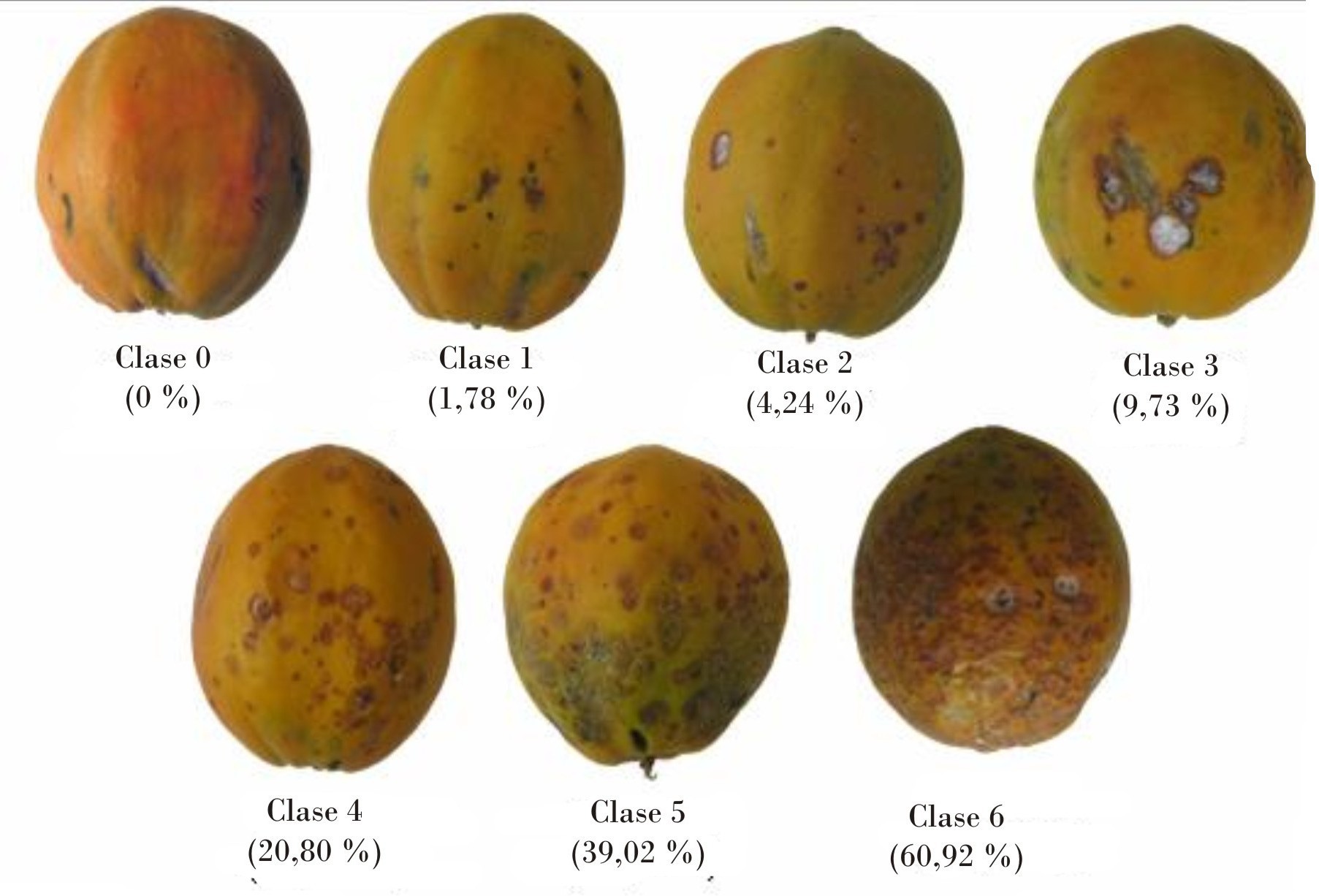
Escala logarítmica diagramática de severidad de la antracnosis (Colletotrichum gloeosporioides) en papaya (Carica papaya)
Article Sidebar
Main Article Content
Abstract
Anthracnose caused by Colletotrichum gloeosporioides represents the fungal disease that affects the quality of papaya fruits in postharvest. A study was realized with the objective of develops and validates a logarithmic scale for severity diagrammatic papaya anthracnose pathosystem. This was inoculated with 130 conidia papaya fruits C. gloeosporioides at concentration of 1 x 10⁶ conidia per mL. The inoculated fruits when ripe expressed different degrees of severity, which was estimated using computer programs. Subsequently, each face photographed fruit and some images with different degrees of damage were projected to a group of 18 inexperienced evaluators to estimate the severity scale developed previously. The data generated by each evaluator were subjected to a simple linear regression analysis. It generated a scale consisted of six classes, covering fruit without damage to fruits with the highest severity calculated. Precision range varied from 0.66 to 0.81 and accuracy from 0.78 to 0.95, however, precision and accuracy were improved or at least maintained during the second evaluation. The logarithmic scale generated for papaya pathosystem anthracnose, can be used as a reliable tool, it is easy to use, is applicable to a wide range of conditions and further provides reproducible, rapid and accurate.
Article Details

This work is licensed under a Creative Commons Attribution-NonCommercial 4.0 International License.
Those authors who have publications with this journal accept the following terms of the License Attribution-NonCommercial 4.0 International (CC BY-NC 4.0):
You are free to:
- Share — copy and redistribute the material in any medium or format
- Adapt — remix, transform, and build upon the material
The licensor cannot revoke these freedoms as long as you follow the license terms.
Under the following terms:
- Attribution — You must give appropriate credit, provide a link to the license, and indicate if changes were made. You may do so in any reasonable manner, but not in any way that suggests the licensor endorses you or your use.
- NonCommercial — You may not use the material for commercial purposes.
- No additional restrictions — You may not apply legal terms or technological measures that legally restrict others from doing anything the license permits.
The journal is not responsible for the opinions and concepts expressed in the works, they are the sole responsibility of the authors. The Editor, with the assistance of the Editorial Committee, reserves the right to suggest or request advisable or necessary modifications. They are accepted to publish original scientific papers, research results of interest that have not been published or sent to another journal for the same purpose.
The mention of trademarks of equipment, instruments or specific materials is for identification purposes, and there is no promotional commitment in relation to them, neither by the authors nor by the publisher.
How to Cite
References
Alvarez, A. M.; W. T. Nishijima: «Postharvest diseases of papaya», Plant Disease 71 (8): 681-686, EE. UU., 1987.
Campbell, C. L.; L. V. Madden: Introduction to Plant Disease Epidemiology, John Wiley and Sons, Nueva York, 1990.
Cristóbal, A. J.; L. E. Caamal; J. M. T. Suárez; A. G. Pérez; L. M. Latournerie: «Epidemiología del mildiú de las cucurbitáceas (Pseudoperonospora cubensis Berk & Curt) en materiales de melón (Cucumis melo L.)», Fitosanidad 10 (3): 197-201, Cuba, 2006.
Flórez, O. A.; H. F. Marín; J. A. Zapata: «Estudio de las prácticas de cosecha y poscosecha de papaya (Carica papaya cv. Maradol), en el departamento del Huila, Colombia», Revista de Investigación Agraria y Ambiental 0 (1): 29-36, Colombia, 2009.
Martins, M. C.; R. A. Guerzoni; G. M. S. Camara; P. Mattiazzi; S. A. Lourenco; L. Amorim. «Escala diagramática para a quantificacäo do complexo de doencas foliares de final de ciclo em soja», Fitopatología Brasileira 29 (2): 179-184, 2004.
Nutter, F. W. Jr.; M. L. Gleason; J. H. Jenco; N. C. Christians: «Assessing the Accuracy, Intra-Rater Repeatability, and Inter-Repeteability of Diseases Assessment Systems», Phytopathology 83 (8): 806-812, EE. UU., 1993.
Nutter, F. W. Jr.; P. M. Schultz: «Improving the Accuracy and Precision of Disease Assessments: Selection of Methods and Use of ComputerAided Training Programs», Canadian Journal of Plant Pathology 17 (2): 174-184, 1995.
Sherwood, R. T.; C. C. Berg; M. R. Hoover; K. E. Zeiders: «Illusions in Visual Assessment of Stagonospora Leaf Spot of Orchardgrass», Phytopathology 73: 173-177, EE. UU., 1983.
Spósito, M. B.; L. Amorim; J. J. Belasque; R. B. Bassanezi; R. de Aquino: «Elaboração e validação de escala diagramática para aviliação da severidade da mancha preta em frutos cítricos», Fitopatologia Brasileira 29 (1): 81-85, 2004.
Tovar, A., M. Hernánadez; J. Cristóbal; R. Romero; G. Mora: «Escala logarítmica diagramática de severidad de la mancha negra (Colletotrichum gloeosporioides Penz.) en Chirimoyo (Annona cherimola Mill.)», Revista Mexicana de Fitopatología 20 (1): 103-109, 2002.
Villanueva, E.; M. A. Sánchez; J. Cristóbal; E. Ruiz; J. M. Tún: «Diagnóstico y alternativas de manejo del tizón foliar (Alternaria chrysanthemi Simmons y Crosier) del crisantemo (Crysanthemum morifolium Ramat.) Kitamura en Yucatán, México», Revista Mexicana de Fitopatología 23 (1): 49-56, 2005.