
Efecto alelopático de Rottboellia cochinchinensis (Lour.) Clayton sobre dos variedades de Saccharum spp.
Article Sidebar
Main Article Content
Abstract
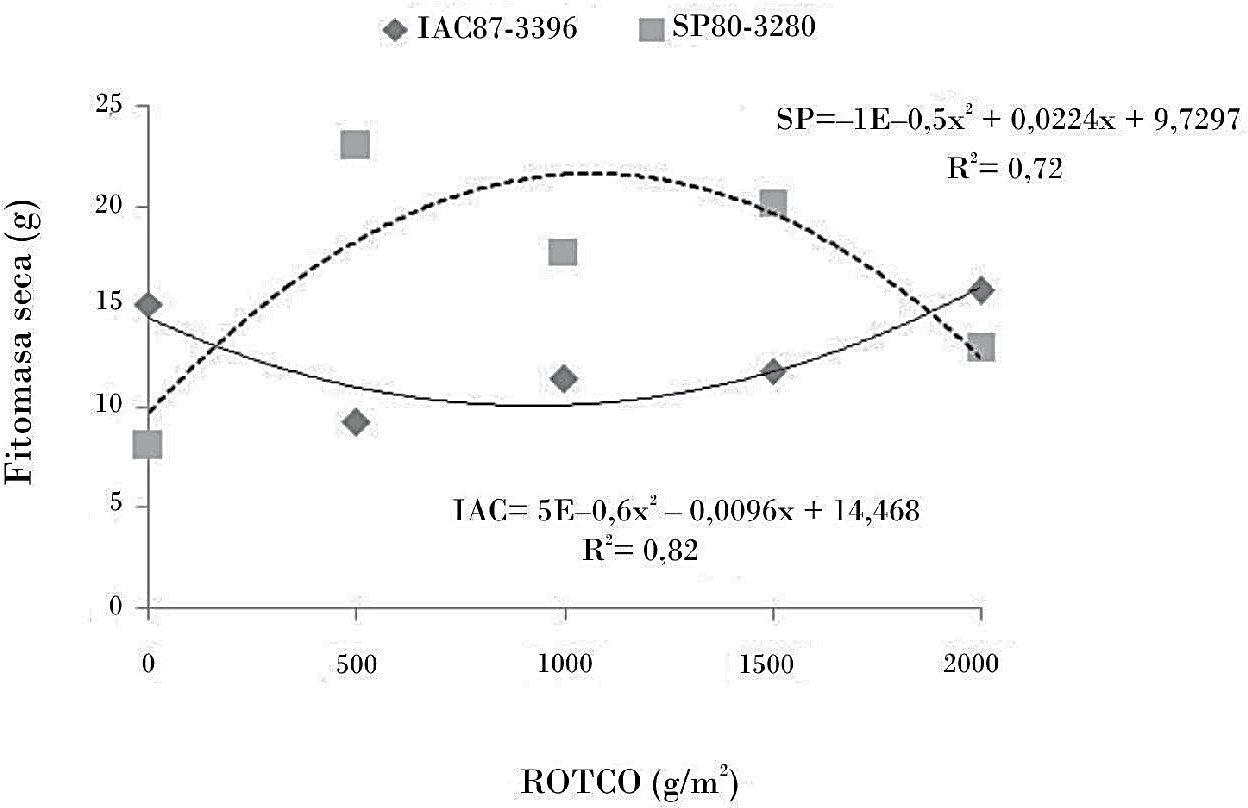
In order to determine the allelophatic effects of ROTCO Rottboellia cochinchinensis (Lour.) Clayton in two sugarcane cultivars IAC 87-3396 and SP 80-3280, an experiment was conducted in semi field conditions by 40 days. Pots of 35 L with soils Rhodic Hapludox and humus (1:1) as substrate were used, and about 10 cm from the surface to the pot bottom were leaved. Ten sugar cane buds by pot were planted and covered with 5 cm of substrate, dry and milled matter of ROTCO mature plants were applied later at rates of 0, 500, 1000, 1500 and 2000 g/m2. The design of treatments in field was factorial 2 x 5 in random blocks with three repetitions. Chemical analyses of the substrate were carried out, and rain and temperatures were recorded during the experimental period. Pots were watered with 2 L of water, except in rain days. Germination and height of plant were measured every seven days. Cane plants were cut at 40 days and the dry matter was determined. ROTCO did not reduce buds germination, which was 100 % in both varieties. In variety IAC87-3396 growth and height reduction of the plants took place, in concentrations of 500 to 1500 g/m2 of ROTCO. Dry biomass and plant height were stimulated in SP80-3280 at the same ROTCO densities. The allelophatic effects in dry mass adjust to a quadratic regression model.
Article Details

This work is licensed under a Creative Commons Attribution-NonCommercial 4.0 International License.
Those authors who have publications with this journal accept the following terms of the License Attribution-NonCommercial 4.0 International (CC BY-NC 4.0):
You are free to:
- Share — copy and redistribute the material in any medium or format
- Adapt — remix, transform, and build upon the material
The licensor cannot revoke these freedoms as long as you follow the license terms.
Under the following terms:
- Attribution — You must give appropriate credit, provide a link to the license, and indicate if changes were made. You may do so in any reasonable manner, but not in any way that suggests the licensor endorses you or your use.
- NonCommercial — You may not use the material for commercial purposes.
- No additional restrictions — You may not apply legal terms or technological measures that legally restrict others from doing anything the license permits.
The journal is not responsible for the opinions and concepts expressed in the works, they are the sole responsibility of the authors. The Editor, with the assistance of the Editorial Committee, reserves the right to suggest or request advisable or necessary modifications. They are accepted to publish original scientific papers, research results of interest that have not been published or sent to another journal for the same purpose.
The mention of trademarks of equipment, instruments or specific materials is for identification purposes, and there is no promotional commitment in relation to them, neither by the authors nor by the publisher.
How to Cite
References
Arévalo, R. A.; E. I. Bertoncini: «Biología e manejo de Rottboellia exaltata L.f. na cultura de cana-de-açúcar Saccharum spp. Análise do problema», Pub. Esp. Centro de Cana Piracicaba, n. 2: p. 3, Brasil, 1994.
Arévalo, R. A.; E. I. Bertoncini; E. M. I. Aranda; T. A. González: «Alelopatía en Saccharum spp. (caña de azúcar)», AIA 15 (1): 51-60, México, 2011.
Castro, P. R. C.; E. L. Vieira: Aplicações de reguladores vegetais na agricultura tropical, Guaíba-RS. Ed. Agropecuária, Brasil, 2001.
Díaz, J. C.; R. Labrada: «Manejo de malezas en caña de azúcar», Manejo de Malezas para Países en Desarrollo, Estudio FAO. Producción y Protección Vegetal (120): 369-373, Roma, 1996.
Harper, J. L.: «Factors Controlling Plant Numbers», The Biology of Weeds, Oxford, Blackwell. Sci. p. 119-132, Inglaterra, 1960.
Holm, L. G.; D. L. Plucknett; J. V. Pancho; J. P. Herberger: «The World’s Worst Weeds. Distribution and Biology», Honolulu. The East-West Center by the University Press of Hawaii, Hawaii, EE. UU., 1977.
Instituto Brasileiro de Geografia e Estatística: «Levantamiento sistemático de la producción agrícola: Confrontación de las Cosechas de 2010 y 2011-Brasil-Enero 2011», http://www.ibge.gov.br/espanhol/estatistica/indicadores/agropecuaria/lspa/lspa_201101_1.shtm (Con- sultado: 4 de abril de 2011).
Invasive Species Specialist Group: «Global Invasive Species Database. Rottboellia cochinchinensis, (Grass)» http://www.issg.org/database/species/search.asp?sts=sss&st=sss&fr=1&sn=Rottboellia+cochinchinensis&rn=&hci=-1&ei=-1&lang=EN&Image1.x= 21&Image1. y=10 (Consultado: 4 de abril de 2011).
Kuijper, J: «Bijdrage Tot de Physiologie der Huidmondjes van Saccharum officinarum L.», Archief Suikerind.Ned.-Indie 23: 1673-1700, India, 1915.
Malavolta, E.; G. C. Vitti; S. A. De Oliveira: «Avaliação do estado nutricional das plantas. Princípios e aplicações», Piracicaba-SP, Associação Brasileira para Pesquisa da Potassa e do Fosfato, Brasil, 1989.
Millhollon, R. W.: «Effects of Itchgrass (Rottboellia cochinchinensis) Interference on Growth and Yield of Sugarcane Saccharum spp. Hybrids», Weed Science 40 (1): 48-53, EE. UU., 1992.
Manechini, C.; A. Ricci; J. L. Donzelli: «An Overview of Controlled and non Controlled Weeds as Influenced by Sugarcane Trashblanckets», International Society of Sugar cane Technologists Congress, 25 Proc. ISSCT, Guatemala, 2005.
MØller, C. H: «Allelopathy as a Factor in Ecological Process», Vegetatio. 18, 348-357, EE. UU., 1969.
Pacific Island Ecosystems: «Rottboellia cochinchinensis (Lour.) Clayton. Poaceae», Brasil, 1999, http://www.hear.org/pier/species/ rottboellia_cochinchinensis.htm (Consultado: 4 de abril de 2011).
Salgado, G. S.; L. A. Bucio; D. D. Riestra; L. C. Lagunes-Espinoza: «Caña de azúcar: hacia un manejo sustentable», Campus Tabasco, Colegio de Posgraduados-Instituto para el Desarrollo de Sistemas de Producción del Trópico Húmedo de Tabasco. Villahermosa, Tabasco, México, 2003.
Silva, F. C.; M. F. Abreu; D. V. Pérez; P. A. Eira; C. A. Abreu; B. V. Raij; C. Gianello; A. M. Coelho; J. A. Quaggio; M. J. Tedesco; C. A. Silva; H. Cantarella; W. O. Barreto. «Métodos de análises químicas para avaliação da fertilidade do solo», Manual de análises químicas de solos, plantas e fertilizantes, EMBRAPA, Brasilia, D. F., 2009.