
Evaluación de la resistencia a la roya (Uromyces phaseoli (Pers.) Wint var. typica Arth) en 25 variedades de frijol común Phaseolus vulgaris L.
Article Sidebar
Main Article Content
Abstract
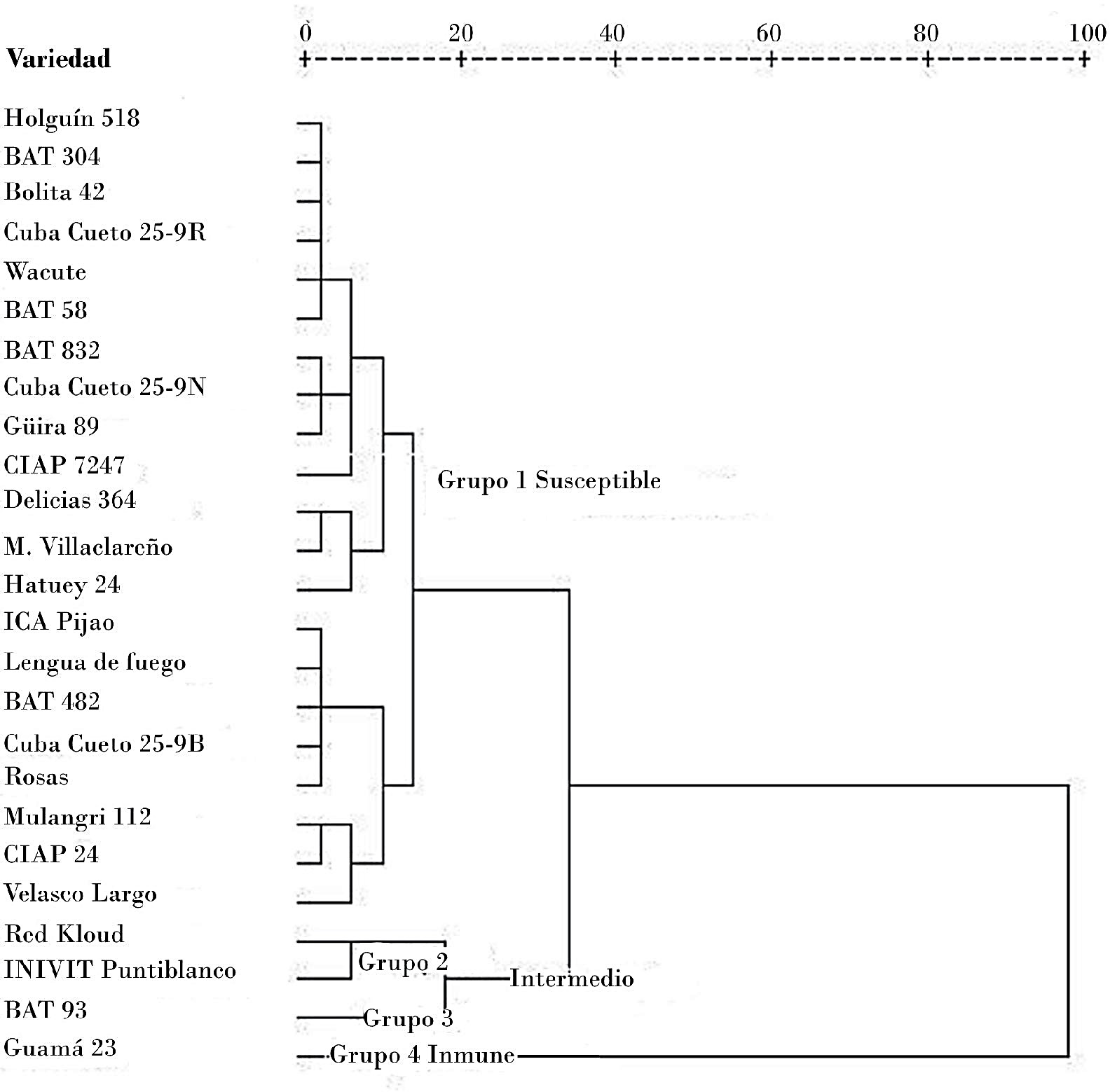
Common bean rust (Uromyces phaseoli var. typica Arth.) is considered one of the most important diseases that affect the crop production in Latin America and the tropics in general. The objective of this work was to assess the response of common bean commercial varieties to this pathogen infection, as well as to compare their reaction using the methodology informed in 1979 by the Colombian International Center of Tropical Agriculture. These experiments were developed in the Agricultural Experimental Station belonging to the Agricultural Sciences Faculty of Las Villas Central University, in the period between January to April 2011 on a brown soil in a design of random blocks with three repetitions. The evaluations were carried out weekly starting from the beginning of disease symptoms in 15 plants for variety in two central rows. Results evidenced differences in the response of commercial varieties as well as a different behaviour to the infection for this phytopathogen fungus. Varieties Guamá 23 and CIAP 24 were classified as resistant to the infection for Uromyces phaseoli var. typica. This work constitutes a fundamental tool for future programs on genetic improvement of common bean cultivation in Cuba.
Article Details

This work is licensed under a Creative Commons Attribution-NonCommercial 4.0 International License.
Those authors who have publications with this journal accept the following terms of the License Attribution-NonCommercial 4.0 International (CC BY-NC 4.0):
You are free to:
- Share — copy and redistribute the material in any medium or format
- Adapt — remix, transform, and build upon the material
The licensor cannot revoke these freedoms as long as you follow the license terms.
Under the following terms:
- Attribution — You must give appropriate credit, provide a link to the license, and indicate if changes were made. You may do so in any reasonable manner, but not in any way that suggests the licensor endorses you or your use.
- NonCommercial — You may not use the material for commercial purposes.
- No additional restrictions — You may not apply legal terms or technological measures that legally restrict others from doing anything the license permits.
The journal is not responsible for the opinions and concepts expressed in the works, they are the sole responsibility of the authors. The Editor, with the assistance of the Editorial Committee, reserves the right to suggest or request advisable or necessary modifications. They are accepted to publish original scientific papers, research results of interest that have not been published or sent to another journal for the same purpose.
The mention of trademarks of equipment, instruments or specific materials is for identification purposes, and there is no promotional commitment in relation to them, neither by the authors nor by the publisher.
How to Cite
References
Bernal, A.; M. Díaz; E. Quintero; R. Quiñones; Karen Ruiz: «Reacción de variedades de frijol común (Phaseolus vulgaris L.) frente a la roya (Uromyces phaseoli var typica Arth.)», Centro Agrícola 31 (1-2): 114-115, Cuba, 2004.
CIAT: Vivero Internacional de la roya del frijol, Centro Internacional de Agricultura Tropical (CIAT), Cali, 1979.
Ciba-Geigy: Manual para ensayos de campo en producción vegetal, 2.a, ed., Basilea, Suiza, 1981.
González, Mirta: Enfermedades fungosas del frijol en Cuba, Ed. Científico-Técnico, La Habana, 1988.
Hernández, A.; J. M. Pérez; D. Bosch: Nueva versión de la clasificación genética de los suelos de Cuba, Minag, La Habana, 1999.
León, Ileana; B. Faure; Odile Rodríguez; R. Benítez; Yipsy Suárez; R. Rodríguez: «Selección de nuevas variedades de frijol común (Phaseolus vulgaris L.) frente a las principales enfermedades del cultivo en Cuba», Fitosanidad 12 (1): 27-31, Cuba, 2008.
Llanes, Ramona: «Caracterización morfoagronómica y fisiológica del banco de germoplasma de frijol (Phaseolus vulgaris L.) del CIAP», trabajo de diploma, Facultad de Ciencias Agropecuarias, Universidad Central de Las Villas, Cuba, 2005.
Minag: Lista oficial de variedades comerciales, Centro Nacional de Sanidad Vegetal, Ministerio de la Agricultura, Cuba, 2009.
Morales, F. J.: «El mosaico dorado y otras enfermedades del frijol común causadas por geminivirus transmitidos por mosca blanca en América Latina», Centro Internacional de la Agricultura Tropical, Palmira, Colombia, 2000.
Paredes, O.; F. Guevara; L. A. Bello: Los alimentos mágicos de las culturas mesoamericanas, Fondo de Cultura Económica, México, 2006.
Quintero, E: Manejo agrotécnico del frijol en Cuba, Facultad de Ciencias Agropecuarias, Universidad Central de Las Villas, Cuba, 2000.
Quintero, E.; V. Gil; L. Guzmán; S. Castillo: «Banco de germoplasma de frijol del CIAP: fuente de resistencia a la roya», Centro Agrícola 31 (3-4): 10-12, Cuba, 2004.
Singh, S. P.; O. Voyset (eds.): Taller de Mejoramiento de Frijol para el Siglo XXI: Bases para una Estrategia para América Latina, Centro Internacional de la Agricultura Tropical, Cali, Colombia, 1997.
Vargas, E.: La roya: Problemas de producción de frijol, Centro Internacional de la Agricultura Tropical, Cali, Colombia, 1980.
Viñals, María; R. Ortiz; M. Ponce; H. Ríos: «Análisis de la diversidad fenotípica de variedades de frijol (P. vulgaris L.) utilizadas por los campesinos en la comunidad La Palma, en Pinar del Río», Cultivos Tropicales 23 (1): 15-19, Cuba, 2002.