
Efecto sinérgico de taninos y flavonoides presentes en Terminalia catappa L. sobre el crecimiento micelial de Rhizoctonia solani Kühn y Sclerotium rolfsii Sacc.
Article Sidebar
Main Article Content
Abstract
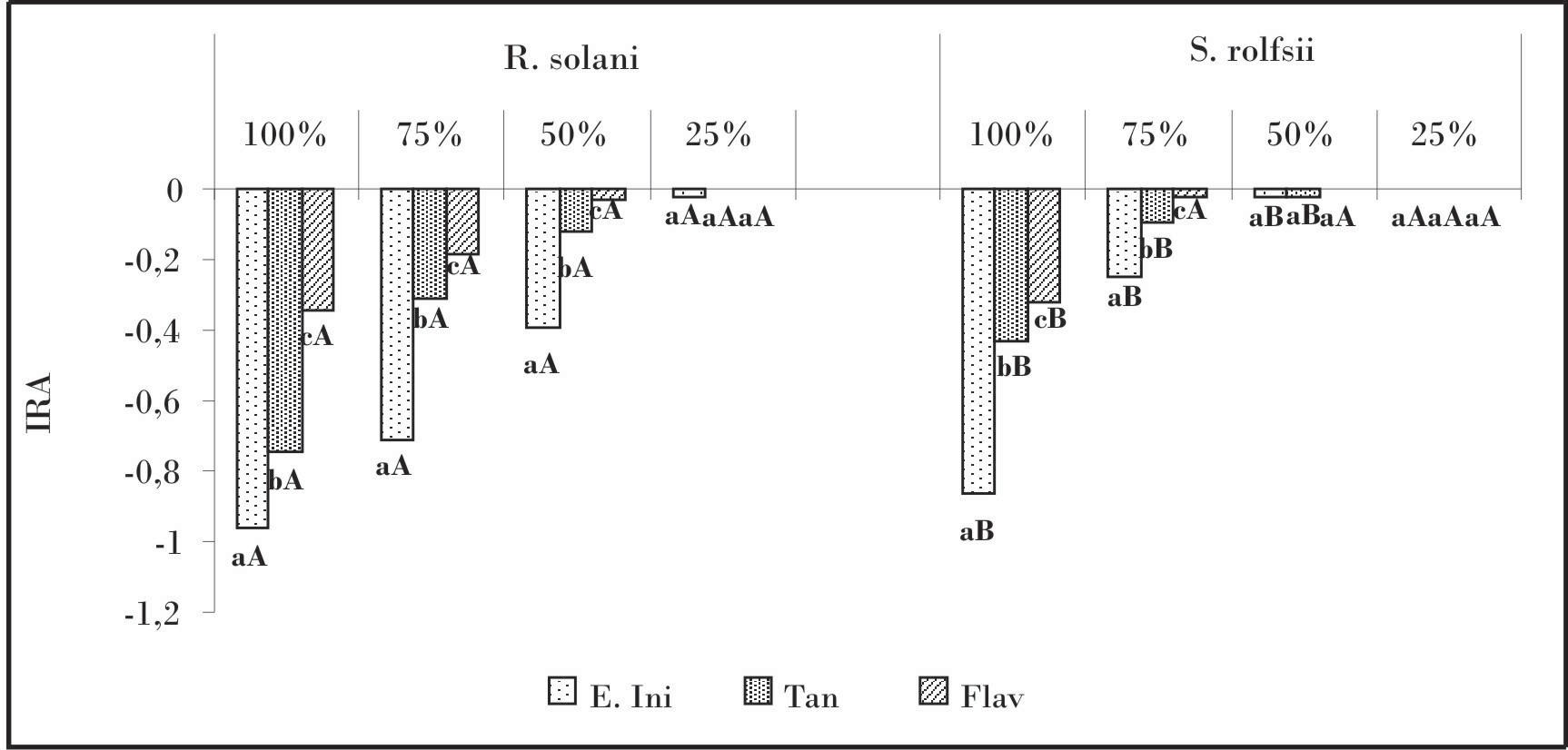
With the main aim of determining either the existence or not of synergy in the allelopathic effect of tannins and flavonoids in Terminalia catappa L. leaves on the mycelial growth of Rhizoctonia solani and Sclerotium rolfsii, a work was developed in the Agriculture Sciences Faculty of the Central University Marta Abreu from Las Villas Cuban province. An isolation of these metabolites was made with Sephadex LH-20 and many dissolutions were probed (100 %, 75 %, 50 % and 25 %). The biological experiments have shown the existence of a synergetic effect in the primary extract where the inhibition level of the mycelial growth was higher than the isolated metabolites. The dilution at 25 % did not show an inhibitory effect in any fungi. R. solani was more susceptible to the action of the extracts at different concentrations.
Article Details

This work is licensed under a Creative Commons Attribution-NonCommercial 4.0 International License.
Those authors who have publications with this journal accept the following terms of the License Attribution-NonCommercial 4.0 International (CC BY-NC 4.0):
You are free to:
- Share — copy and redistribute the material in any medium or format
- Adapt — remix, transform, and build upon the material
The licensor cannot revoke these freedoms as long as you follow the license terms.
Under the following terms:
- Attribution — You must give appropriate credit, provide a link to the license, and indicate if changes were made. You may do so in any reasonable manner, but not in any way that suggests the licensor endorses you or your use.
- NonCommercial — You may not use the material for commercial purposes.
- No additional restrictions — You may not apply legal terms or technological measures that legally restrict others from doing anything the license permits.
The journal is not responsible for the opinions and concepts expressed in the works, they are the sole responsibility of the authors. The Editor, with the assistance of the Editorial Committee, reserves the right to suggest or request advisable or necessary modifications. They are accepted to publish original scientific papers, research results of interest that have not been published or sent to another journal for the same purpose.
The mention of trademarks of equipment, instruments or specific materials is for identification purposes, and there is no promotional commitment in relation to them, neither by the authors nor by the publisher.
How to Cite
References
Argüello, E. V.; E. Yossen; M. Conles: «Efecto del extracto de puerro (Allium porrum L.) sobre la supervivencia de esclerocios de Sclerotium cepivorum», Agriscientia XXVI (1): 23-27, Argentina, 2009.
Beltrán, M. J.; T. Ogura: «Catalasas de hongos fitopatógenos: ¿factores de virulencia y resistencia a los fungicidas», Revista Mexicana de Fitopatología 24 (1): 50-58, México, 2007.
Clares, J. A.; A. R. Canchos; Y. Mejía: «Screening fitoquímico, evaluación de la actividad antiulcerosa y citostática de los extractos obtenidos de las hojas de Rumex crispus L. cotormaza», http://www.BuenasTareas.com (Consultado: 20 de diciembre de 2011).
Elzawely, A.; T. Xuan; S. Tawata: «Allelopathyc Activity and Identification of Allelochemicals From Rimex japonicus Houtt.», Allelopathy Journal 16 (2): 209-216, India, 2006.
Espinosa, R: «Efecto alelopático negativo de los metabolitos secundarios presentes en Terminalia catappa L., Tagetes erecta L. y Tectona grandis L. sobre los hongos Rhizoctonia solani Kühn y Sclerotium rolfsii Sacc.», tesis en opción al título de Máster en Agricultura Sostenible, Departamento de Agronomía, Universidad Central Marta Abreu de Las Villas, Cuba, 2007.
Hagerman, A. E: «Tannin Chemistry», The Tannin Handbook, Oxford University. http://www.muohio.edu.com (Consultado: 12 de junio de 2005).
Junio, H. A.; A. A. Sy-Cordero; K. A. Ettefagh; J. T. Burns; K. T. Micko; T. N. Graf; S. J. Richter; R. E. Cannon; N. H. Oberlies; N. B. Cech: «SynergyDirected Fractionation of Botanical Medicines: a Case Study with Goldenseal (Hydrastis canadensis)», J Nat Prod. 74 (7): 1621-1629, EE. UU., 2011.
Kuete, V.; T. K. Tabopda; B. Ngameni; F. Nana; T. E. Tshikalange; B. T. Ngadjui: «Antimiycobacterial, Antibacterial and Antifungal Activities of Terminalia superba (Combretaceae)», Journal of Ethnopharmacology 120: 494-501, Holanda, 2010.
Lee, S. H.; S. Y. Ryu; S. U. Choi; C. O. Lee; Z. No; S. K. Kim; J. W. Ahn: «Hydrolysable Tannins and Related Compound Having Cytotoxic Activity from the Fruits of Terminalia chebula», Archives of Pharmacal Research 18 (2): 118-120, Alemania, 1995.
Lorenzo, P.; L. González: «Alelopatía: una característica ecofisiológica que favorece la capacidad invasora de las especies vegetales», Ecosistemas 19 (1): 79-91, Vigo, España, 2010.
Minsap: «Medicamentos de origen vegetal: Extracto fluidos y tinturas. Procesos tecnológicos», Norma Ramal de Salud Pública 311/98, La Habana, 1998.
Mlambo, V.; F. L. Mould; T. Smith; E. Owen; J. L. Sikosana; I. Mueller: «In Vitro Biological Activity of Tannin from Acasia and Other Tree Fruits: Correlation with Colorimetric and Gravimetric Phenolic Assays», South African Journal of Animal Science 39 (2): 131-143, Sudáfrica, 2009.
Moreno, M. B.; A. Sánchez; R. Quevedo; M. L. Pabón; J. E. Carulla: «3-o-al-ramnopiranosilflavonoides y otros derivados fenólicos de hojas de Calliandra calothyrsus Meissner. (mimosaceae)», Revista Colombiana de Química 37 (3): 287-295, Colombia, 2008.Palma, M.; Z. Piñeiro; M. Rostagno; C. Barroso: «Ultrasound-Assisted Extraction of Compounds From Foods», Ultrasonics Sonochemestry 4: 135- 138, Holanda, 2006.
Puente, M.; K. Allaert; L. Herrera; N. Suárez; S. Torres; C. Pérez; M. Rodríguez: «Determinación de la actividad alelopática de extractos vegetales sobre algunos hongos fitopatógenos del suelo», Centro Agrícola 30 (1): 64-68, Cuba, 2003.
Sampietro, D. A.: «Definición de alelopatía. Futuro Verde», http://www.pwp.007mundo.com/futuroverde/documentos_658.htmı (Consultado: 10 de noviembre de 2003).
Serrano, S. I.; C. Ragagnin de Menezes; E. Franciscon; E. da Costa dos Santos; L. R. Durrant: «Degradation of Lignosulfonic and Tannic Acids by Ligninolytic Soil Fungi Cultivated Under Icroaerobic Conditions», Brazilian Archives of Biology and Technology 53 (3): 693-699, Brasil, 2010.
Shivanna, M. B.; G. E. Mallikarjunaswamy: «Fungal Diseases and Their Effect on Phytochemical Constituents of Medicinally Important Terminalia species in Bhadra Wildlife Sanctuary, Karnataka, India», Journal Indian Phytopathology 62 (1): 37-43, India, 2009.
Utkhede, R: «Soil Sickness, Replant Problem or Replant Disease and its Integral Control», Allelopathy Journal 18 (1): 23-38, India, 2006.
Vijayalakshmi, A.; A. Tripura; V. Ravichandiran: «Development and Evaluation of Anti-Acne Products from Terminalia arjuna Bark», International Journal of ChemTech Reseve:arch 3 (1): 320-327, EE. UU., 2011.
Wang, Z.; P. Christie; Q. Chen; X. Liu; L. Xie; C. Bai; V Li: «Allelopathyc Potencial and Chemical Constituents of Volatil Oil from Praxelis clematidea», Allelopathy Journal 18 (2): 225-236, India, 2006.