
Enfermedades virales cuarentenarias para Cuba en los cultivos de frijol (Phaseolus vulgaris, P.) y soya (Glycine max (L.) Merrill)
Article Sidebar
Main Article Content
Abstract
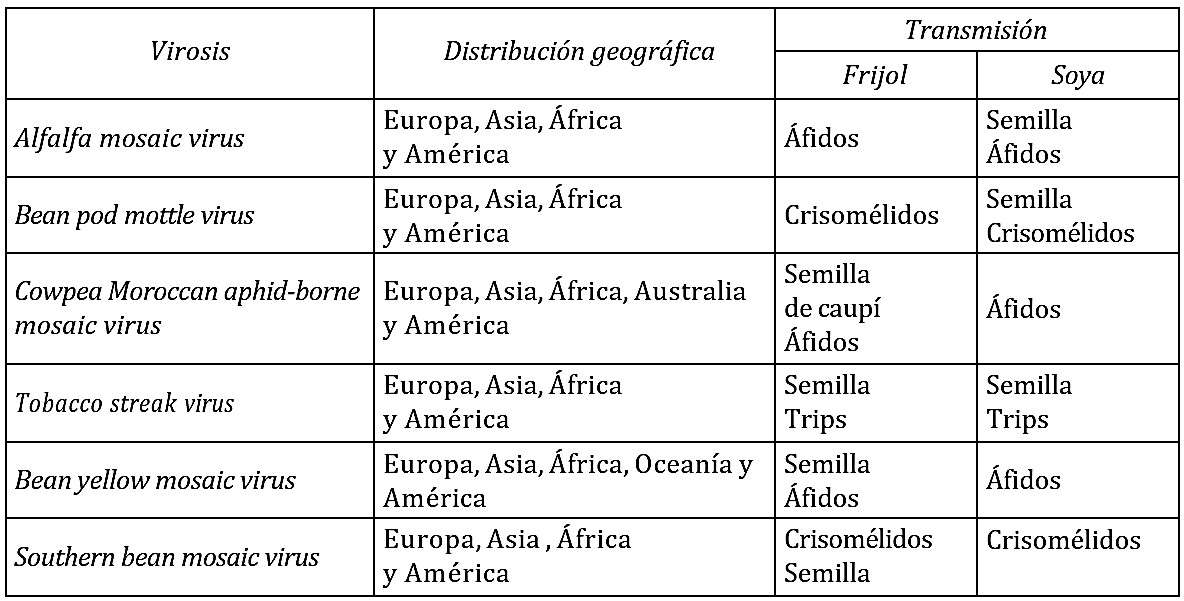
Beans and soybean crops are affected by viral diseases included in the Quarantine Organisms List of Cuban Republic, and which constitute a potential threat to obtain acceptable yields for food security. In order to know main aspects of the virus Alfalfa mosaic virus (AMV), Bean pod mottle virus (BPMV), Cowpea Moroccan aphid-borne mosaic virus (CABMV), Tobacco streak virus (TSV), Bean yellow mosaic virus (BYMV) and Southern bean mosaic virus (SBMV), it was realized searches online, in websites of accredited institutions and in technical standards of the crops. Data revealed the importance of these viruses, which are transmitted by seeds and vector established in the national territory, produce symptoms from light to very severe and cause yield losses. This information has practical use for authorities who take decisions in order to enforce field regulations and maintain the monitoring fitosanitary.
Article Details

This work is licensed under a Creative Commons Attribution-NonCommercial 4.0 International License.
Those authors who have publications with this journal accept the following terms of the License Attribution-NonCommercial 4.0 International (CC BY-NC 4.0):
You are free to:
- Share — copy and redistribute the material in any medium or format
- Adapt — remix, transform, and build upon the material
The licensor cannot revoke these freedoms as long as you follow the license terms.
Under the following terms:
- Attribution — You must give appropriate credit, provide a link to the license, and indicate if changes were made. You may do so in any reasonable manner, but not in any way that suggests the licensor endorses you or your use.
- NonCommercial — You may not use the material for commercial purposes.
- No additional restrictions — You may not apply legal terms or technological measures that legally restrict others from doing anything the license permits.
The journal is not responsible for the opinions and concepts expressed in the works, they are the sole responsibility of the authors. The Editor, with the assistance of the Editorial Committee, reserves the right to suggest or request advisable or necessary modifications. They are accepted to publish original scientific papers, research results of interest that have not been published or sent to another journal for the same purpose.
The mention of trademarks of equipment, instruments or specific materials is for identification purposes, and there is no promotional commitment in relation to them, neither by the authors nor by the publisher.
How to Cite
References
Ahtahi, F.; K. Habibi: «Host Range and Some Characterization of Tobacco streak virus Isolated from Lettuce in Iran», African Journal of Biotechnology 7 (23): 4260-4264, December, Africa, 2008.
Bashir. M.; R. O. Hampton: «Seed and Aphid Transmission of Some Isolates of Blackeye Cowpea and Cowpea Aphid-Borne Mosaic Potyviruses», Pakistán Journal of Phytopathology 6 (2): 140-146, Pakistán, 1994.
Blanco, N.; I. Bencomo: «Afluencia de la mosca blanca (Bemisia tabaci) vector del virus del mosaico dorado en plantaciones de fríjol», Ciencias de la Agricultura 2: 39-46, Cuba, 1978.
Blanco, N.: «Características del virus del moteado amarillo del frijol (BYSV) en Cuba», tesis de opción al grado de candidato a Doctor en Ciencias Agrícolas, Academia de Ciencias de Cuba, La Habana, 1979.
Blanco, N.; N. Lastres: «Presencia en Cuba de las razas amarilla y severa del virus del mosaico del frijol carita (CPMV) sobre frijol», Ciencias de la Agricultura 8: 123-124, Cuba, 1981.
Brunt, A.; K., Crabtree; M. Dallwitz; A. Gibbs; L. Watson; E. Zurcher (eds.): Plant Viruses Online: Descriptions and Lists from the VIDE Database. Versión: 20th August, Inglaterra, 1996, http://www. agls.uidaho.edu/ebi/vdie/refs.htm (Consultado: diciembre 2011).
Byamukama, E.; A. Robertson: F. Nutter: «Quantifying the Within-Field Temporal and Spatial Dynamics of Bean pod mottle virus in Soybean», Plant Disease 95 (2): 126-136, EE. UU., 2011.
CAB International: Crop Protection Compendium, edition Walling, Inglaterra, 2007.
Cabrera, M.; N. Nicolaus; M. J. Mendoza: «Tolerancia a la sequía de cultivares de frijol común», Revista Agrisost 17 (3): 9, Cuba, 2011.
Davis, R.; E. Miyao; J. Stapleton: Diseases. UC IPM Pest Management Guidelines Publication 3470. http://www.ipm.ucdavis.edu/PMG/ r783101411.html). EE. UU. 2007.
Duraisamy, G.; R. Pokomý; L. Holková: «Possibility of Bean yellow mosaic virus Detection in Gladiolus Plants by Different Methods», Journal of Plant Diseases and Protection 118 (1): 2-6, Checoeslovaquia, 2011.
Echemendia, A. L.; P. Ramos; R. Peral; A. Fuentes; Gloria González; J. Sanpedro; F. Morales: «Cuban Isolate of Bean golden mosaic yellow virus is a Member of the Mesoamerican BGYMV Group», Plant Disease 85: 1030, EE. UU., 2001.
Edwardson, J. R.; R. G. Christie: «Viruses Infecting Peppers and Other Solanaceous Crops», Viruses Infecting Peppers and Other Solanaceous Crops, vol. 1, Gainesville, Florida, University of Flori- da, EE. UU., 1997
EPPO (European and Mediterranean Plant Protection Organization): Database on Quarantine Pests, http://www.eppo.org (Consultado: enero-marzo 2011; enero-abril 2012).
Fernández, R.: «Presencia de enfermedades virosas en soya, en diferentes zonas de Cuba», Ciencias de la Agricultura 18: 10-15, Cuba, 1984.
Laguna, I. G.; P. Rodríguez y G. Truol: «Enfermedades de etiología virosa en cultivos de soja (Glycine max (L) Merr) en la Argentina», Fitopatología Brasilera 13(3): 192-198, Brasil,1988.
Laguna, I.; Magdalena Fiorona; D. L. Ploper, R. Gálvez; Patricia Rodríguez:
«Prospección de enfermedades virales del cultivo de soja en distintas áreas de producción de Argentina y bajo distintos sistemas de labranzas», Fitopatología 42 (2): 65-72, Argentina, 2007.
Laguna, I. G.; P. Rodríguez; G. Truol; M. Fiorona; C. Fernanda; L. Di Feo y V. Alejandri: Enfermedades causadas por virus en soja en Argentina, Ediciones Instituto Nacional de Tecnología Nacional (INTA), Argentina, 2008.
Lastres, N.: «El virus del mosaico común del frijol en Cuba», Ciencias de la Agricultura 10: 113-114, Cuba, 1981.
Minag: «Resolución no. 604, Ministerio de la Agricultura, La Habana, 14 de agosto de 2008».
Mueller, E. E.; C. R. Grau: «Seasonal Progression, Symptom Development, and Yield Effects of Alfalfa mosaic virus Epidemics on Soybean in Wisconsin», Plant Dis. 91: 266-272, EE. UU., 2007.
Ojuederie, O; B. Odu; C. Ilori: «Serological Detection of Seed Borne Viruses in Cowpea Regenerated Germplasm Using Protein a Sandwich Enzyme Linked Inmusorbent Assay», African Crops Science Journal 7 (3): 125-132, África, 2009.
Ponce, M.; R. Ortiz; C. de la Fe: «Informe de nuevas variedades: INCASOY-1: variedad de soya Glycine max L. Merrill) para usos múltiples», Cultivos Tropicales 28 (1): 57, Cuba, 2007.
Tremaine, J.; R. Hamilton: «Southern Bean mosaic virus», Descriptions of Plant Viruses no. 274, CMI/AAB, Kew, Surrey, Inglaterra, 1983.
Ugwuoke, K.; C. Onyeke: «Bean Pod Mottle Virus (BPMV) (Genus Comovirus): A Limiting Factor in the Production of Soybean (Glycine max (L.) Merril) in Humid Tropical Zone of Nigeria», Bio- Research 8 (1): 571-578, Nigeria, 2010.
Ziems, A.; Loren Giesler; G. Graef; Margaret Redinbaugh; J. Vacha; SueAnn Berry; L. Madden; Anne Dorrance: «Response of Soybean Cultivars to Bean pod mottle virus Infection», Plant Disease 91 (6): 721-726, EE. UU., 2007.