
Identificación de enemigos naturales de Diaphorina citri Kuwayama (Hemiptera: Psyllidae) en el estado de Yucatán, México
Article Sidebar
Main Article Content
Abstract
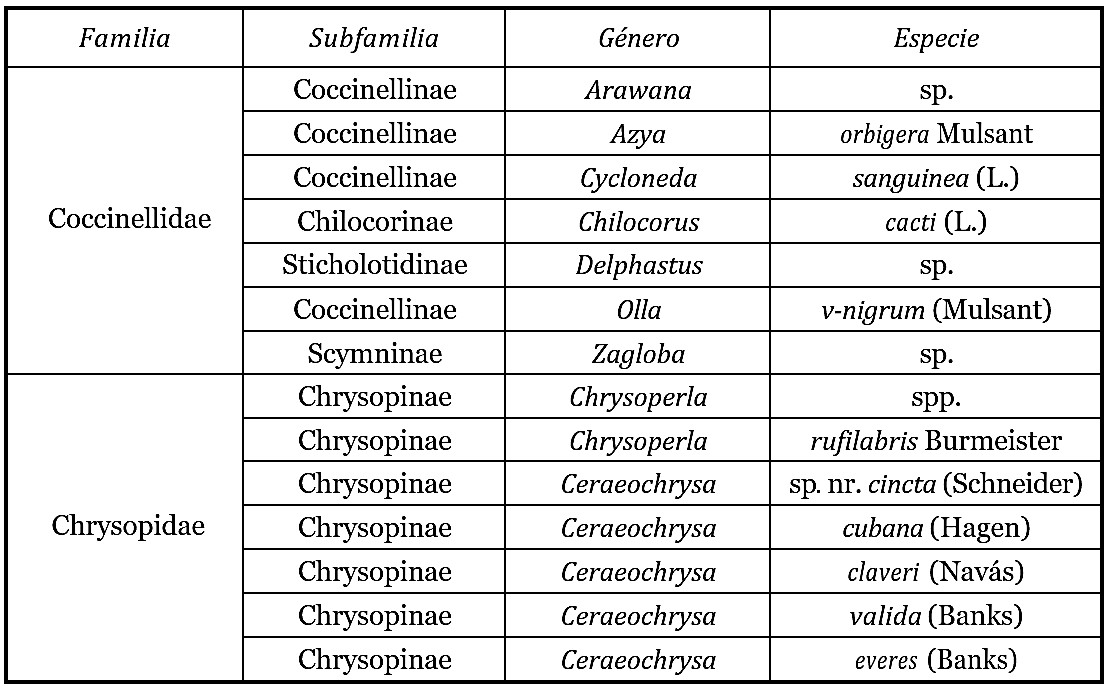
To implement a biological control program, it is important first to have a background of the natural enemies present in the region. The objective of the present study was to identify and record the distribution and abundance of natural enemies of D. citri in commercial orchards of citrus in Yucatán State. There were surveyed 92 commercial orchards in 18 municipalities of the State from April to September in 2010, and quantified and identify the population of predators in their different stages of development. Seven species belonging to the Coccinellidae family were identified (Arawana sp., Azya orbigera, Cycloneda sanguinea, Chilocorus cacti, Delphastus sp., Olla v-nigrum, Zagloba sp.) and seven species of the Chrysopidae family (Chrysoperla spp., Chrysoperla rufilabris, Ceraeochrysa sp. nr. cincta, Ceraeochrysa cubana, Ceraeochrysa claveri, Ceraeochrysa valida, Ceraeochrysa everes). The abundance of predators among cultivated citrus species was higher in Persian lime with 33 %, followed by Mandarin with 28.7 %, sweet orange with 22.25 %, Italian lemon with 10.55 % and finally grapefruit with 5.28 %. The greatest abundance of predators was observed in the southern region of the State with 56.63 %, followed by the northern region with 41 %, and the west region with 2.29 %.
Article Details

This work is licensed under a Creative Commons Attribution-NonCommercial 4.0 International License.
Those authors who have publications with this journal accept the following terms of the License Attribution-NonCommercial 4.0 International (CC BY-NC 4.0):
You are free to:
- Share — copy and redistribute the material in any medium or format
- Adapt — remix, transform, and build upon the material
The licensor cannot revoke these freedoms as long as you follow the license terms.
Under the following terms:
- Attribution — You must give appropriate credit, provide a link to the license, and indicate if changes were made. You may do so in any reasonable manner, but not in any way that suggests the licensor endorses you or your use.
- NonCommercial — You may not use the material for commercial purposes.
- No additional restrictions — You may not apply legal terms or technological measures that legally restrict others from doing anything the license permits.
The journal is not responsible for the opinions and concepts expressed in the works, they are the sole responsibility of the authors. The Editor, with the assistance of the Editorial Committee, reserves the right to suggest or request advisable or necessary modifications. They are accepted to publish original scientific papers, research results of interest that have not been published or sent to another journal for the same purpose.
The mention of trademarks of equipment, instruments or specific materials is for identification purposes, and there is no promotional commitment in relation to them, neither by the authors nor by the publisher.
How to Cite
References
Alemán, J.; B. Heyker; J. Ravelo: «Diaphorina citri y la enfermedad Huanglongbing: una combinación destructiva para la producción citrícola», Revista de Protección Vegetal 22 (3): 154-165, Cuba,
Alvis, L.; A. Raimundo; M. Villalba; F. García-Marí: «Identificación y abundancia de coleópteros coccinélidos en los cultivos de cítricos valencianos», Boletín de Sanidad. Vegetal Plagas 28: 479-491, España, 2002.
Díaz-Zorrilla, U.; J. I. López-Arroyo; H. Cabrera-Mireles; F. D. Murillo- Cuevas; J. A. Villanueva-Jiménez: «Evaluación de insecticidas selectivos para controlar Diaphorina citri en naranja valencia (Citrus sinensis (L.) Osbeck.) en Veracruz», I Simposio Nacional sobre Investigación para el Manejo del Psílido Asiático de los Cítricos y el Huanglongbing en México ,408-420, México, 2010.
Figueira, L. K.; F. M. Lara; I. Cruz: «Efeito de genótipos de sorgo sobre o predador Chrysoperla externa (Hagen) (Neuroptera: Chrysopidae) alimentado con Schizaphis graminum (Rondani) (Hemiptera: Aphididae)», Neotropical Entomology, Londrina 31 (1): 133-139, Brasil, 2002.
González, C.; D. Hernández, R. I. Cabrera; J. R. Tapia: «Diaphorina citri Kuw., inventario y comportamiento de los enemigos naturales en la citricultura cubana», FAO Cuba, 2005, p. 11.
Graca, J. V. da; L. Korsten: «Citrus Huanglongbing: Review, Present Status and Future Strategies», Diseases of Fruits and Vegetables, vol. 1. 229-245, Kluwer Academic Publishers, EE. UU., 2004.
Hernández-Fuentes, L. M.; M. A. Urias-López; J. I. López-Arroyo; R. Gómez-Jaimes; N. Bautista-Martínez: «Control químico de Diaphorina citri Kuwayma (Hemiptera: Psyllidae) en lima persa Citrus latifolia Tanaka», Revista Mexicana de Ciencias Agrícolas (3) 3: 427-439, México, 2012.
Hoy, M. A.; R. Nguyen; A. Jeyaprakash: «Classical Biological Control of the Asian Citrus Psylla-release of Tamarixia radiata», Citrus Indust. 80: 20-22, EE. UU., 1999.
Jasso-Argumedo, J.; M. G. Lozano-Contreras; H. Barroso-Aké; D. M. Morales-Koyoc; H. Guillén-Solís; Y. Chan-May; L. Magaña-Martínez: «Fluctuación poblacional de Diaphorina citri Kuwayama (Hemiptera: Psyllidae) en limón persa Citrus latifolia Tan. en la etapa de desarrollo», II Simposio Nacional sobre Investigación para el Manejo del Psílido Asiático de los Cítricos y el Huanglongbing en México, pp 203-209, México, 2011.
Michaud, J. P.: «Numerical Response of Olla v-nigrum (Coleoptera: Coccinellidae) to Infestations of Asian Citrus Psyllid (Hemiptera: Psyllidae) in Florida», Florida Entomology 84: 608-612, EE. UU., 2001.
Michaud, J. P.: «Biological Control of Asian Psyllid, Diaphorina citri (Hemiptera: Psyllidae) in Florida: a Preliminary Report», Entomological News 113: 216-222, EE. UU., 2002.
Michaud, J. P.: «Natural Mortality of Asian Citrus Psyllid (Homoptera: Psyllidae) in Central Florida», Biological Control 29: 260-269, EE. UU., 2004.
Mc Farland, C.; M. Hoy: «Survival of Diaphorina citri (Homoptera: Psyllidae), and its Two Parasitoids, Tamarixia radiata (Hymenoptera: Eulophidae) and Diaphorencytus aligarhensis (Hymenoptera: Encyrtidae) Under Different Relative Humidities and Temperature Regimes», Florida Entomologist 84 (2): 227-233, EE.UU., 2001.
NAPPO: «Seguimiento a la detección del Psílido Asiático de los Cítricos Diaphorina citri Kuwayama (Hemiptera: Psyllidae) en Tijuana, Baja California, México», Sistema de Alerta Fitosanitaria SAF, 2008.
Pelz-Stelinski, K. S.; M. Rogers; R. Brlansky: «Vector Pathogen Interactions: Transmission of Candidatus Liberibacter asiaticus and its Effect on Asian citrus Psyllid Life History», II Annual Citrus Health Research Forum, Denver, Co, 4-6 October 2011, EE.UU., 2011, p.10.
Pluke, W. H. R.; A. Escribano; J. P. Michaud; P. A. Stansly: «Potential Impact of Lady Beetles on Diaphorina citri (Homoptera: Psyllidae) in Puerto Rico», Florida Entomology 22: 123-128, EE.UU., 2005.
Qureshi, J. A.; P. A. Stansly: «Integrated Approaches for Managing the Asian Citrus Psyllid Diaphorina citri (Homoptera: Psyllidae) in Florida», Proceedings Florida State Horticultural Society 3-4 june 2007, Palm Beach, Fl., 2007, pp.110-115.
Rogers, M. E.: «General Pest Management Considerations», Citrus Industry 89: 12-17, EE.UU., 2008.
Shankar, U.; K. M. De Angelis; Trivedi, P; G. L. Andersen; E. Shi-Lu; N. Wang: «Bacterial Diversity Analysis of Huanglongbing Pathogen-Infected Citrus, Using PhyloChip Arrays and 16S Rrna Gene Clone Library Sequencing», Applied and Environmental Microbiology 75: 1, 566-1574, EE.UU., 2009.
Servicio de Información Agroalimentaria y Pesquera. (SIAP): «Producción anual, estatal, distrital y municipal», SAGARPA, México, http://www.siap.gob.mx/index.php?option=com_wrapper&view=wrapper &Itemid=351 (Consultado: octubre, 2011.
Thomas, D. B: «Trip Report: Status of the Brown Citrus Aphid in the Mexican State of Campeche: April 2002» , USDA-ARS. Kika de la Garza Subtropical Agriculture Research Center, Weslaco, Texas, EE. UU., p. 9, 2002.
Tsai J. H; Y. H. Liu: «Biology of Diaphorina citri (Homoptera: Psyllidae) on Four Host Plants», Journal Economic Entomology 93 (6): 1721- 1725, EE. UU., 2000.