
Micobiota asociada a lotes importados de semillas de moringa (Moringa oleifera)
Article Sidebar
Main Article Content
Abstract
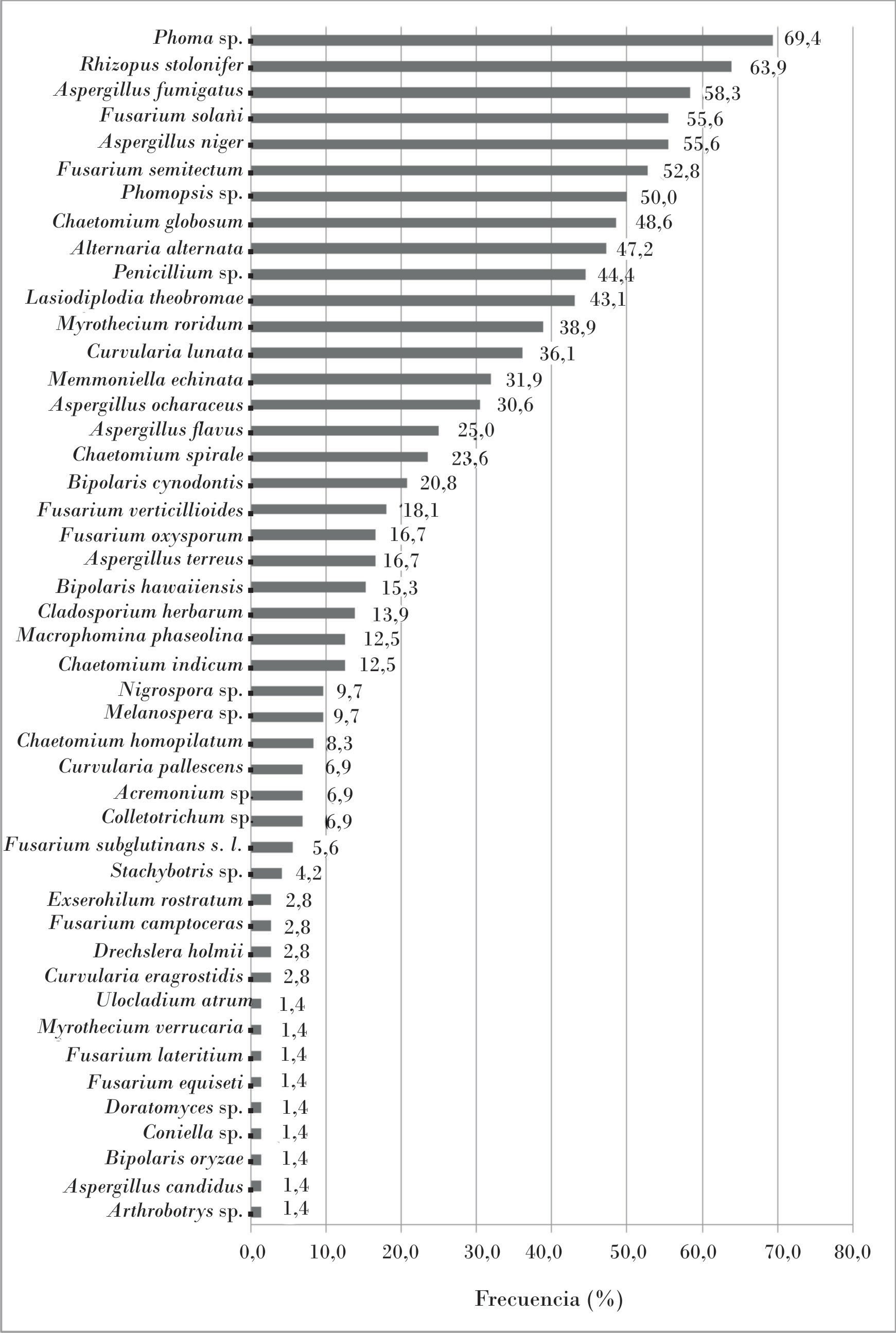
Drumstick tree or horse radish tree (Moringa oleífera Lam.) is a highly valued plant, widely cultivated in the tropics and subtropics with many uses as human and animal food, with medicinal and antimicrobial properties and its oil is considered a source of biofuels. For these reasons, Cuba has imported seed lots from different origins to spread this crop in the country. The objective of the present study was to determine mycobiota associated to drumstick imported seeds lots by blotter test methods and classic taxonomy for the identification of fungal species. 400 seeds from each 73 lot from 12 countries were analized by blotter test. A great fungal biodiversity with a total of 708 isolates belonging to 47species of 26 genera was detected. Fusarium, Aspergillus and Chaetomium, with 8, 6 and 4 species identified, were the predominant genera constituting 44.35 % of all isolates. More frequent detected species were Phoma sp. (69.4 %), Rhizopus stolonifer (63.9 %), Aspergillus fumigatus (58.3 %), Fusarium solani (55.6 %), Aspergillus niger (55.6 %), Fusarium semitectum (52.8 %), Phomopsis sp. (50 %) y Chaetomium globosum (48.6 %). From detected species only Bipolaris hawaiiensis, Cladosporium herbarum, Fusarium semitectum, Lasiodiplodia theobromae and Rhizopus stolonifer have been described as drumstick pathogens.
Article Details

This work is licensed under a Creative Commons Attribution-NonCommercial 4.0 International License.
Those authors who have publications with this journal accept the following terms of the License Attribution-NonCommercial 4.0 International (CC BY-NC 4.0):
You are free to:
- Share — copy and redistribute the material in any medium or format
- Adapt — remix, transform, and build upon the material
The licensor cannot revoke these freedoms as long as you follow the license terms.
Under the following terms:
- Attribution — You must give appropriate credit, provide a link to the license, and indicate if changes were made. You may do so in any reasonable manner, but not in any way that suggests the licensor endorses you or your use.
- NonCommercial — You may not use the material for commercial purposes.
- No additional restrictions — You may not apply legal terms or technological measures that legally restrict others from doing anything the license permits.
The journal is not responsible for the opinions and concepts expressed in the works, they are the sole responsibility of the authors. The Editor, with the assistance of the Editorial Committee, reserves the right to suggest or request advisable or necessary modifications. They are accepted to publish original scientific papers, research results of interest that have not been published or sent to another journal for the same purpose.
The mention of trademarks of equipment, instruments or specific materials is for identification purposes, and there is no promotional commitment in relation to them, neither by the authors nor by the publisher.
How to Cite
References
Abdullah, S. K.; K. A. Al-Mosawi: «Fungi Associated with Seeds of Sunflower (Helianthus annuus) Cultivars Grown in Iraq», Phytopathologia 57: 11-20, Polonia, 2010.
Amadi, J. E.; D. O. Adeniyi: «Mycotoxin Production by Fungi Isolated from Stored Grains», African Journal of Biotechnology 8 (7):1219- 1221, Kenya, 2009.
Anwar, F.; S. Latif; M. Ashraf; A. H. Gilani: «Moringa oleifera: A Food Plant with Multiple Medicinal Uses», Phytotherapy Research 21: 17- 25, EE.UU., 2007.
Burgess, T. I.; S. Mohali; G. Pegg; W. de Beer; M.J. Wingfield: «Three New Lasiodiplodia spp. from the Tropics, Recognized Based on DNA Sequence Comparison and Morphology», Mycologia 98 (3): 423-435, EE.UU., 2006.
Ellis, M. B.: Dematiaceous Hyphomycetes CMI, Kew, Surrey, Reino Unido, 1971.
Enikuomehin, O. A.; E. O. Oyedeji: «Fungitoxic Effect of Some Plant Extracts Against Tomato Fruit Rot Pathogens», Archives of Phytopathology and Plant Protection 43 (3): 233-240, Reino Unido, 2010.
Farr, D. F.; A. Y. Rossman: «Fungal Databases», Systematic Mycology and Microbiology Laboratory, ARS, USDA, http://nt.ars-grin.gov/fun-galdatabases/index.cfm. EE.UU., 2012. (consultado el 8 de marzo de 2012).
Ishnava, K. B.; K. H. Chauhan; C. A. Bhatt: «Screening of Antifungal Activity of Various Plant Leaves Extracts from Indian Plants», Archi ves of Phytopathology and Plant Protection 45 (2): 152-160, Reino Unido, 2012.
Ismail, M.; S. A. Anwar; M. I. Ul-Haque; A. Iqbal; N. Ahmad; M. A. Arain: «Seed-Borne Fungi Associated with Cauliflower Seeds and Their Role in Seed Germination», Pak. J. Phytopathol. 24 (1): 26-31, Pakistán, 2012.
ISTA: «International Rules for Seed Testing», Seed Science Technology 24: 1-335, Suiza, 1996.
Klich, M. A.; J. I. Pitt: A Laboratory Guide to the Common Aspergillus Species and Their Teleomorphs. Commonwealth Scientific and Industrial Research Organization, Australia, 1988.
Krishnamurthy, Y. L.; J. Shashikala; B. Shankar Naik: «Antifungal Potential of Some Natural Products Against Aspergillus flavus in Soybean Seeds During Storage», Journal of Stored Products Research, 44: 305-309, Holanda, 2008.
Kshirsagar, C. R.; T. F. D´Souza: «A New Disease of Drumstick», Journal of Maharashtra Agricultural Universities 14 (2): 241-242, India, 1989.
Leslie J.; B. Summerell: The Fusarium Laboratory Manual, Blackwell Publishing, Ames Iowa, EE.UU., 2006.
Lezcano, J. C.; B. Martínez; O. Alonso: «Detección de Chaetomium indicum Corda asociado a semillas de Leucaena leucocephala cv. Perú», Revista Protección Vegetal, 21 (3): 191-193, Cuba, 2006.
Mandokhot, A. M.; P. A. Fugro; S. B. Gonkhalekar: «A New Disease of Moringa oleifera in India», Indian Phytopathology 47 (4): 443, India, 1994.
Mena, J.: «Taxonomía del complejo Bipolaris, Curvularia, Drechslera y Exserohilum en Cuba», tesis en opción al grado científico de Doctor en Ciencias Biológicas, Facultad de Biología, Universidad de La Habana, 2004.
Minter, D. W.: «Chaetomium globosum», IMI Descriptions of Fungi and Bacteria, Sheet 1685, Reino Unido, 2006 a.
Minter, D. W.: «Chaetomium indicum» IMI Descriptions of Fungi and Bacteria, Sheet 1687, Reino Unido, 2006 b.
Neergaard, P.: Seed Pathology. MacMillan Press LTD. vols. 1 y 2, Reino Unido.1988. pp. 165, 462.
Niaz, I.; S. Dawar: «Detection of Seed Borne Mycoflora in Maize (Zea mays L.)», Pak. Journal of Botany 41 (1): 443-451, Pakistán, 2009.
Pérez, A.; T. Sánchez; N. Armengol; F. Reyes: «Características y potencialidades de Moringa oleifera, Lamark. Una alternativa para la alimentación animal», Pastos y Forrajes 33 (4): 1-16, Cuba, 2010.
Rahman, Z.; Z. Alam; A. Nurul: «A Comparative Investigation on the Physio-Chemical Properties and Some Selected Enzymes Content in the Flesh of Healthy and Rhizopus stolonifer Infected Moringa Fruit», Indian Phytopathology 54 (3): 293-298, India, 2001.
Rahmatullah, M.; A. Noman; S. Hossan; Md. Harun-Or-Rashid; T. Rahman; M. H. Chowdhury; J. Rownak: «A Survey of Medicinal Plants in Two Areas of Dinajpur district, Bangladesh Including Plants Which Can Be Used As Functional Foods», American-Eurasian Journal of Sustainable Agriculture 3 (4): 862-876, Jordania, 2009.
Rashid, U.; F. Anwar; B. R. Moser; G. Knothe: «Moringa oleifera oil: A possible Source of Biodiesel», Bioresource Technology 99 (17) 8175-8179, Holanda, 2008.
Riba, A.; S. Mokrane; F. Mathieu; A. Lebrihi; N. Sabaou: «Mycoflora and Ochratoxin A Producing Strains of Aspergillus in Algerian Wheat», International Journal of Food Microbiology, 122: 85-92, Holanda, 2008.
Rocha, M. F. G.; F. L. Nascimento de Aguiar; R. S. Nogueira; R. de Aguiar; C. E. Cordeiro; D. de Souza; M. Castelo-Branco; M. Neto; J. P. Otaviano; J. MafezoliI; C. M. de Souza, F. G. Barbosa; J. J. Costa: «Moringa oleifera and Vernonia sp. Extracts Against Candida albicans and Microsporum canis Isolates from Dogs and Cats and Analysis of Toxicity to Artemia sp.», Ciência Rural 41 (10):1807-1812, Brasil, 2011.
Seifert, K. A.; G. Morgan-Jones; W. Gams; B. Kendrick: The Genera of Hyphomycetes, CBS Biodiversity Series 10.CBS-KNAW Fungal Biodiversity Centre, Holanda, 2011.
Sutton, B. C.: The Coelomycetes Surrey: CABI Publications, Reino Unido, 1980.
Sharfun-Nahar, Mushtaq M., Hashmi M. H.: «Seed-Borne Mycoflora of Sunflower (Helianthus annuus L.)», Pakistan Journal of Botany 37: 451-458, Pakistán, 2005.
Sumanth, G. T.; B. M. Waghmare; S. R. Shinde: «Incidence of Mycoflora from the Seeds of Indian Main Spices», African Journal of Agricultural Research 5 (22): 3122-3125, Nigeria, 2010.
Talreja, T: «Screening of Crude Extract of Flavonoids of Moringa oleifera Against Bacteria and Fungal Pathogens», Journal of Phytology 2: 31-5, Japón, 2010.
Watanabe, T.: Pictorial Atlas of Soil and Seed Fungi: Morphologies of Cultured Fungi and Key to Species, CRC Press LLC, Boca Raton, Florida, EE.UU., 2002.
Zhao, J.; Y. Zhang; L. Wang; J. Wang; C. Zhang: «Bioactive Secondary Metabolites from Nigrospora sp. LLGLM003, an Endophytic Fungus of the Medicinal Plant Moringa oleifera Lam», World Journal of Microbiology and Biotechnology 28 (5): 2107-2112, Holanda, 2012.