
La acelga china, nuevo hospedante en Cuba de Hyaloperonospora parasitica
Article Sidebar
Main Article Content
Abstract
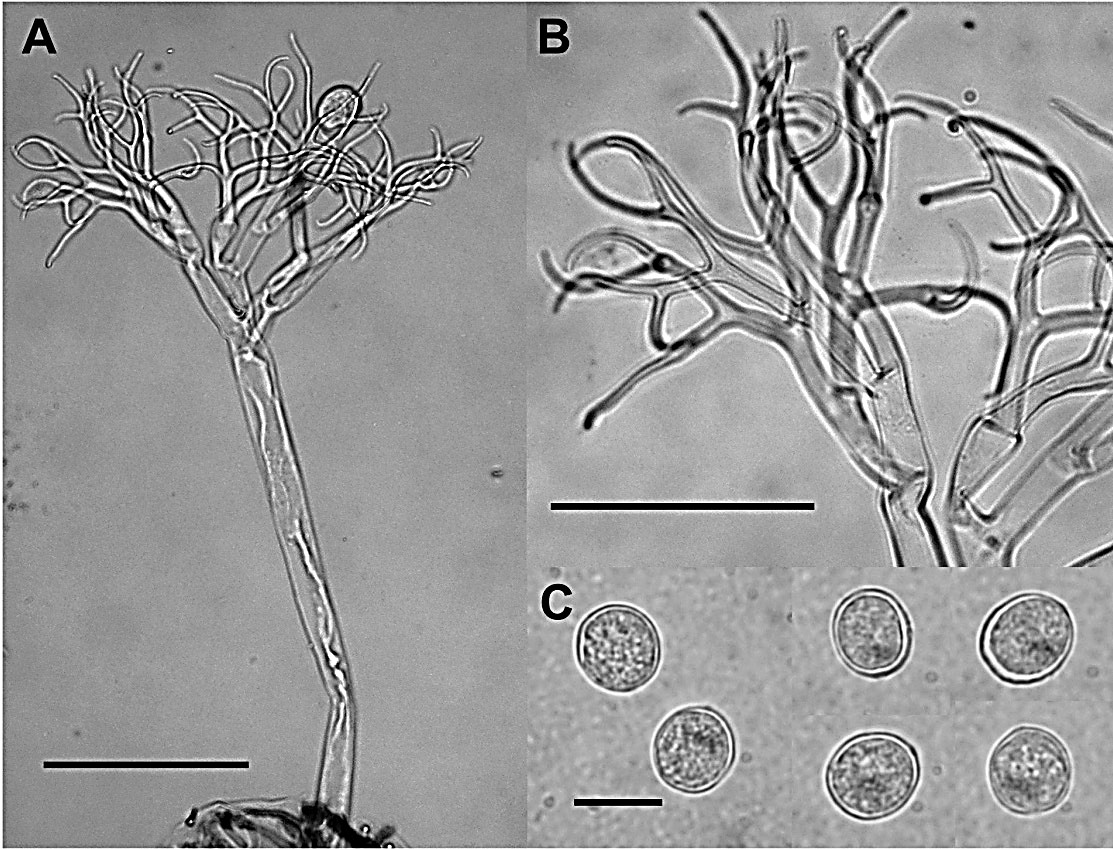
During the second two weeks of February 2013, plants of green pack choi var. Cantón with foliar chlorosis and necrosis were detected in Organopónico 23 de Diciembre, Sancti Spíritus province. A characteristic downy mildew growth was evident on the lower surface of infected leaves. With the objective of identified the causal agent of these symptoms, chlorotic leaves were analyzed by blotter test method. Conidiophores and conidia were morphologically characterized. Pathogenicity tests were carried out three times by inoculating leaves healthy plants of green pack choi var. Cantón, with a conidial suspension (1 × 10⁵ conidia/mL). Non-inoculated plants served as controls. In all analyzed and inoculated plants, hyaline conidiophores, 350-520 x 10-20 μm, with final branches usually strongly curved were observed. Conidia hyaline, 23-29 x 20-24 µm (length/width = 1.15-1.21) are similar to those described for Hyaloperonospora parasitica. This is the first report of a H. parasitica on green pack choi in Cuba.
Article Details

This work is licensed under a Creative Commons Attribution-NonCommercial 4.0 International License.
Those authors who have publications with this journal accept the following terms of the License Attribution-NonCommercial 4.0 International (CC BY-NC 4.0):
You are free to:
- Share — copy and redistribute the material in any medium or format
- Adapt — remix, transform, and build upon the material
The licensor cannot revoke these freedoms as long as you follow the license terms.
Under the following terms:
- Attribution — You must give appropriate credit, provide a link to the license, and indicate if changes were made. You may do so in any reasonable manner, but not in any way that suggests the licensor endorses you or your use.
- NonCommercial — You may not use the material for commercial purposes.
- No additional restrictions — You may not apply legal terms or technological measures that legally restrict others from doing anything the license permits.
The journal is not responsible for the opinions and concepts expressed in the works, they are the sole responsibility of the authors. The Editor, with the assistance of the Editorial Committee, reserves the right to suggest or request advisable or necessary modifications. They are accepted to publish original scientific papers, research results of interest that have not been published or sent to another journal for the same purpose.
The mention of trademarks of equipment, instruments or specific materials is for identification purposes, and there is no promotional commitment in relation to them, neither by the authors nor by the publisher.
How to Cite
References
AGRINFOR: Manual Técnico de organopónicos y huertos intensivos, Grupo Nacional de Agricultura Urbana, Ministerio de la Agricultura, Cuba, 2000.
Camino, M.; J. Mena; D. W. Minter: «Hongos de Cuba», www.cybertruffle. org.uk/cubafung [sitio internet, versión 1.00], Cuba, 2006 (consultado: 9 de abril de 2013).
Constantinescu, O.; J. Fatehi: «Peronospora-like Fungi (Chromista, Peronosporales) Parasitic on Brassicaceae and Related Hosts», Nova Hedwigia 74: 291-338, Israel, 2002.
Farr, D. F.; A. Y. Rossman: «Fungal Databases» Systematic Mycology and Microbiology Laboratory ARS, USDA,EE.UU.», http://nt.ars-grin. gov/fungaldatabases/index.cfm (consultado: 9 de abril de 2013).
Hong, S. Y.; H. J. Jee; Y. J. Choi; H. D. Shin: «First Confirmed Report of Downy Mildew Caused by Hyaloperonospora parasitica on Broccoli in Korea», Plant Pathology 57: 777, Inglaterra, 2008.