
Efecto del Nemacid sobre Meloidogyne incognita en cultivo protegido de pepino (Cucumis sativus)
Article Sidebar
Main Article Content
Abstract
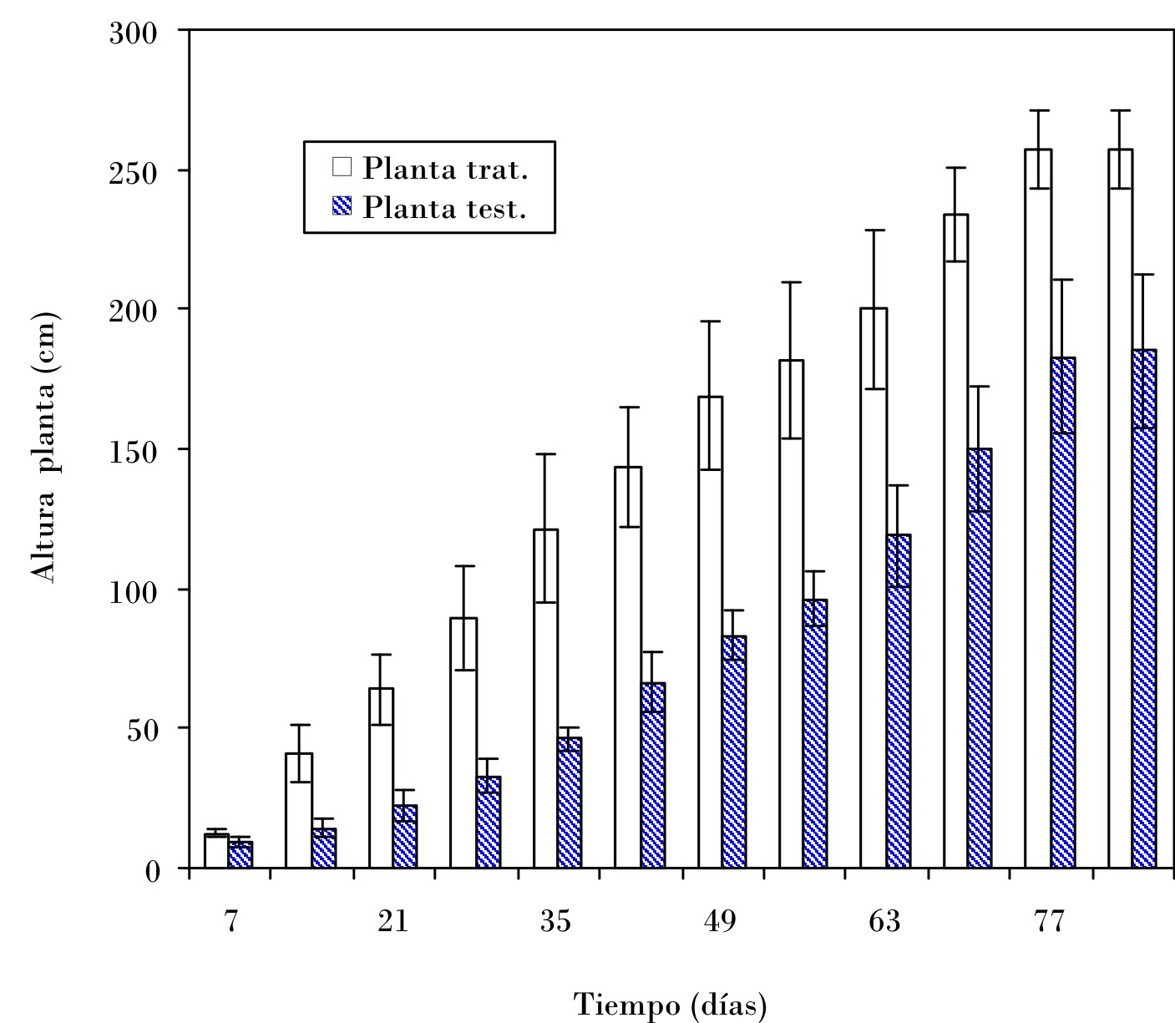
Bioprocess Plant (Cuba-10, ICIDCA) in Havana produced Nemacid (wettable powder), whose active ingredients are metabolites obtained from the effluents of submerged fermentation of Lecanicillium lecanii. This work had the objective of evaluating Nemacid effect on Meloidogyne incognita in cucumber protected crops, by an experimental design with two blocks of ten samples, two of them without treatment and the rest using doses of 30 kg/ha, in four applications and seven days frequency. The nematode infestation degree (IA) and the vegetative development of a cucumber crop were evaluated. A high effectiveness against M. incognita was achieved (90-95 %) with an optimal vegetative development. The infestation degree decreased from 5 in the precedent tomato crop to 1 and 0 in cucumber, ratifying its effectiveness for handling the M. incognita populations. Nemacid has proved to be an alternative in an integrated management programme in protected vegetable production.
Article Details

This work is licensed under a Creative Commons Attribution-NonCommercial 4.0 International License.
Those authors who have publications with this journal accept the following terms of the License Attribution-NonCommercial 4.0 International (CC BY-NC 4.0):
You are free to:
- Share — copy and redistribute the material in any medium or format
- Adapt — remix, transform, and build upon the material
The licensor cannot revoke these freedoms as long as you follow the license terms.
Under the following terms:
- Attribution — You must give appropriate credit, provide a link to the license, and indicate if changes were made. You may do so in any reasonable manner, but not in any way that suggests the licensor endorses you or your use.
- NonCommercial — You may not use the material for commercial purposes.
- No additional restrictions — You may not apply legal terms or technological measures that legally restrict others from doing anything the license permits.
The journal is not responsible for the opinions and concepts expressed in the works, they are the sole responsibility of the authors. The Editor, with the assistance of the Editorial Committee, reserves the right to suggest or request advisable or necessary modifications. They are accepted to publish original scientific papers, research results of interest that have not been published or sent to another journal for the same purpose.
The mention of trademarks of equipment, instruments or specific materials is for identification purposes, and there is no promotional commitment in relation to them, neither by the authors nor by the publisher.
How to Cite
References
Casanova, A. S.; O. Gómez; M. Hernández; M. Chailloux; T. Depestre; F. R. Pupo: Manual para la producción protegida de hortalizas, IIH L. Dimitrova, La Habana, 2007, 13 pp.
Cuadra, R; J. Ortega; O. L. Morfi; L. Soto; M. A. Zayas; E. Perera: «Efecto de los productos biológicos Trifesol y Nemacid sobre los nematodos de las agallas en la producción protegida de hortalizas», Rev. Protección Vegetal 23 (1): 59-62, Cuba, 2008.
Gómez, E.; R. M. Álvarez; A. N. San Juan; M. A. Zayas; R. Fraga; X. Cruz; J. Hernández; T. Lemes; I. Reyes; G. Croche: «Empleo de los efluentes del hongo Verticillium lecanii con fines biocontroladores», VII Congreso Internacional sobre Azúcar y Derivados de la Caña, Palacio de Convenciones, La Habana, 17-21 de junio, 2002.
Gómez, E.; R. M. Álvarez; M. A. Zayas; X. Cruz: «Efectividad biológica del Nemacid contra Meloidogyne incognita», Ascolfi Informa 30 (6): 40-42, Colombia, 2004.
Guevara, Y.: «Potencialidades del Nemacid para el manejo de Meloidogyne incognita (Kofoid y White) Chitwood en hortalizas», tesis en opción al titulo académico de Máster en Agroecología y Agricultura Sostenible, Universidad Agraria de La Habana Fructuoso Rodríguez Pérez, Facultad de Agronomía, 2009.
Hernández, R.; M. Escobar; E. Gómez: «Efectos in vitro de metabolitos de Lecanicillium lecanii (Zim.) Zare & W. Gams sobre las ootecas y juveniles del segundo estadio del nematodo de las agallas Meloidogyne incognita (Kofoid & White) Chitwood», Fitosanidad 13 (2): 123-124, La Habana, 2009.
Muiño, B. L.; E. Botta; E. Pérez; A. Ballester; D. Moreno; F. Rodríguez; E. Fernández; R. Cuadra: «Sistemas de manejo integrado de plagas como alternativa al uso del bromuro de metilo en la producción de cultivos protegidos, flores y ornamentales», Boletín Fitosanitario 12 (1): 1-71, Instituto de Investigaciones de Sanidad Vegetal, Cuba, 2007.
Rodríguez, M. G.; L. Sánchez; L. Gómez; L. Hidalgo; E. González: «Meloidogyne spp., plagas de las hortalizas: alternativas para su manejo en sistemas de cultivo protegido», Rev. Protección Veg. 20 (1): 1-10, 2005.
SAS. Statistic Analysis System version 9.0. Institute Inc., Cary, NC, EE. UU., 2002.
Taylor, A. L.; J. N. Sasser: Biology, Identification and Control of RootKnot Nematodes Meloidogyne spp.), Graphics, North Carolina State University, EE. UU., 1978, 111 pp.