
Presencia de Gaeumannomyces graminis var. graminis y Magnaporthe salvinii en variedades de arroz cultivadas en Cuba
Article Sidebar
Main Article Content
Abstract
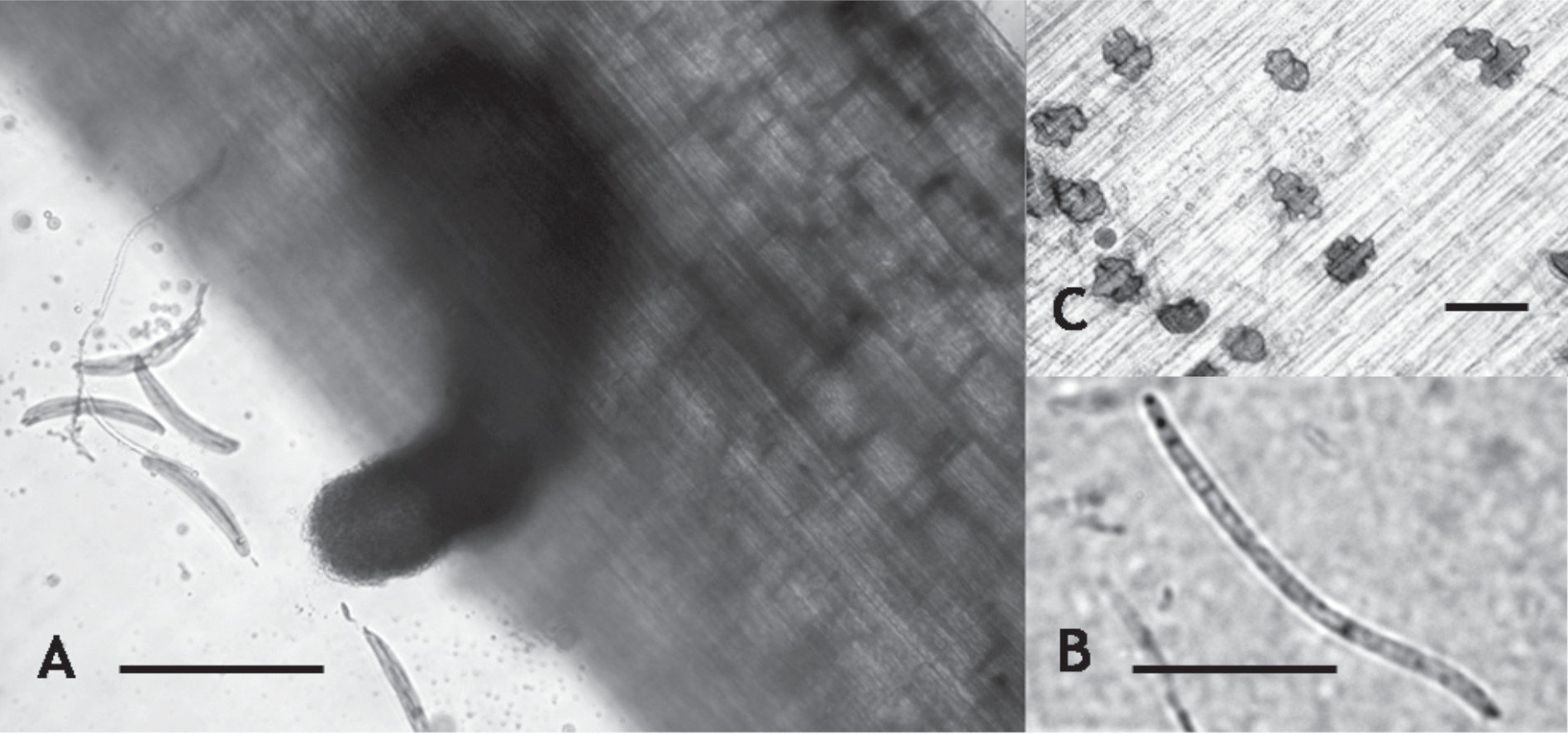
In Cuba, rice together with beans constitutes essential components of the diary diet. Within the main causes of rice low yields, are the incidence of fungal diseases. In the several studies related to main rice diseases conducted in the country, soil-borne phytopathogenic fungi have received little attention. The aim of this work was to determine Gaeumannomyces graminis var. graminis and Magnaporthe salvinii presence in rice varieties cultivated in Cuba. Nighty one samples of eight varieties from nine provinces were analyzed by the methodology of humid chamber and isolation in culture media. G. graminis var. graminis was detected on IACuba 41, INCA LP-5, INCA LP-7, Jucarito-104, Perla de Cuba y Reforma varieties from Pinar del Río, Artemisa, Mayabeque, Matanzas, Sancti Spíritus, Camagüey and Guantánamo provinces. While Magnaporthe salvinii, in his sclerotial or conidial state, was identified on IACuba 41, INCA LP-5, INCA LP-7, Jucarito-104, Perla de Cuba and Reforma in all the provinces studied. The findings in samples from Pinar del Río and Granma constitues the first reports of his presence in those territories. Other soil-borne phytopathogenic fungus detected were Pyrenochaeta oryzae, Rhizoctonia solani, Rhizoctonia zeae and Sclerotium hydrophilum.
Article Details

This work is licensed under a Creative Commons Attribution-NonCommercial 4.0 International License.
Those authors who have publications with this journal accept the following terms of the License Attribution-NonCommercial 4.0 International (CC BY-NC 4.0):
You are free to:
- Share — copy and redistribute the material in any medium or format
- Adapt — remix, transform, and build upon the material
The licensor cannot revoke these freedoms as long as you follow the license terms.
Under the following terms:
- Attribution — You must give appropriate credit, provide a link to the license, and indicate if changes were made. You may do so in any reasonable manner, but not in any way that suggests the licensor endorses you or your use.
- NonCommercial — You may not use the material for commercial purposes.
- No additional restrictions — You may not apply legal terms or technological measures that legally restrict others from doing anything the license permits.
The journal is not responsible for the opinions and concepts expressed in the works, they are the sole responsibility of the authors. The Editor, with the assistance of the Editorial Committee, reserves the right to suggest or request advisable or necessary modifications. They are accepted to publish original scientific papers, research results of interest that have not been published or sent to another journal for the same purpose.
The mention of trademarks of equipment, instruments or specific materials is for identification purposes, and there is no promotional commitment in relation to them, neither by the authors nor by the publisher.
How to Cite
References
Arnold, G. R. W.: Lista de hongos fitopatógenos de Cuba, Ed. Científico-Técnica, Cuba, 1986.
Barrios, L. M.; E. Hidalgo; H. Neninger; M. Pérez; L. Betancourt: «Especies de hongos formadores de esclerocios en el arroz en Cuba. Morfología y propuesta de una clave de identificación», Fitosanidad, 6(4):15-19, Cuba, 2002.
Barrios, L. M.; I. O. Pérez: «Uso del pH, la luminosidad, temperatura y vitaminas del complejo B en el diagnostico de Gaeumannomyces graminis var. graminis, patógeno del arroz en Cuba», Manejo Inte- grado de Plagas y Agroecológica, no.79-80: 81-86, Costa Rica, 2007.
Borges, E.; L. E. Rivero; L. Fabré; R. Rodríguez: «Efectividad biológica del fungicida difeconazol + propiconazol (TASPA 500CE) en el control de enfermedades fungosas en el cultivo del arroz», Revista Cubana del Arroz 11(1):35-42, Cuba, 2010.
Camino Vilaró, M.; J. Mena Portales; D. W. Minter: «Hongos de Cuba», 2006, disponible en www.cybertruffle.org.uk/cubafung (consultado 12/1/2015).
Duarte, Y.; O. PinoI; B. Martínez: «Efecto de cuatro aceites esenciales sobre hongos asociados al manchado del arroz», Protección Vegetal 29(1):62-65, Cuba, 2014.
FAOSTAT: «Rice, paddy harvested area and production». Food and Agriculture Organization of the United Nations (FAO), Statistics Division», 2015, disponible en http://faostat3.fao.org/download/Q/QC/E (consultado 7/1/2015).
Farr, D. F.; A. Y. Rossman: «Fungal Databases», Systematic Mycology and Microbiology Laboratory, ARS, USDA», 2015, disponible en http://nt.ars-grin.gov/fungaldatabases/index.cfm (consultado 12/1/2015).
Fernández-Roseñada, M.: Catálogo de enfermedades de plantas cubanas, Serie Agrícola no. 27, Academia de Ciencias de Cuba, La Habana, Cuba, 1973.
Food and Agriculture Organization of the United Nations (FAO): FAO production yearbook, Roma, Italia, 2010.
González, B.: «Espectro patológico de las principales enfermedades del cultivo del arroz», 2002, disponible en http://www.bibliociencias. cu/gsdl/collect/libros/index/assoc/HASH7bb5.dir/doc.pdf. (consultado 12/1/2015). Cuba.
Hernández, A.; N. Rives; Y. Acebo; A. Diaz; M. Heydrich; V. L. Divan: «Potencialidades de las bacterias diazotróficas asociativas en la promoción del crecimiento vegetal y el control de Pyricularia oryzae (Sacc.) en el cultivo del arroz (Oryza sativa L.)», Rev. Protección Vegetal, 29(1): 1-10, Cuba, 2014.
Mondal, A.; S. Dutta; S. P. Kuiry; D. Chakraborty; S. Nandi; S. Das; S. K. Ray; S. Chaudhuri: «The biochemical constituents and pectinase activities associated with the virulence of Rhizoctonia solani isolates in rice in West Bengal, India», African Journal of Agricultural Research 8(23): 3029-3035, Kenya, 2013.
Nerey, Y.; J. Pannecoucque; H.P. Hernández; M. Díaz; R. Espinosa; E. De Vos; S. Van Beneden; L. Herrera; M. Höfte: «Rhizoctonia spp. causing root and hypocotyl rot in Phaseolus vulgaris in Cuba», Journal of Phytopathology 158:,236-243, Reino Unido, 2010.
Nunes, C. D. M.: «Ocorrência das doenças mal-do-pé (Gaeumannomyces graminis) e mancha parda (Dreschlera sp.) na cultura de arroz», 2008, Pelotas RS. Embrapa Clima Temperado. (Comunicado Técnico 205), disponible en http://ainfo.cnptia.embrapa.br/digital/bitstream/item/31438/1/comunicado-205.pdf . (consultado 12/1/2015).
Peixoto, C. N.; G. Ferreira; V. Lemes; M. C. Corsi; A. Sitarama: «Crown sheath rot of rice: host-range and varietal resistance to Gaeumannomyces graminis var. graminis», Pesq. Agropec. Trop., Goiânia, 44(3): 318-324, Brasil, 2014.
Pérez-Vicente, L.; V. Cordero; L. Fabret-Leal: «Eficacia del azoxystrobin y diferentes triazoles en el control en campo de las principales enfermedades fúngicas del arroz en Cuba», Centro Agrícola 36(2): 15-23, Cuba, 2009.
Punithalingam, E.: «Pyrenochaeta oryzae», CMI Description of Pathogenic Fungi and Bacteria no. 666, Commonwealth Mycological Institute, Kew Surrey, Reino Unido, 1971.
Rodríguez, D.: «Mancha naranja (Gaeumannomyces graminis var. graminis), nuevo patógeno está afectando los cultivos de arroz en Costa Rica», 2013, CONARROZ, Corporación Arrocera Nacional, Costa Rica, disponible en http://www.conarroz.com (consultado 12/1/2015).
Walker, J.: «Taxonomy of take-all fungi and related genera and species», en Biology and Control of Take-All, Londres, Academic Press, 1981.
Webster, R. K.; P. S. Gunell: Compendium of rice diseases, St. Paul MN, USA. APS Press. EE.UU., 1992.
Xu, Z.; T. C. Harrington; M. L. Gleason; J. C. Batzer: «Phylogenetic placement of plant pathogenic Sclerotium species among teleomorph genera», Mycologia 102(2): 337-346, EE.UU., 2010.