
Identification of Buchnera sp., symbiont of Toxoptera aurantii
Article Sidebar
Main Article Content
Abstract
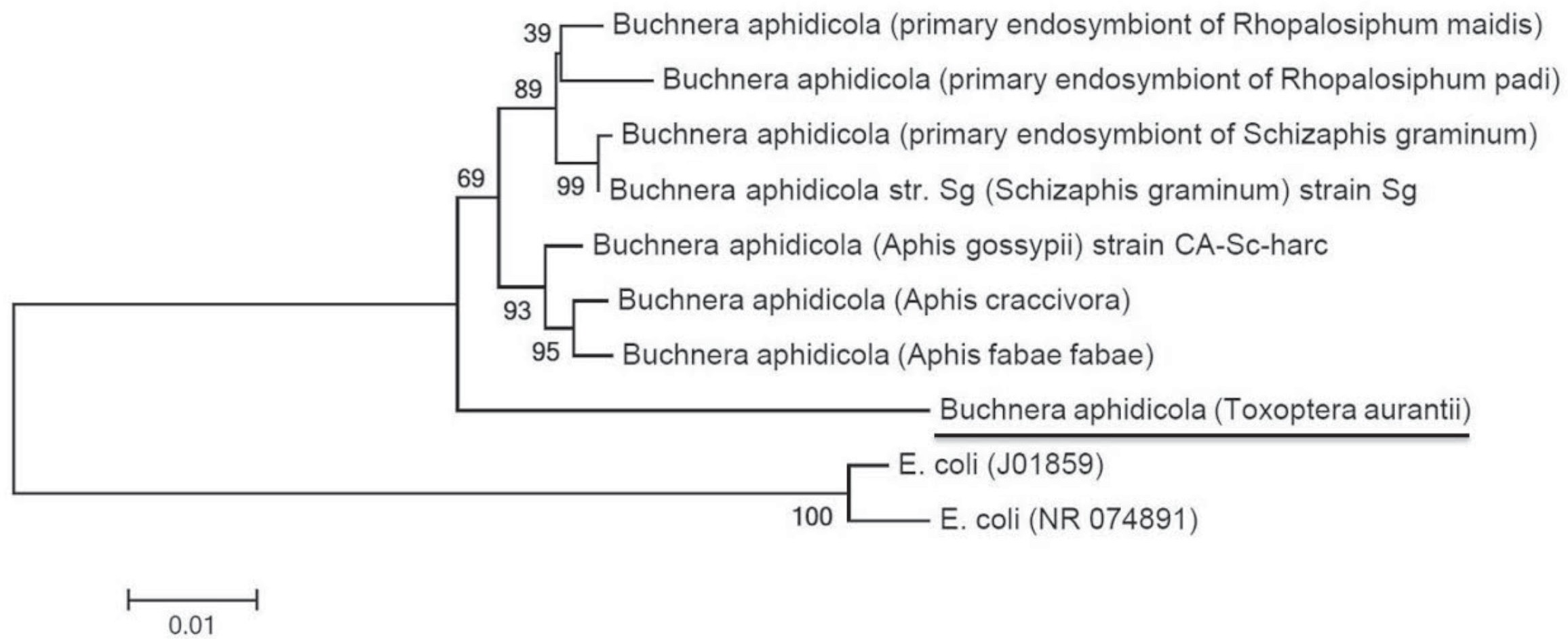
Aphids are phloem-feeding insects which have developed symbiotic association with bacteria to acquire amino acids lacking in the phloem. Toxoptera aurantii affecting Macadamia integrifolia trees in Cuba were analyzed for the presence of Buchnera aphidicola, to characterize the aphids and find efficient management methods. The PCR amplification and sequencing showed that in all populations detected in every tree, was present the symbiotic bacteria. The phylogenetic analysis indicates that the bacteria detected could be new specie belonging to Buchnera genus, and is the first report of this bacterium in T. aurantii.
Article Details

This work is licensed under a Creative Commons Attribution-NonCommercial 4.0 International License.
Those authors who have publications with this journal accept the following terms of the License Attribution-NonCommercial 4.0 International (CC BY-NC 4.0):
You are free to:
- Share — copy and redistribute the material in any medium or format
- Adapt — remix, transform, and build upon the material
The licensor cannot revoke these freedoms as long as you follow the license terms.
Under the following terms:
- Attribution — You must give appropriate credit, provide a link to the license, and indicate if changes were made. You may do so in any reasonable manner, but not in any way that suggests the licensor endorses you or your use.
- NonCommercial — You may not use the material for commercial purposes.
- No additional restrictions — You may not apply legal terms or technological measures that legally restrict others from doing anything the license permits.
The journal is not responsible for the opinions and concepts expressed in the works, they are the sole responsibility of the authors. The Editor, with the assistance of the Editorial Committee, reserves the right to suggest or request advisable or necessary modifications. They are accepted to publish original scientific papers, research results of interest that have not been published or sent to another journal for the same purpose.
The mention of trademarks of equipment, instruments or specific materials is for identification purposes, and there is no promotional commitment in relation to them, neither by the authors nor by the publisher.
How to Cite
References
Batista, L.; K. Velázquez; I. Estévez; I. Peña; D. López; M. L. Reyes; D. Rodríguez; F. F. Laranjeira: «Spatio Temporal Dynamics of Citrus Tristeza Virus in Cuba», Plant Pathology 57: 427–437, UK, 2008.
Douglas, A. E.: «Nutritional Interactions in Insects-Microbial Symbioses: Aphids and Their Symbiotic Bacteria Buchnera», Annual Reviews of Entomology, 43, 17-37, EE. UU., 1998.
Essig, E: «Aphids in Relation to Quick Decline and Tristeza of Citrus», Pan-Pac Entomology 25: 13-23, EEUU., 1949.
Jaraslau, K.: «Los áfidos de Cuba», La Habana, Cuba, 1974.
Leonard, M. D.; H. G. Walker; L. Enari: «Host Plants of Toxoptera aurantii at the Los Angeles State and County Arboretum». Arcadia. California (Homoptera: Aphididae). Proceeding of entomology society Washington 73: 324-326, EE. UU., 1971.
Rusell, J. A.; A. Latorre; B. Sabater Muñoz; A. Moya; N. A. Moran: «Rickettsia Symbiont in the Pea Aphid Acyrthosiphon pisum: Novel Cellular Tropism, Effect on Host Fitness, and Interaction with the Essential Symbiont Buchnera», Applied Environment Microbiology, 7, 4069-4075, EE. UU., 2003.
Shigenobu, S.; H., Watanabe; M., Hattori; Y., Sakaki; H., Ishikawa «Genome Sequence of the Endocellular Bacterial Symbiont of Aphids Buchnera sp.», Nature, 407, 81-86, EE. UU., 2000.
Stackebrandt, E. and B. M., Goebel: «Taxonomic Note: A Place for DNADNA Re Association and 16SrRNA Sequence Analysis in the Present Species Definition in Bacteriology», International Journal of Systematic Bacteriology ,44, 846-849, EE. UU., 1994.
Van der Goot: «The Aphididae of Lahore», Memoirs of the Indian Museum 6:217, India, 1918.
Weisburg, W. G.; S. M., Barns;D. A., Pellentier; D. J., Lane: «16S ribosomal DNA Amplification for Phylogenetic Study», Journal of Bacteriology, 173, 697-703, EE. UU., 1991.