
Establishment of black aphid in Macadamia nut trees in Cuba
Article Sidebar
Main Article Content
Abstract
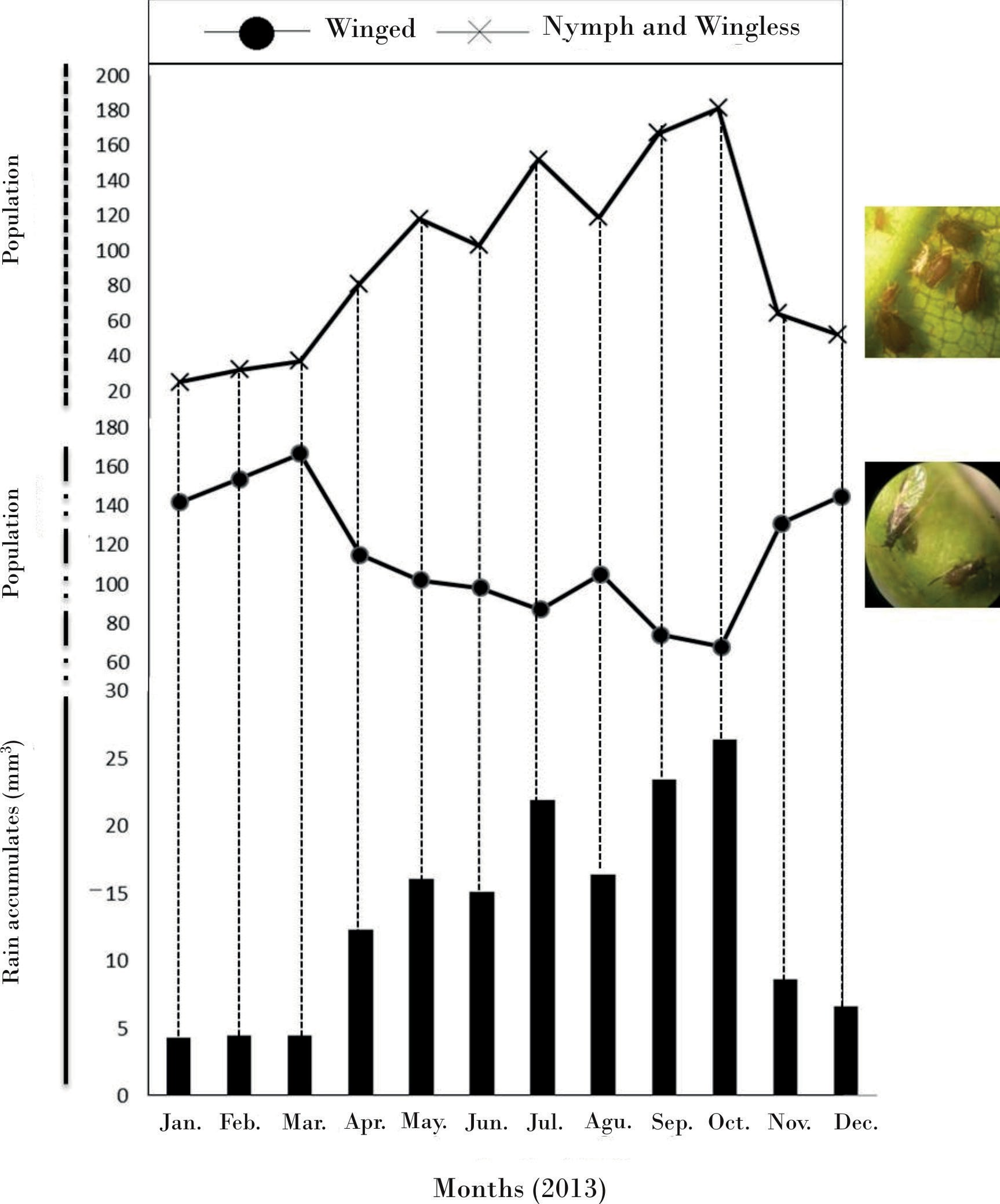
The Black Aphid Toxoptera aurantii (Boyer de Fonscolombe) (Homoptera: Aphididae), is a polyphagous pest that uses Macadamia integrifolia trees as its host. In Cuba, Macadamia trees do not have any economic relevance. Nonetheless, since 2012 an agronomic and phytopathology screening started on an ex situ tropical and ‘subtropical fruit trees collection in Artemisa, Cuba. During the screening it was detected for the first time that T. aurantii affects Macadamia trees. After the taxonomic identification, was detected the presence of natural enemies and fluctuations of different instars due to the different monthly rain. The previous detection of a phytoplasmin ten of twelve Macadamia trees was used to corroborate that T. aurantii was indeed feeding from Macadamia trees. We provided biological and molecular evidences of the establishment of T. aurantii in Macadamia trees in Cuba. This is the first report of Macadamia nut trees as natural host for T. aurantii in Cuba.
Article Details

This work is licensed under a Creative Commons Attribution-NonCommercial 4.0 International License.
Those authors who have publications with this journal accept the following terms of the License Attribution-NonCommercial 4.0 International (CC BY-NC 4.0):
You are free to:
- Share — copy and redistribute the material in any medium or format
- Adapt — remix, transform, and build upon the material
The licensor cannot revoke these freedoms as long as you follow the license terms.
Under the following terms:
- Attribution — You must give appropriate credit, provide a link to the license, and indicate if changes were made. You may do so in any reasonable manner, but not in any way that suggests the licensor endorses you or your use.
- NonCommercial — You may not use the material for commercial purposes.
- No additional restrictions — You may not apply legal terms or technological measures that legally restrict others from doing anything the license permits.
The journal is not responsible for the opinions and concepts expressed in the works, they are the sole responsibility of the authors. The Editor, with the assistance of the Editorial Committee, reserves the right to suggest or request advisable or necessary modifications. They are accepted to publish original scientific papers, research results of interest that have not been published or sent to another journal for the same purpose.
The mention of trademarks of equipment, instruments or specific materials is for identification purposes, and there is no promotional commitment in relation to them, neither by the authors nor by the publisher.
How to Cite
References
Anon: «Macadamia. Summary of insect control recommendations», Queensland Agricultural Journal 101: 286-290, Australia, 1975.
Atanassova, P.; C. P. Brookes; H. D. Loxdale; W. Powell: «Electrophoretic Study of Five Aphid Parasitoid Species of the Genus Aphidius (Hymenoptera: Braconidae), Including Evidence for Reproductively Isolated Sympatric Population and a Cryptic Species», Bulletin of Entomological Research 88: 3-13, Italy,1998.
Batista, L.; K. Velázquez; I. Estévez; I. Peña; D. López; M. L. Reyes; D. Rodríguez; F. F. Laranjeira: «Spatio Temporal Dynamics of Citrus Tristeza Virus in Cuba», Plant Pathology 57: 427-437, UK, 2008.
Cainelli, C.; F. Forno; L. Mattedi; M. Grando: «Can Apple Aphids Be Vectors of ‘Candidatus phytoplasma mali?», IOBC/WPRS Bulletin30: 261-266, Italy, 2007.
Cavaletto, C. G: «Macadamia Nuts», Handbook of Tropical Foods, EE. UU., 1983.
Calilung, V. J.: «A Faunistic Study of Philippine Aphids (Aphididae, Homoptera)», Philippine Agriculture 51: 93-170, Philippine, 1967.
Cottier, W: «Aphids of New Zealand», Bulletin of New Zealand Scientific Industry Research 106: 1-382, New Zealand, 1953.
Deng, S.; C. H. Hiruki: «Amplification of 16S rRNA Genes from Culturable and Non-Culturablemollicutes», Journal of Microbiology Methods 14: 53-61, EE. UU., 1991.
Eastop, V. F.:«A taxonomic study of the Australian Aphidoidea (Homoptern)», Australian Journal of Zoology 14: 399-539, Australia, 1966.
Essig, E: «Aphids in Relation to Quick Decline and Tristeza of Citrus», Pan-Pac Entomology 25: 13-23, EE.UU., 1949.
Gordon, R. D: «The Coccinellidae (Coleoptera) of America North of Mexico», Journal of New York Entomology Society 93:901-912, EE. UU., 1985.
Gundersen, D. E.; I. M. Lee: «Ultrasensitive Detection of Phytoplasmas by Nested-PCR Assays Using Two Universal Primer Sets», Phytopathologia Mediterranea 35: 144-151, Italy, 1996.
Jaraslau, K: Los áfidos de Cuba, La Habana, Cuba, 1974.
Leonard, M. D.; H. G. Walker; L. Enari: «Host Plants of Toxoptera aurantii at the Los Angeles State and County Arboretum», Arcadia. California (Homoptera: Aphididae), Proceeding of Entomology Society 73: 324-326, EE. UU., 1971.
Milán, O. V.; N. Z. Cueto; N. P. Hernández; T. T. Ramos; M. D. Pineda ; R. S. Granda; M. R. Peñas; J. Díaz del Pino; S. F. Caballero; E. Campbell; T. S. Corona; L. A. R. Rodríguez; J. L. G. De Armas; J. M. G. Montalvo; E. H. Delís: «Prospección de los coccinélidos benéficos asociados a plagas y cultivos de Cuba», Fitosanidad 12: 71-78, Cuba, 2008.
Mondal, P. K.; R. C.Basu; D. N. Raychaudhuri: «Studies on the Aphids (Homoptera: Aphididae) from Castern India XXX. The genus Toxoptera», Orient Insects 10: 533-540, India, 1976.
Murray, M. G.; W. F. Thompson: «Rapid Isolation of High Molecular Weight Plant DNA», Nucleic Acids Research 239:487-491, EE. UU., 1980.
Peck, S.: «A Checklist of the Beetles of Cuba with Data on Distributions and Bionomics (Insecta: Coleoptera), Arthropods of Florida and Neighboring Land Areas», The Florida Entomologist 18:136-139, EE. UU., 2005.
Pérez-López, E.; L. Hernández Rodríguez; M. L. Pantoja; M. R. H. Zaldívar: «First Report of a ‘Candidatus Phytoplasma asteris’ Isolate Affecting Macadamia Nut Trees in Cuba», New Disease Report 28: 1, UK, 2013.
Rivnay, E.:«Moisture As the Factor Affecting Wing Development in the Citrus Aphis, Toxoptera aurantii, Boy», Bulletin of Entomological Research 28: 173-179, EE. UU., 1937.
Schneider, B.; M. Cousin; S. Klinkong; E. Seemüller: «Taxonomic Relatedness and Phylogenetic Positions of Phytoplasmas Associated with Diseases of Faba Bean, Sunhemp, Sesame, Soybean and Eggplant», ZeitschriftfürPflanzenkrankheiten und Pflanzenschutz 102: 225-232, Germany, 1995.
Starý, P.: «Parasites and Their Role in Limitation and Control of Aphids Attacking Annonaceous Trees in the West Indies (Hymenoptera: Aphidiidae: Homoptera: Aphidoidea)», Turrialba 18: 129-132, Costa Rica, 1968.
Stroyan, H. L. G: «Identification of Aphids Living on Citrus», Pf. Prot. Bull. F.A.O. 9: 45-65, EE. UU., 1961.
Van der Goot: «The Aphididae of Lahore», Memoirs of the Indian Museum 6:217, India, 1918.
Traugott, M.: «Habitat Use and Activity Patterns of Larval and Adult Cantharis Beetles in Arable Land», European Journal of Soil Biology 42: 82-88, Germany, 2006.
Wang, J. J., J. H. Tsai: «Development, Survival and Reproduction of Black Citrus Aphid, Toxoptera aurantii (Hemiptera: Aphididae), As a Function of Temperature», Bulletin of Entomological Research91: 477-487, UK, 2001.
Weintraub, P. G.; L. Beanland: «Insect Vectors of Phytoplasmas», Annual Review Entomology 51: 91-111, EE. UU., 2006.
Yokomi, R. K.; G. N. Oldfield: «Seasonal Fluctuations of Alate Aphid Activity in California Citrus Groves », Proceedings of the Eleventh IOCV Conference 71-76, EE. UU., 1991.