
Evaluación del efecto de Melaleuca quinquenervia sobre la población de Plutella xylostella en el cultivo de la col
Article Sidebar
Main Article Content
Abstract
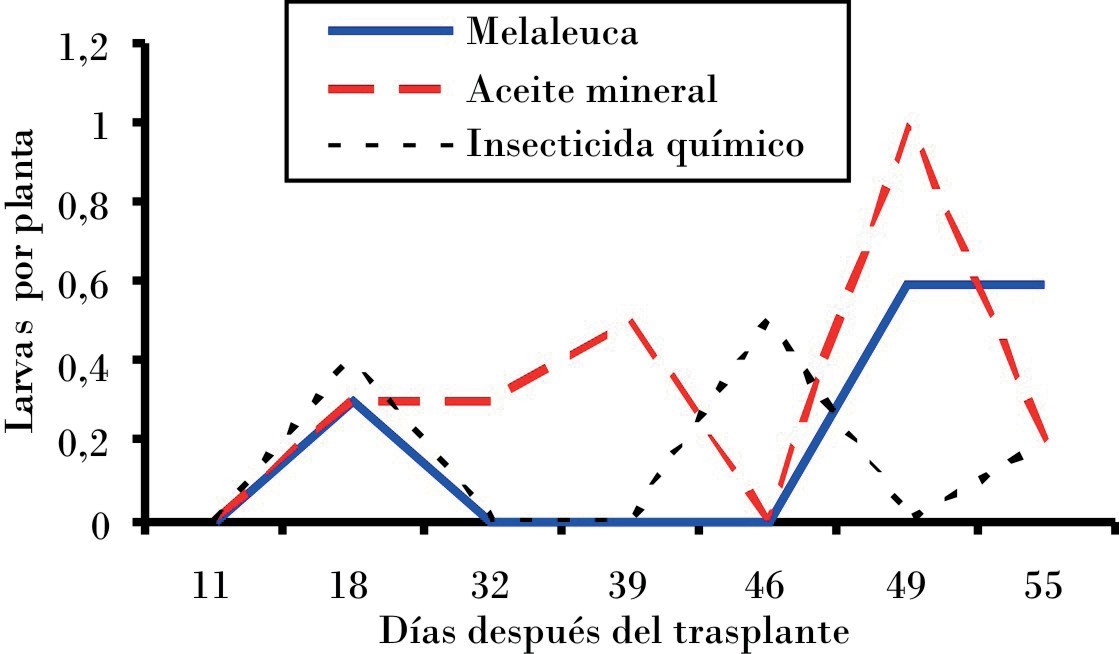
Plutella xylostella (L.) (Lepidoptera: Yponomeutidae) is considered as the biggest pest in the crucifers in the world, and it causes losses bigger than 90%. To evaluate the effect of the essential oil of Melaleuca quinquenervia (Cav.), two field experiments were carried out on cabbage crop, in the period of March to November of 2012, where three treatments were applied with oil from M. quinquenervia to 0.2%, oil mineral to 0.2% and fentoato + novaluron CE 51.2 as standard of comparison to 0, 75 L/ha cp. The behavior of P. xylostella with the application of M. quinquenervia oil was evaluated weekly under field conditions. A reduction of pest population was achieved and it was demonstrated that M. quinquenervia oil has insecticide action on P. xylostella.
Article Details

This work is licensed under a Creative Commons Attribution-NonCommercial 4.0 International License.
Those authors who have publications with this journal accept the following terms of the License Attribution-NonCommercial 4.0 International (CC BY-NC 4.0):
You are free to:
- Share — copy and redistribute the material in any medium or format
- Adapt — remix, transform, and build upon the material
The licensor cannot revoke these freedoms as long as you follow the license terms.
Under the following terms:
- Attribution — You must give appropriate credit, provide a link to the license, and indicate if changes were made. You may do so in any reasonable manner, but not in any way that suggests the licensor endorses you or your use.
- NonCommercial — You may not use the material for commercial purposes.
- No additional restrictions — You may not apply legal terms or technological measures that legally restrict others from doing anything the license permits.
The journal is not responsible for the opinions and concepts expressed in the works, they are the sole responsibility of the authors. The Editor, with the assistance of the Editorial Committee, reserves the right to suggest or request advisable or necessary modifications. They are accepted to publish original scientific papers, research results of interest that have not been published or sent to another journal for the same purpose.
The mention of trademarks of equipment, instruments or specific materials is for identification purposes, and there is no promotional commitment in relation to them, neither by the authors nor by the publisher.
How to Cite
References
Blanco, E.: «Problemas y soluciones para el control de la polilla de la col Plutella xylostella (L.)», Taller Regional sobre Producción Intensiva en los Trópicos Húmedos. FAO. 21-24 de noviembre. La Habana, Cuba, 1995.
CAB Internacional: Crop Protection Compendium, Wallingford, CAB International, Inglaterra, 2007.
Ciba-Geigy: Manual de ensayo de campo en producción vegetal, 2.a ed., Ciba-Geigy, Suiza, 1981.
Elizondo, Ana I.; C. Murguido; Felicia Piedra; Zoila Trujillo; Susana Caballero; Elina Massó; M. Neyra; Magali Suárez; E. Paredes; E. Blanco; L. Alarcón; J. Montero; M. Milán. «Manejo integrado de plagas insectiles en el cultivo de la col», informe final de proyecto, Instituto de Investigaciones de Sanidad Vegetal, La Habana, 2000.
García, G.: «Evaluación de plaguicidas biológicos y botánicos para el control de Plutella xylostella en el repollo», tesis en opción al título de Ingeniero Agrónomo, El Zamorano, Honduras, 2000.
Grainge, M.; S. Ahmed: Handbook of Plants with Pest Control Properties, Ed. Wiley, EE. UU., 1988.
Larenas, Giovanna; Marta de Viana; T, Chafatinos; Nieves Escobar: «Relación suelo-especie invasora (Tithonia tubaeformis) en el sistema ribereño del río Arenales, Salta, Argentina», Ecología Austral 14 (1): 19-29, Argentina, 2004.
Leyva, M.; J. E. Tacoronte; María del C. Marquetti; R. Scull; D. Montada; Yanisley Rodríguez; R. Y. Bruzón. «Actividad insecticida de aceites esenciales de plantas en larvas de Aedes aegypti» (Diptera: Culicidae), Rev. Cubana Med. Trop. 60 (1): 78-82, Cuba, 2008, http://scielo.sld. cu/scielo.php?pid=S0375-07602008000100012&script=sci_arttext (Consultado: 1/10/2012).
MINAG: Instructivo técnico para el cultivo de la col, Ministerio de la Agricultura, Cuba, 2000.
Miranda, F.: «Control biológico de Plutella xylostella L. en fincas semi-orgánicas comparados con sistemas convencionales de producción en el cultivo de repollo Estelí, Nicaragua», Taller Producción y Manejo Agrecológico de artrópodos benéficos, Instituto de Investigaciones de Sanidad Vegetal, La Habana, 15-18 de mayo de 2007.
O’Farril, H. «Insecticidas biorracionales», 2009, http://www.ippc.orst.edu/biocontrol/biopesticides.htm (consultado: 21/10/2012).
Olivares, S. E.: Paquete de diseños experimentales, Facultad Agronómica, Universidad Autónoma de Nuevo León, versión 2.5, México, 1994.
Pino, Oriela; Yaíma Sánchez; Miriam M. Rojas; H. Rodríguez; Yudith Abreu; Yanisia Duarte; B. Martínez; Belkis Peteira; Teresa M. Correa; Dayamín Martínez: «Composición química y actividad plaguicida del aceite esencial de Melaleuca quinquenervia (Cav) S.T. Blake», Protección Vegetal 26 (3): 177-186, Cuba, 2011.
Quintana, F. O.: «Características y uso del aceite esencial Melaleuca quinquenervia», informe parcial sobre resultados acerca del uso del aceite esencial Melaleuca quinquenervia, Organización Integral para el Bienestar Social, La Habana, Cuba, 2012.