
Nematodes in vegetables under protected cultivation and their management in three localities of Havana
Article Sidebar
Main Article Content
Abstract
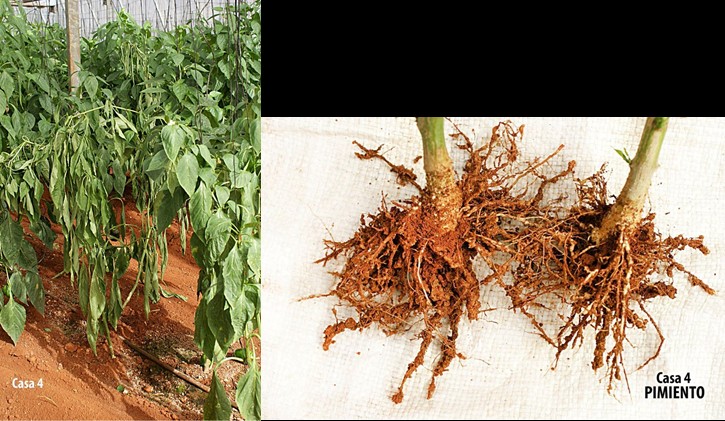
Vegetables grown in protected crops showed pests problems, among them nematodes of Meloidogyne genus. To contribute with the nematode management in these crop systems in the localities of Wajay, Atabey and Las Guásimas, Havana province were determined the species of plant parasitic nematodes associated and their plant damage, the characteristics of plant crop systems which influenced in the nematological problems, the effectiveness of some practices of nematode management and the teaching and training of people on charge in these systems Meloidogyne genus were present in all localities (78 % of systems sampled) with predominance of M. Incognita (78,8 %) and M. arenaria (12,1%); Rotylenchulus reniformis, occurred in two localities and Xiphinema basiri, Helicotylenchus dihystera and Tylenchorhynchus sp. were detected only in Las Guásimas locality. There were appreciated damage on roots with Meloidogyne and Xiphinema. Contamination in water irrigation systems were detected in some places which contributed to spread the nematodes and the increasing of problems in the fields. Also Meloidogyne was found in new zones where some susceptible weeds are grown and the contaminated water dragging. Biofumigation with cabbage residues has showed reductions of more than 75 % of nematode infection by M. incognita, meanwhile T. viride (strain TS-3) and B. thuringiensis (strain LBT-25) have decreased in more than 50 %. 1,3 D plus chloropicrine produced more higher reductions of nematodes. Training activities included four participative workshops and four brochures were performed which improved the knowledge and the quality of decisions.
Article Details

This work is licensed under a Creative Commons Attribution-NonCommercial 4.0 International License.
Those authors who have publications with this journal accept the following terms of the License Attribution-NonCommercial 4.0 International (CC BY-NC 4.0):
You are free to:
- Share — copy and redistribute the material in any medium or format
- Adapt — remix, transform, and build upon the material
The licensor cannot revoke these freedoms as long as you follow the license terms.
Under the following terms:
- Attribution — You must give appropriate credit, provide a link to the license, and indicate if changes were made. You may do so in any reasonable manner, but not in any way that suggests the licensor endorses you or your use.
- NonCommercial — You may not use the material for commercial purposes.
- No additional restrictions — You may not apply legal terms or technological measures that legally restrict others from doing anything the license permits.
The journal is not responsible for the opinions and concepts expressed in the works, they are the sole responsibility of the authors. The Editor, with the assistance of the Editorial Committee, reserves the right to suggest or request advisable or necessary modifications. They are accepted to publish original scientific papers, research results of interest that have not been published or sent to another journal for the same purpose.
The mention of trademarks of equipment, instruments or specific materials is for identification purposes, and there is no promotional commitment in relation to them, neither by the authors nor by the publisher.
How to Cite
References
Ajwa,H. A.; S. Klose; S. D. Nelson; A. Minuto; M. L. Gullino; F. Lamberti; J. M López Aranda: «Alternatives to methyl bromide in strawberry production in United Status of America and the Mediterranean region. Phytopathology Mediterranea. 42: 220-244, 2003.
Bello, A.: «Biofumigation and Integrated Pest Management. En: Alternatives to Methyl Bromide for the Southern European Countries (pp. 99-126) Phytoma. España. DGXI EU.CSIC.Valencia Spain, 1998.
Bello, A.; J. A. López; R. Sanz; M. Escuer; J. Herrero: Biofumigation and Organic Amendments. Regional Workshop on Methyl Bromide. Alternatives for North Africa and Southern European Countries. United Nations Enviroment Programme (UNEP) Francia, 113-141, 2000.
Bongiorno, M.; C. Larosa; A. Maidama; M. Arenas; Y. Cruz; R. López; L. Gianuzzi; G. Cap: «Biofumigación con recursos locales: el caso de la producción hortícola de los quinteros del Parque Pereyra Iraola, revista LEISA 20(4):20,2005.
Candelero, J.; J. Cristóbal; J. M. Tun; E. Sánchez; A. Reyes: «Inoculantes fúngicos con actividad antagónica de nemátodos en plantas de chile habanero. Resúmenes 47 Reunión Anual de la Organización de Nematólogos de los Trópicos Americanos (ONTA). 18-22 mayo. Matanzas. Cuba. p. 113.2015.
Casanova, A. S.; O. Gómez; F. R. Pupo; M. Hernández; M. Challioux; T. Depestre; J. C. Hernández; V. Morero; M. León; A. Igarza; C. Duarte; I. Jiménez; R. Santos; A. Navarro; A. Marrero; H. Car- doza; F. Piñeiro; N. Arozarena; L. Vilarino; M. I. Hernández; E. Martínez; M. Martínez; B. Muiño; B. Bernal; J. M. Salgado; H. Martínez; A. Socorro; F.Cañet; J. Fi; A. Rodríguez: Manual para la producción protegida de hortalizas. MINAG. Editorial LILIANA. Cuba, 211 pp., 2006
Fernández, E.; M. Pérez; H. Gandarilla; R. Vázquez; M. Fernández; M. Paneque; O. Acosta; M. Basterrechea: «Guía para disminuir infestaciones de Meloidogyne ssp. mediante el empleo de cultivos no susceptibles. Boletín Técnico (INISAV) La Habana. 4(3):1-18,1998.
García, O.: «Métodos de extracción de nemátodos del suelo y tejido vegetal. Información Técnica, año II, No. 4 .INISAV, 1979.
Gómez, L.: «Diagnóstico de nemátodos agalleros y prácticas agronómicas para el manejo de Meloidogyne incognita en la producción protegida de hortalizas, Tesis para optar por el Grado Científico de Doctor en Ciencias Agrícolas. UNAH-CENSA, 2007.
Gómez, L; E. González; R. Enrique; M. A. Hernández y M. G. Rodríguez: «Uso de la biofumigación para el manejo de Meloidogyne spp. en la producción protegida de hortalizas. Rev. Protección Vegetal 25 (2):76-81, 2010.
Greco, N.; D. Esmenjaud: «Management strategies for nemátodo control in Europe. En: R. Cook, R. and D.J.Hunt (Eds). Nematology Monographs and Perspectives 2.Proceedings of the Fourth International Congress on Nematology, 2002. Tenerife, Spain. Leiden.The Netherlands.Brill. pp: 33-43, 2004
Howell, C. R.: «Mechanisms employed by Trichoderma species in the biological control of plant diseases: the history and evolution of current concepts. Plant Disease 87(1):4-10, 2003.
Hunt, D. J.; Z. A.Handoo: «Taxonomy, Identification and Principal Species. P:55-97. En: Root-knot Nematodes. R.Perry, M.Moens and J.L.Starr (Eds.) CAB International,London,UK. 488 pp.
Kariuki, G. M.; L. Muriuki; A. K. Thuo; J. W. Kibunja; P. M. Kariuki; D. L. Coyne: «Safe and effective nematode and other pests management strategies to strenghten the tomato value chain in coastal Kenya. En: Proceedings of Sixth International Congress of Nematology. South Africa 4-9 may. 2014
Krall, E.: Clave para la determinación de especies del género Helicotylenchus Steiner. Paraziticheskie kornevie nematodi.Fam.Hoplolaimidae.
:238-242 Est.
Loof, P. A.; A. M. Luc: «A revised polytomous key for the identification of species of the genus Xiphinema Coob ,1913 (Nematoda:Longidoridae) with the exclusion of the X. americanum group. Systematic Parasitology 16: 35-66. 1990.
Márquez, M.: «Selección y evaluación tóxico-patogénica de cepas cubanas de Bacillus thuringiensis con efecto nematicida». Tesis en opción al Grado Científico de Doctora en Ciencias Agrícolas. Ciudad de La Habana 115 pp.2005.
MBTOC: Assessment Report of the Methyl Bromide Technical Options Comitte.2010.UNEP.Nairobi:73-77, 2011.
Melgarejo, P.; J. García; M. C. Jordá; M. M. López; M. F. Andrés; N. Durán: Patógenos de las plantas descritos en España. 2a. ed., Madrid. Spain. Ministerio de Medio Ambiente, Rural y Marino. 854 pp., 2010.
Méndez, M.; A. Polanco: «Efectividad de Trichoderma harzianum Cepa A-34 en el control de nemátodo Rotylenchulus reniformis en el cultivo de la lechuga (Lactuca sativa). Resúmenes MIP 2000, Forúm tecnológico sobre Manejo integrado de Plagas. INISAV, La Habana 27-28 de mayo, 2000.
MINAG: Programa de Defensa Fitosanitaria para casas de cultivo protegido. Tomate, pimiento, melón y pepino. Centro Nacional de Sanidad Vegetal. Ministerio de Agricultura. Cuba. 52 pp. 2002.
Olivares, N.; L. J Devesa: «Control de Meloidogyne incognita con el hongo Trichoderma spp. cepaG-6. Resúmenes MIP 2000, Forúm tecnológico sobre Manejo integrado de Plagas. INISAV, La Habana 27-28 de mayo, 2000.
Pérez, E.; B. L. Muiño; A. Fernández y L. Rojas: Impacto de la eliminación total del bromuro de metilo en Cuba. Editorial CIDISAV/INISAV. La Habana. Cuba.112 pp., 2012
Pérez, E.; E. Paredes; A. Fernández; M. González: Evaluación y uso de fumigantes de suelo como alternativas al bromuro de metilo en Cuba. P: 219-239. En: Tecnologías en el proceso de eliminación total del bromuro de metilo en tratamientos al suelo en Cuba E. Pérez (Editor). Editorial CIDISAV/INISAV. La Habana. Cuba.246 pp., 2012.
Pérez, J. M.; H. Gandarilla; E. Fernández; J. L. Rodríguez; R. Rodríguez; I. Martínez; C. M. Andreu; M. Méndez; A. Espino: Manejo agroecoló- gico de nemátodos en la Agricultura Urbana. Resúmenes 47 Reunión Anual de la Organización de Nematologos de los Trópicos Americanos (ONTA). 18-22 mayo. Matanzas. Cuba. 117-118,2015.
Rodríguez, M. G.; L. Hernández; D. Enrique; R. Miranda; I. Pino; O. Castro; I. Rosales; L. C. Díaz: Efecto de la biodesinfección con residuos de nim (Azadirachta indica A.Juss.) sobre población de Meloidogyne spp. en suelo. Revista Protección Vegetal 27(3): 197-201,2013.
Rodríguez, M. G.; L. Gómez; D. Hernández; R. Enrique; B. Peteira; E. González; O. Pino; B. Martínez; I. Miranda: Perfeccionamiento del manejo de Meloidogyne spp en la producción protegida de hortalizas. Premio MINAG 2014. 70 pp., 2014.
Rodríguez, R.; O. Mirabal; R. Liriano: Utilización de Trichoderma spp. para el manejo de Meloidogyne en tomate (Solanum lycopersicum) en la provincia de Matanzas, Cuba. Resúmenes 47 Reunión Anual de la Organización de Nematologos de los Trópicos Americanos (ONTA). 18-22 mayo. Matanzas. Cuba. p. 59,2015.
Siddiqi, M. R.: Tylenchida.Parasites of Plant and Insects.2nd Edition. CAB International. 833 pp. 2000.
Talavera, M.; S.Verdejo; C. Ornat; J. Torres; M. D. Vela; F. J. Macías; L. Cortada; D. J. Arias; J. Valero; F. J. Sorribas: Crop rotations with Mi gene resistant and susceptible tomato cultivars for management for root-knot nematodes in plastic-houses. Crop Protection 28: 662- 667, 2009.
Viaene, N.; D. L. Coyne y B. R.Kerry: Biological and cultural management. En: R. N. Perry and M. Moens (Eds).Plant Nematology. CABI. UK. P 346-349, 2006.
Van Wesenback, I.; S. Knowles; K. Racke: Enviromental fate of 1,3 D dichloropropene and evaluation of ground water protection. 6thInternational Congress of Nematology. 4 -9 May. Cape Town. South Africa. 2014.
Verdejo, S.:Principles for root-knot nemátodo management in protected cultivation. Resúmenes 47 Reunión Anual de la Organización de Nematologos de los Trópicos Americanos(ONTA). 18-22 mayo. Matanzas. Cuba. p. 62. 2015.
Vuelta, D. R.: La biofumigación y la solarización como alternativas al manejo de plagas en suelo. Ciencia en su PC. No. 1:15-26. Enero-marzo. 2014.