
The populations’ behavior of trips (Thysanoptera: Thripidae) and Nesidiocoris tenuis Reuter (Hemiptera: Miridae) in potato crop (Solanum tuberosum L.) in Cuba
Article Sidebar
Main Article Content
Abstract
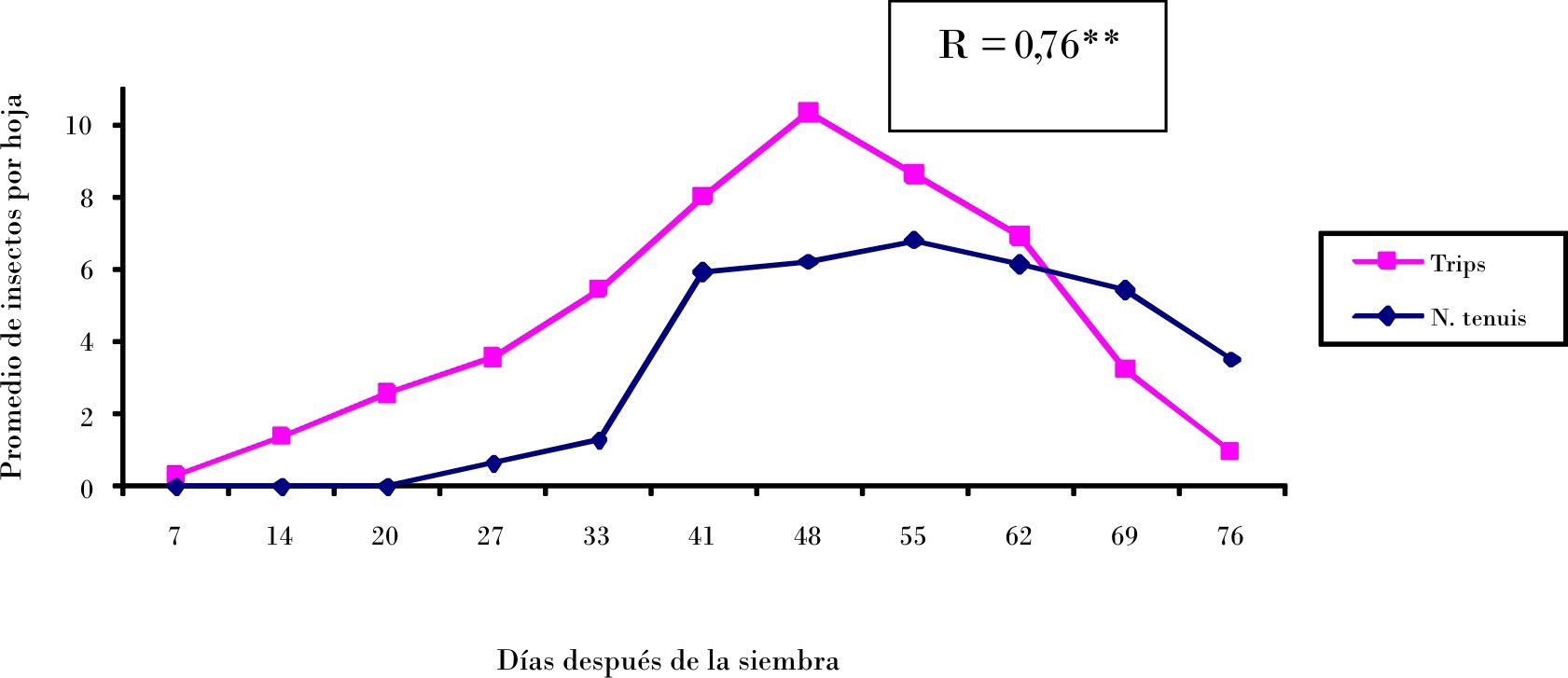
Among the main pest that affect to potato crop in Cuba they are the trips (Thysanoptera; Thripidae). These insects cause direct damages when feeding of the plants and they can also be vectorial of Orthotospovirus. The biological control is one of the alternatives that have been investigated and it can constitute an important component of the MIP. Inside the family Miridae several species are included whose activity predatory is demonstrated in diverse crops. To give answer to this problem it was carried out a study on the relationship among the populations of the different species of present trips on potato crop and mirids. The experiment was developed in an area of 400 m2. They were carried out weekly evaluations and the trips species and mírids were identified and their quantity. The results demonstrated that the trips populations and mírids were present during the cycle of the crop, reaching the biggest populational density in the floración-tuberización stage. The trips population was composed by five species: Thrips palmi Karny, Frankliniella tritici Ficth, Frankliniella schultzei (Trybom), Frankliniella insularis (Franklin) and Thrips tabaci Lindeman and that of mírids for a single species, Nesidiocoris tenuis Reuter. N. tenuis fed fundamentally of the instars trips nymphs and its population indexes didn’t overcome those of the trips in none of the carried out samplings.
Article Details

This work is licensed under a Creative Commons Attribution-NonCommercial 4.0 International License.
Those authors who have publications with this journal accept the following terms of the License Attribution-NonCommercial 4.0 International (CC BY-NC 4.0):
You are free to:
- Share — copy and redistribute the material in any medium or format
- Adapt — remix, transform, and build upon the material
The licensor cannot revoke these freedoms as long as you follow the license terms.
Under the following terms:
- Attribution — You must give appropriate credit, provide a link to the license, and indicate if changes were made. You may do so in any reasonable manner, but not in any way that suggests the licensor endorses you or your use.
- NonCommercial — You may not use the material for commercial purposes.
- No additional restrictions — You may not apply legal terms or technological measures that legally restrict others from doing anything the license permits.
The journal is not responsible for the opinions and concepts expressed in the works, they are the sole responsibility of the authors. The Editor, with the assistance of the Editorial Committee, reserves the right to suggest or request advisable or necessary modifications. They are accepted to publish original scientific papers, research results of interest that have not been published or sent to another journal for the same purpose.
The mention of trademarks of equipment, instruments or specific materials is for identification purposes, and there is no promotional commitment in relation to them, neither by the authors nor by the publisher.
How to Cite
References
Cermeli, M.; P. Morales; F. Godoy: “Plagas agrícolas introducidas en Venezuela y nativas poco conocidas en los últimos años”, XVII Congreso Venezolano de Entomología. Maturín-Monagas, Venezuela, pp. 16-25, Julio, 2001.
Dakshina, R. S.: “Seasonal abundance and distribution of Thrips palmi Karny (Thysanoptera: Thripidae) in Southern Florida”, Proceeding of the Florida State Horticultual Society 114: 337-342, 2001.
Deroncelé, C.; J. Salomón; F. Manso; J. Linares; R. Santos; R. Roque; P. González; H. Navarro y O. Tabera: “Guía técnica para la producción de papa en Cuba”, Ed. Liliana, Cuba, 2000.
Elizondo, Ana I.; C. A. Murguido; M. Milán; J. Montero y L. Mirabal: “El insecticida imidacloprid y los hongos Metarhizium anisopliae, Lecanicillium lecanii para el control de Thrips palmi en el cultivo de la papa (Solanum tuberosum L.)”, Fitosanidad 17 (1): 31-34, Cuba, 2013.
FAO: “El estado mundial de la agricultura y la alimentación”. Disponible en http://www.fao.org/catalog/inter, Roma, Italia, 2011.
González, C.: “Los trips en las provincias habaneras: inventario, identificación, hospedantes y comportamiento de las poblaciones en diferentes sistemas de producción”. Tesis presentada en opción al Grado Científico de Doctor en Ciencias Agrícolas, Universidad Agraria de La Habana, Cuba, 2005.
González, C. y M. Surís. “Clave ilustrada de las familias, géneros y especies pertenecientes al Suborden Terebrantia, Orden Thysanoptera presentes en Cuba”, Boletín Fitosanitario INISAV, 76 pp. 13 (1), Cuba, 2008.
Goula, M. y O. Alomar: “Míridos (Heteroptera: Miridae) de interés en el control integrado de plagas en el tomate. Guía para su identificación”, Boletín de Sanidad Vegetal. Plagas, 20: 131-143, Barcelona, España, 1994.
Grillo, H.: “Heterópteros de Cuba”. Tesis presentada en opción al título de Doctor en Ciencias, Universidad Central de las Villas, Cuba, 2012.
Martínez, A.M.; M. Baena; J. I. Figueroa; P. Del Estal; M. Medina; E. Guzmán-Lara y S. Pineda: “Primer registro de Engytatus varians (Distant) (Hemiptera: Heteroptera: Miridae) en México y su depredación sobre Bactericera cockerelli (Šulc) (Hemiptera: Triozidae): una revisión de su distribución y hábitos”, Acta Zool. Mex., vol. 30, no. 3, Xalapa, México, 2014.
Martínez, M. A.; L. Duarte; H. Baños; L. Rivas; A. Adayakni: “Míridos depredadores (Hemiptera: Heteroptera: Miridae) en cultivos de tomate y tabaco en Cuba”, Protección Vegetal, vol. 29, no. 3, Cuba, 2014.
Mena, L.; A. M. Martínez; S. Pineda; A. L. Escalante; B. Gómez y J. I. Figueroa. “Preferencia de depredación de Engytatus varians (Hemiptera: Miridae Dist.) sobre el psílido del tomate, Bactericera cockerelli (Sulc.)”, Bol. Soc. Mex. Ento. (nueva serie), número especial 1: 42- 46, 2015.
Mound, L.; Kibby, G. “Thysanoptera an Identification Guide. Second Edition. CAB International. 67p. 1998.
Murguido, C. A.; A. I. Elizondo; E. Peña; M. Martínez: “Manejo Integrado de Thrips palmi Karny en la papa”, Protección Vegetal 17 (3): 216-217, Cuba, 2002.
Palmer, J.; L. Mound; G. Heaume: “Guide to insects of importance to man. 2. Thysanoptera”, CAB International, Wallngford, UK, 73 pp., 1989.
Rengifo, L. y R. González: “Clave ilustrada para la identificación de las Familias de Pentatomomorpha (Hemiptera: Heteroptera) de distribución neotropical”, Boletín Científico de Museos de Historia Natural. 15 (1): 168-187, 2011.
Salomón, J.; J. Castillo; A. Estévez; J. Arzuaga; W. Torres; E. Díaz; B. Araújo; R. Tejeda; O. Céspedes; A. Caballero; A. Pérez y L. Suárez: “Mejoramiento genético de semilla sexual en Cuba como material de siembra en el cultivo de papa (Solanum tuberosum L.)”, Premio MINAG, INCA, Cuba, 2011.
Suris, M.; C. González; A. Rodríguez; N. Castillo y S. Ramírez: “Los trips como factor de riesgo de enfermedades emergentes para la agricultura en Cuba”, Premio Anual Academia de Ciencias de Cuba, 2015.
Valderrama, K., J. Granobles; E. Valencia y M. Sánchez. “Nesidiocoris tenuis (Hemiptera: Miridae) depredador en el cultivo de tabaco (Nicotiana tabacum)”, Revista Colombiana de Entomología, vol. 33, no. 2, Bogotá, Colombia, 2007.
Vázquez, L. L.: “Bases para el manejo integrado de Thrips palmi”, Manejo Integrado de Plagas y Agroecología, Costa Rica, no. 69, pp. 84-91, 2003.
Vázquez, L.L.; C. A. Murguido; A. I. Elizondo; O. Elósegui; F. J. Morales. “Control biológico de la mosca blanca Bemisia tabaci”. CIAT. No. 355, Colombia. 2007.
Vázquez, L. L.; Y. Matienzo; M. Veitía y J. Alfonso. “Conservación y manejo de enemigos naturales de insectos fitófagos en los sistemas agrícolas de Cuba”. INISAV. 202 p. Cuba. 2008.
Vincini, A. M.; Jacobsen, B.; Tulli, M. C.; Carmona, D. M. y López, R. “Dinámica poblacional de Frankliniella occidentalis (Pergande) y Thrips tabaci Lindeman en cultivos de papa (Solanum tuberosum)”. Entomotropica. Vol. 29 (1) 17-27. 2014.